Logo

American Heart Association

  21
  0


Final ID: MP24

Cerebral Infarction Mortality Trends in Older Adults in the United States From 1999 to 2020

Abstract Body (Do not enter title and authors here):
Background: Stroke is the 5th leading cause of death in the United States and an estimated 160,000 people die annually from it according to the American Heart Association (AHA) and costs the US healthcare system $56 billion annually. 85% of strokes are due to cerebral infarction. We aim to study the patterns of cerebral infarction mortality in older adults from age 55 to 85+ years.

Methods: We used the CDC Wonder database and searched from 1999 to 2020 using the ICD-10 code I63. The year 2000 for population and 2013 for urbanization were selected as standards. The outcome of mortality was reported as an age-adjusted rate (AAR) or an age-adjusted mortality rate (AAMR) per 100,000 and that for the ten-year age groups was reported as a crude rate.

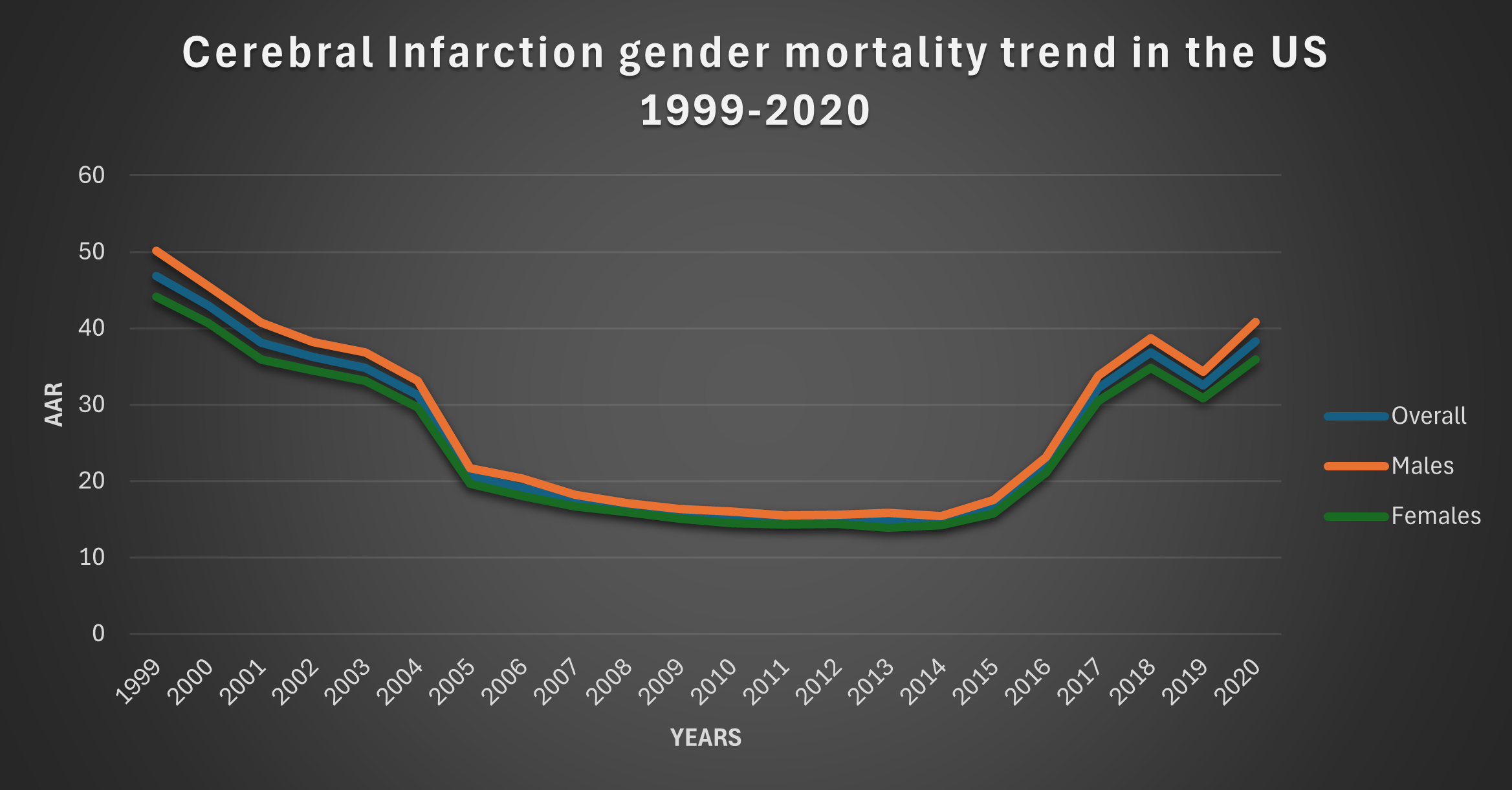
Results: Mortality trends overall as well as for both genders followed a 15-year decrease, then a 4-year increase (large U-shaped pattern), followed by a yearly decrease-increase pattern (small V-shaped pattern). There was a decreasing mortality trend from 1999 (AAR= 46.8) till 2014 (AAR= 14.8) and then increased till 2018 (AAR= 36.8). There was a decrease in AAR in 2019 (AAR= 32.5) and then an increase in 2020 (AAR= 38.3). Males had higher mortality than the overall and female mortality rates throughout this period (Figure 1).

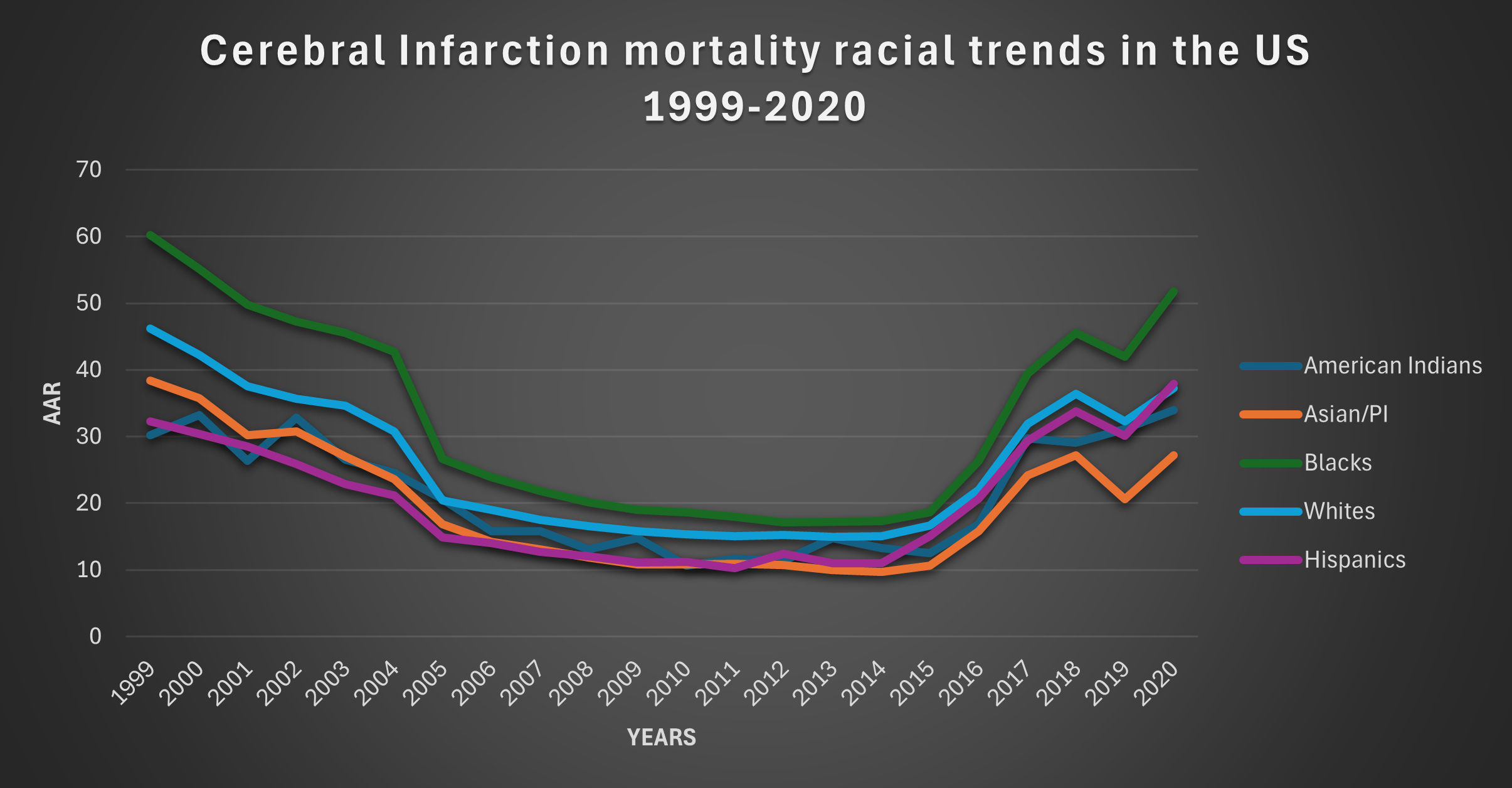
Similarly, all the races followed this decreasing trend till mid-2010, then increased till 2018 followed by a brief dip in 2019 and a spike in 2020. Blacks had the highest mortality of all the races (1999 AAR= 60.2) (2012 AAR= 17.1) (2020 AAR= 51.7). In 2020 after blacks (AAR= 51.7) the second highest mortality rate was for Hispanics (AAR= 37.9), followed closely by whites (AAR= 37.3), then American Indians (AAR= 34), and lastly Asians/Pacific Islanders (AAR= 27.2) (Figure 2).

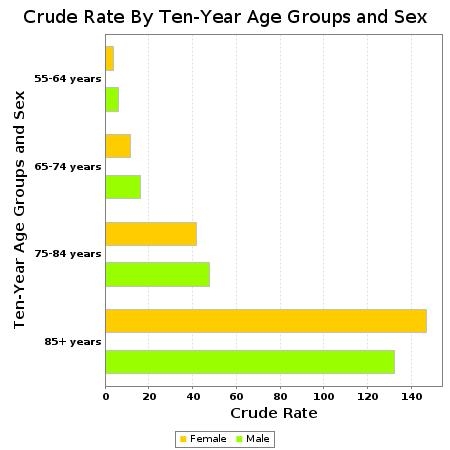
When the mortality in this age group was stratified on the basis of gender in 10-year groups (55-64, 65-74, 75-84, 85+), in the first 3 periods (from 55 till 84 years) males had a higher crude mortality rate than the females but interestingly female mortality surpassed males in 85+ years age group (Figure 3).

Conclusion: In people 55 years and above the mortality decreased from 1999 till 2014 and then a brief increase till 2018. Males had more mortality during this period. Blacks had the highest mortality amongst all races. In 10-year age groups males had the highest mortality than females in all groups except 85 years and above where females had more mortality.
  • Baig, Muhammad Usman  ( Weill Cornell Medicine , New York , New York , United States )
  • Akram, Rabia  ( Quaid-e-Azam Medical College , Bahawalpur , Pakistan )
  • Balaji, Adarsh  ( Brookdale Hospital Medical Center , Brooklyn , New York , United States )
  • Singhal, Krtin  ( Brookdale Hospital Medical Center , Brooklyn , New York , United States )
  • Abdelaziz, Nuha  ( Vassar Brothers Medical Center , Poughkeepsie , New York , United States )
  • Haider, Muhammad Usman  ( Geisinger Health System , Wilkes Barre , Pennsylvania , United States )
  • Khalid, Fatima  ( Tower Health Reading Hospital , Reading , Pennsylvania , United States )
  • Manzoor, Ibrahim  ( Riphah International University , Islamabad , Pakistan )
  • Khan, Sardar Muhammad Imran  ( NUMS , Rawalpindi , Pakistan )
  • Mahmood, Muhammad Usman  ( University of Health Sciences , Wah Cantt , Pakistan )
  • Author Disclosures:
    Muhammad Usman Baig: DO NOT have relevant financial relationships | Rabia Akram: DO NOT have relevant financial relationships | Adarsh Balaji: DO NOT have relevant financial relationships | Krtin Singhal: No Answer | Nuha Abdelaziz: No Answer | Muhammad Usman Haider: DO NOT have relevant financial relationships | Fatima Khalid: No Answer | Ibrahim Manzoor: DO NOT have relevant financial relationships | Sardar Muhammad Imran Khan: DO NOT have relevant financial relationships | Muhammad Usman Mahmood: DO NOT have relevant financial relationships
Meeting Info:

Scientific Sessions 2025

2025

New Orleans, Louisiana

Session Info:

Stroke Mortality, Mechanisms, and Disparities: Trends, Timing, and Technologies

Saturday, 11/08/2025 , 01:45PM - 02:55PM

Moderated Digital Poster Session

More abstracts on this topic:
A distinct clot transcriptomic signature is associated with atrial fibrillation-derived ischemic stroke in the INSIGHT Registry

Seah Carina, Rivet Dennis, Fraser Justin, Kellner Christopher, Devarajan Alex, Vicari James, Dabney Alan, Baltan Selva, Sohrabji Farida, Pennypacker Keith, Nanda Ashish, Woodward Britton

3-HKA Promotes the Vascular Remodeling after Stroke by Modulating the Activation of A1/A2 Reactive Astrocytes

Chen Jun-min, Shi Guang, Yu Lulu, Shan Wei, Zhang Xiangjian, Wang Qun

More abstracts from these authors:
Hypertensive Diseases Related Mortality in middle-aged adults (25-54 years) in the United States from 1999 to 2020

Baig Muhammad Usman, Haider Muhammad Usman, Singhal Krtin, Balaji Adarsh, Khalid Fatima, Abdelaziz Nuha, Akram Rabia, Manzoor Ibrahim

Clinical Outcomes with Optical Coherence Tomography vs Angiography or Intravascular Ultrasound Guided Percutaneous Coronary Intervention: A Systematic Review and Meta-analysis of Randomized Controlled Trials

Baig Muhammad Usman, Waqas Muhammad, Khan Sardar Muhammad Imran, Akram Rabia, Khalid Fatima, Mahmood Muhammad Usman, Haider Muhammad Usman, Abdelaziz Nuha, Singhal Krtin, Balaji Adarsh, Khan Eisha, Manzoor Ibrahim, Sohail Auj, Naseem Syed Danish, Awais Abdul Raffay, Ausaf Rabeea, Saadat Ayesha, Ul Duaa Sehar

You have to be authorized to contact abstract author. Please, Login
Not Available