
Handgrip Strength, Obesity, and Outcomes in Heart Failure with Preserved Ejection Fraction
Abstract Body (Do not enter title and authors here): Background Obesity is paradoxically associated with better outcomes in adults with heart failure with preserved ejection fraction (HFpEF). Handgrip strength is a simple validated measure of systemic muscle strength and serves as a proxy for sarcopenia and frailty—conditions that are clinically relevant in HFpEF. The prognostic value of handgrip strength, particularly in relation to body habitus, is unknown in this population.
Goals/Aims This study aimed to examine the relationship between low handgrip strength, body habitus, and clinical outcomes in adults with HFpEF.
Methods We examined 255 ambulatory patients with HFpEF seen at Weill Cornell Medicine from June 2018 – November 2023. Handgrip strength was measured with a dynomanomter using the average handgrip strength from both hands. Low handgrip strength was defined as values < 29.0 kg for men and < 18.0 kg for women. Cox proportional-hazard model analysis was used to examine the association between low handgrip strength and the composite endpoint (a 1-year composite of all-cause mortality and all-cause hospitalization) adjusting for race, the MAGGIC prognostic risk score and malnutrition: this was conducted among the entire cohort, and also among those with and without obesity (based on BMI ≥ 30 and < 30).
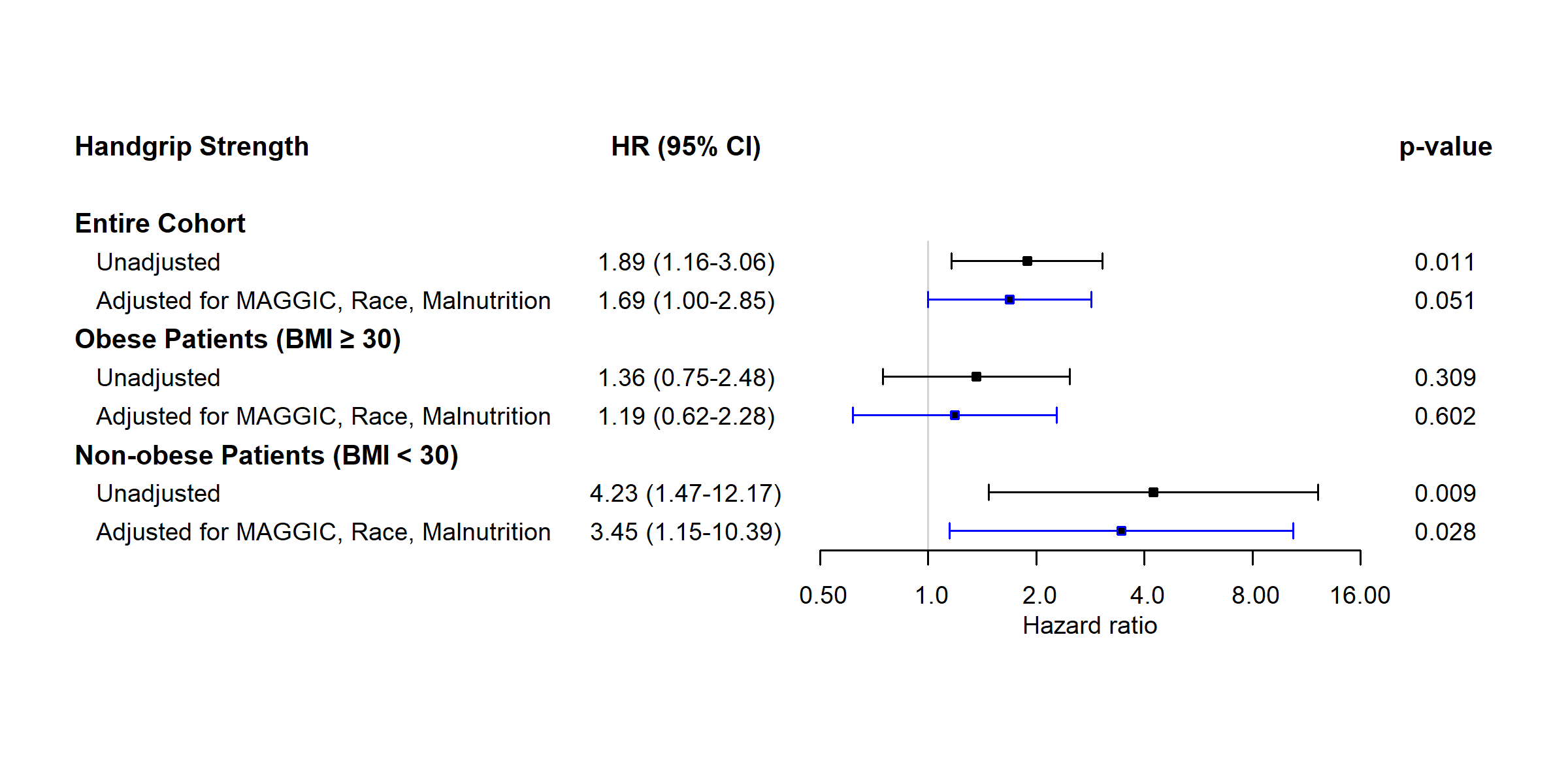
Results The median age was 77.0 years (IQR [69.0-84.0]), LVEF was 63.0 (IQR [59.0-67.0]), BMI was 29.9 (IQR [25.90 – 36.59]) and MAGGIC risk score was 24.0 (IQR [19.0-28.0]). The prevalence of low handgrip strength was 66.3% overall (n=169), 43.2% in obese (n=73) and 56.8% in non-obese (n=96) patients. Figure 1 shows results of the cox poportional hazard models. Among the entire cohort, low handgrip strength was associated with the composite endpoint in a crude model, but not after adjusting for covariates. Among the obesity strata, low handgrip strength was associated with the composite endpoint in non-obese patients with HFpEF, but not in obese patients with HFpEF.
Conclusion Low handgrip strength is associated with adverse outcomes in non-obese patients with HFpEF. This data supports the value of handgrip strength as an incrementally valuable prognostic tool in patients with HFpEF.
Zainul, Omar
( Weill Cornell Medicine
, New York
, New York
, United States
)
Chau, Kristi
( Weill Cornell Medicine
, New York
, New York
, United States
)
Lapenna, Kyle
( Weill Cornell Medicine
, New York
, New York
, United States
)
Hashemi, Ashkan
( Weill Cornell Medicine
, New York
, New York
, United States
)
Reich, Alexandra
( Weill Cornell Medicine
, New York
, New York
, United States
)
Marshall, Dylan
( Columbia University Medical Center
, New York
, New York
, United States
)
Zarzuela, Kate
( Weill Cornell Medicine
, New York
, New York
, United States
)
Goyal, Parag
( Weill Cornell Medicine
, New York
, New York
, United States
)
Author Disclosures:
Omar Zainul:DO NOT have relevant financial relationships
| Kristi Chau:DO NOT have relevant financial relationships
| Kyle LaPenna:No Answer
| Ashkan Hashemi:DO NOT have relevant financial relationships
| Alexandra Reich:No Answer
| Dylan Marshall:No Answer
| Kate Zarzuela:No Answer
| Parag Goyal:DO have relevant financial relationships
;
Consultant:Axon therapies:Active (exists now)
; Consultant:Pfizer:Active (exists now)
; Consultant:Bridgebio:Active (exists now)
; Consultant:Bayer HealthCare:Active (exists now)