
Logo

American Heart Association

  16
  0


Final ID: Mo2001

Forecasting the Onset of Atrial Fibrillation in the Intensive Care Unit Using Real-World Telemetry Data

Abstract Body (Do not enter title and authors here): Background: Paroxysmal atrial fibrillation (AF) is a common arrhythmogenic complication in the intensive care unit (ICU) associated with significant costs and morbidity. AF detection models in the literature have utilized entropic analyses of telemetry to diagnose AF, but they have not been utilized to forecast its onset.

Hypothesis: Deep learning techniques applied to high-frequency telemetry data can be utilized to forecast AF with clinically significant lead time.

Methods: Telemetry data were collected from 72 ICU monitored beds in a tertiary care center from 4/2018-12/2023. Coefficient of sample entropy (COSEn), a metric of heart rate variability complexity, was calculated on successive 1-minute windows and utilized to identify areas of AF initiation as well as control windows without AF. ECG lead II (256Hz) and beat-to-beat (B2B) measurements were analyzed by the MOMENT time-series foundational model to generate representation embeddings. A binary classification multilayer perceptron (MLP) was trained on these embeddings to forecast AF onset 5m in advance. All results were reported on separate test sets. Group-based trajectory modelling (GBTM) was performed on risk score trajectories from the 20m before AF onset or absence.

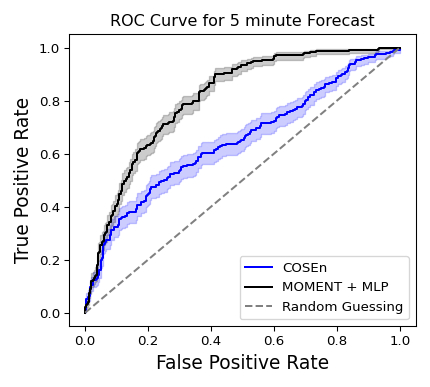
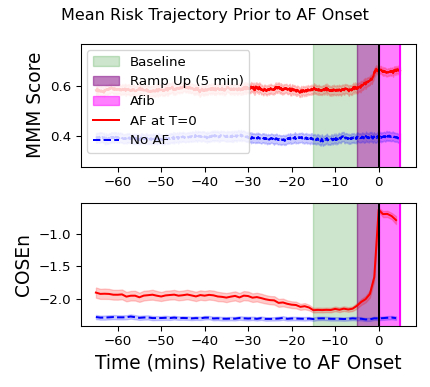
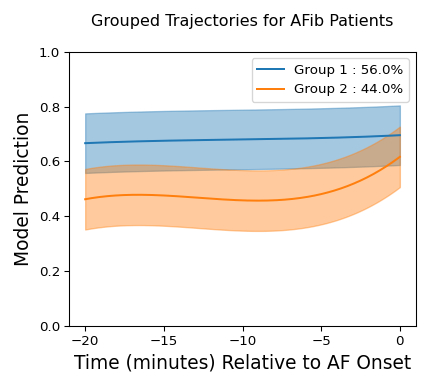
Results: Over 230,000 hours of B2B data from 2263 patients was analyzed using COSEn to identify 287 transitions to AF from 136 patients. The same number of AF-absent windows were randomly selected. COSEn alone as a forecaster produced an area under the receiver operating characteristic curve (AUC) of 0.65 (95% CI: 0.61-0.69). The MOMENT + MLP model (MMM) achieved an AUC of 0.81 (0.78-0.83) (Fig. 1). COSEn and MMM were subsequently applied to the two hours preceding AF onset or absence. For COSEn, the mean risk trajectory dipped in the baseline period whereas the MMM risk trajectory sustained a high level through the baseline, highlighting its capacity to forecast AF (Fig. 2). For AF patients, GBMT yielded two types of trajectories: one with elevated risk throughout, and another with a rising trend 5 minutes prior to AF onset (Fig. 3).

Conclusions: Deep learning techniques can forecast the onset of AF with up to 5 minutes of lead-time and GBTM allowed for the identification of different pre-AF risk trajectory phenotypes.The ability to forecast AF onset has potential to clinically prevent poor outcomes in the ICU, though further refinements to augment the amount of lead time are warranted.
  • Howarth, Dan  ( Carnegie Mellon University , Seattle , Washington , United States )
  • Rooney, Sydney  ( UPMC , Pittsburgh , Pennsylvania , United States )
  • Murugan, Raghavan  ( UPMC , Pittsburgh , Pennsylvania , United States )
  • Parker, Robert  ( University of Pittsburgh , Pittsburgh , Pennsylvania , United States )
  • Herasevich, Vitaly  ( Mayo Clinic , Rochester , Minnesota , United States )
  • Kashani, Kianoush  ( Mayo Clinic , Rochester , Minnesota , United States )
  • Pinsky, Michael  ( University of Pittsburgh , Pittsburgh , Pennsylvania , United States )
  • Hauskrecht, Milos  ( University of Pittsburgh , Pittsburgh , Pennsylvania , United States )
  • Dubrawski, Artur  ( Carnegie Mellon University , Pittsburgh , Pennsylvania , United States )
  • Clermont, Gilles  ( University of Pittsburgh , Pittsburgh , Pennsylvania , United States )
  • Author Disclosures:
    Dan Howarth: DO NOT have relevant financial relationships | Sydney Rooney: DO NOT have relevant financial relationships | Raghavan Murugan: DO have relevant financial relationships ; Consultant:Vantive:Active (exists now) ; Research Funding (PI or named investigator):Vantive:Active (exists now) ; Consultant:Baxter:Active (exists now) ; Research Funding (PI or named investigator):Novartis Inc:Active (exists now) ; Speaker:Fresenius Medical:Active (exists now) | Robert Parker: DO NOT have relevant financial relationships | Vitaly Herasevich: DO NOT have relevant financial relationships | Kianoush Kashani: DO NOT have relevant financial relationships | Michael Pinsky: DO NOT have relevant financial relationships | Milos Hauskrecht: No Answer | Artur Dubrawski: No Answer | Gilles Clermont: DO NOT have relevant financial relationships
Meeting Info:

Scientific Sessions 2025

2025

New Orleans, Louisiana

Session Info:

Innovations in Cardiovascular Care Delivery: AI, Digital Tools, and Population-Centered Approaches

Monday, 11/10/2025 , 10:30AM - 11:30AM

Abstract Poster Board Session

More abstracts on this topic:
A Comprehensive Study on Machine Learning Models Combining with Oversampling for One-year Persistent Coronary Artery Aneurysm in Kawasaki Disease

Liang Kaizhi, Pang Yusheng, Su Danyan

An Integrated Germline and Somatic Genomic Model Improves Risk Prediction for Coronary Artery Disease

Kim Min Seo, Zhang Rufan, Liu Zhaoqi, A Yunga, Ellinor Patrick, Natarajan Pradeep, Wang Minxian, Fahed Akl, Yang Xiong, Uddin Md Mesbah, Nakao Tetsushi, Cho So Mi Jemma, Koyama Satoshi, Zhu Xinyu, Xu Tingfeng, Reeskamp Laurens

More abstracts from these authors:
Admission Acid-Base Status and Mortality in Cardiac Intensive Care Unit Patients

Canova Tyler, Lipps Kirsten, Hillerson Dustin, Kashani Kianoush, Dahiya Garima, Jentzer Jacob

Incidence and Predictors of Atrial Tachyarrhythmia in Fontan Patients from the Fontan Outcome Registry using CMR Examinations (FORCE)

Rooney Sydney, Kamp Anna, Kreutzer Jacqueline, Morell Victor, Rathod Rahul, Alsaied Tarek, Schiff Mary, Li Yu, Olivieri Laura, Christopher Adam, Wolfe Natasha, Fogel Mark, Arora Gaurav, Follansbee Christopher

You have to be authorized to contact abstract author. Please, Login
Not Available