Admission Acid-Base Status and Mortality in Cardiac Intensive Care Unit Patients
Abstract Body (Do not enter title and authors here): Background: Little is known about the epidemiology and prognostic significance of acid-base disturbances in the cardiovascular intensive care unit (CICU). This study examines the association of acid-base status at admission with in-hospital mortality among CICU patients.
Methods: We conducted a retrospective analysis of adults admitted to the Mayo Clinic CICU from 2007-2018 who had available blood gas data, utilizing laboratory values obtained closest to the time of CICU admission. Arterial pH, serum bicarbonate, base excess, and partial pressure of carbon dioxide (PaCO2) were examined as predictors of in-hospital mortality. Logistic regression models were used to assess associations, with adjustment for demographics, comorbidities, illness severity, and interventions. A composite acidosis score (CAS, range 0–5), incorporating predefined cut-offs for arterial pH, base excess, and anion gap was calculated to quantify acid-base disturbance severity.
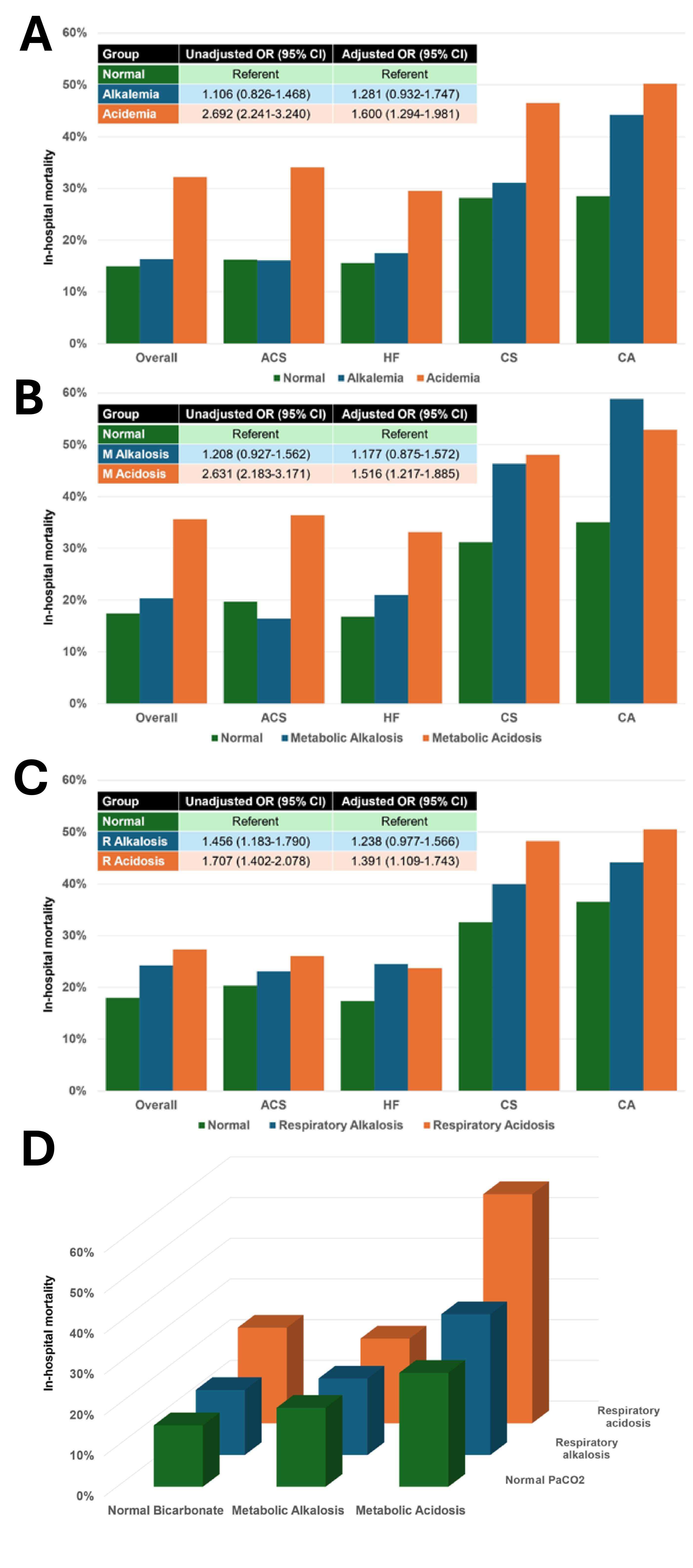
Results: A total of 3,229 patients were included for analysis. Of all acid-base variables, acidemia (pH<7.35) emerged as the strongest predictor of in-hospital mortality (adjusted odds ratio [aOR] 1.60, 95% confidence interval [CI] 1.29-1.98, p<0.003). Metabolic acidosis (HCO3<20 mEq/L) aOR 1.55, 95% CI 1.24-1.95, p<0.001) and respiratory acidosis (PaCO2>45 mmHg, aOR 1.44, 95% CI 1.14-1.81, p=0.002) were associated with worse adjusted in-hospital mortality, whereas alkalemia, metabolic alkalosis, and respiratory alkalosis were not (Fig. 1A-C). After adjustment, lower pH and more negative base excess were associated with higher in-hospital mortality (both p<0.001), whereas HCO3 and PaCO2 were not (p=0.053 & p=0.051, respectively; Fig. 2). Patients with combined metabolic and respiratory acidosis had the highest in-hospital mortality (56.3%), followed by patients with isolated or compensated metabolic acidosis (Fig.1D). Patients with severe acidosis (CAS>1) had higher mortality (aOR 2.34, 95% CI 1.88–2.90; p<0.001, Fig. 3AB). In-hospital mortality rose with increasing CAS (aOR 1.36 per point higher, 95% CI 1.26–1.47; p<0.001), with consistent effects across admission diagnoses (Fig. 3C).
Conclusions: Acidemia, especially in the context of combined metabolic and respiratory acidosis, strongly predicts in-hospital mortality in the CICU. Incorporating combined acid-base disorders into risk stratification scores may facilitate earlier recognition and prevent progression of hemometabolic shock, thereby improving prognosis.
Canova, Tyler
(
Mayo Clinic
, Rochester , Minnesota , United States )
Lipps, Kirsten
(
Mayo Clinic
, Rochester , Minnesota , United States )
Hillerson, Dustin
(
Mayo Clinic
, Rochester , Minnesota , United States )
Kashani, Kianoush
(
Mayo Clinic
, Rochester , Minnesota , United States )
Dahiya, Garima
(
Mayo Clinic
, Rochester , Minnesota , United States )
Jentzer, Jacob
(
Mayo Clinic
, Rochester , Minnesota , United States )
Author Disclosures:
Tyler Canova:DO NOT have relevant financial relationships
| Kirsten Lipps:DO NOT have relevant financial relationships
| Dustin Hillerson:No Answer
| Kianoush Kashani:DO NOT have relevant financial relationships
| Garima Dahiya:DO NOT have relevant financial relationships
| Jacob Jentzer:DO NOT have relevant financial relationships