Predicting Non-Zero Coronary Artery Calcium Score in Middle-Aged Population: Comparing an Artificial Intelligence-based Model with Existing ASCVD Risk Scores in the Multi-Ethnic Study of Atherosclerosis (MESA)
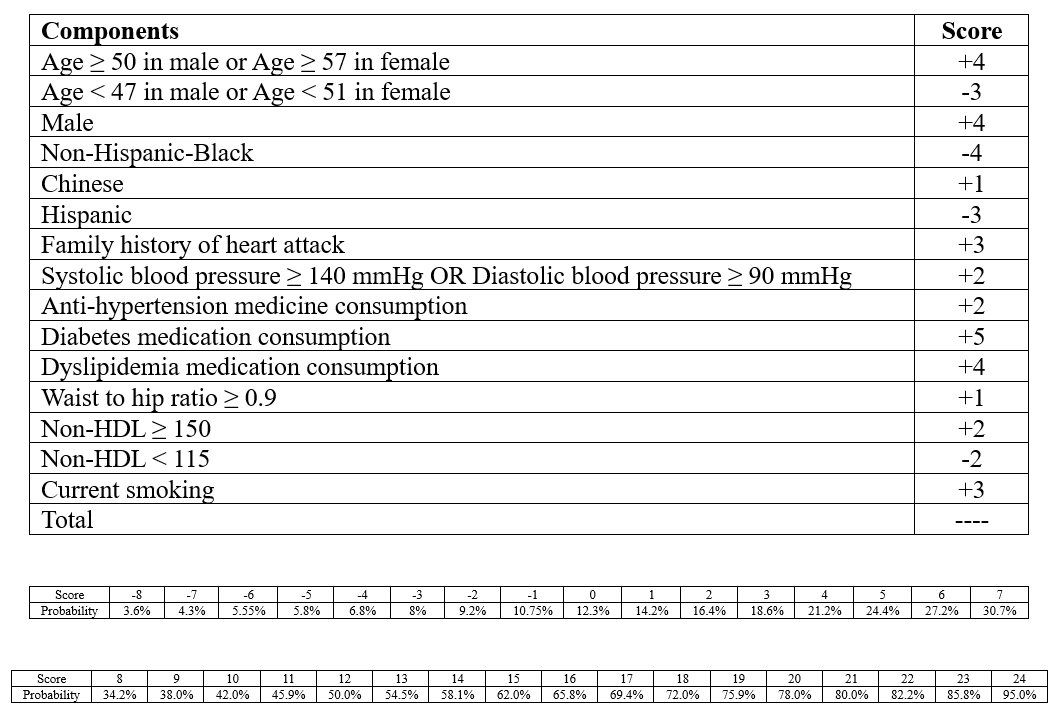
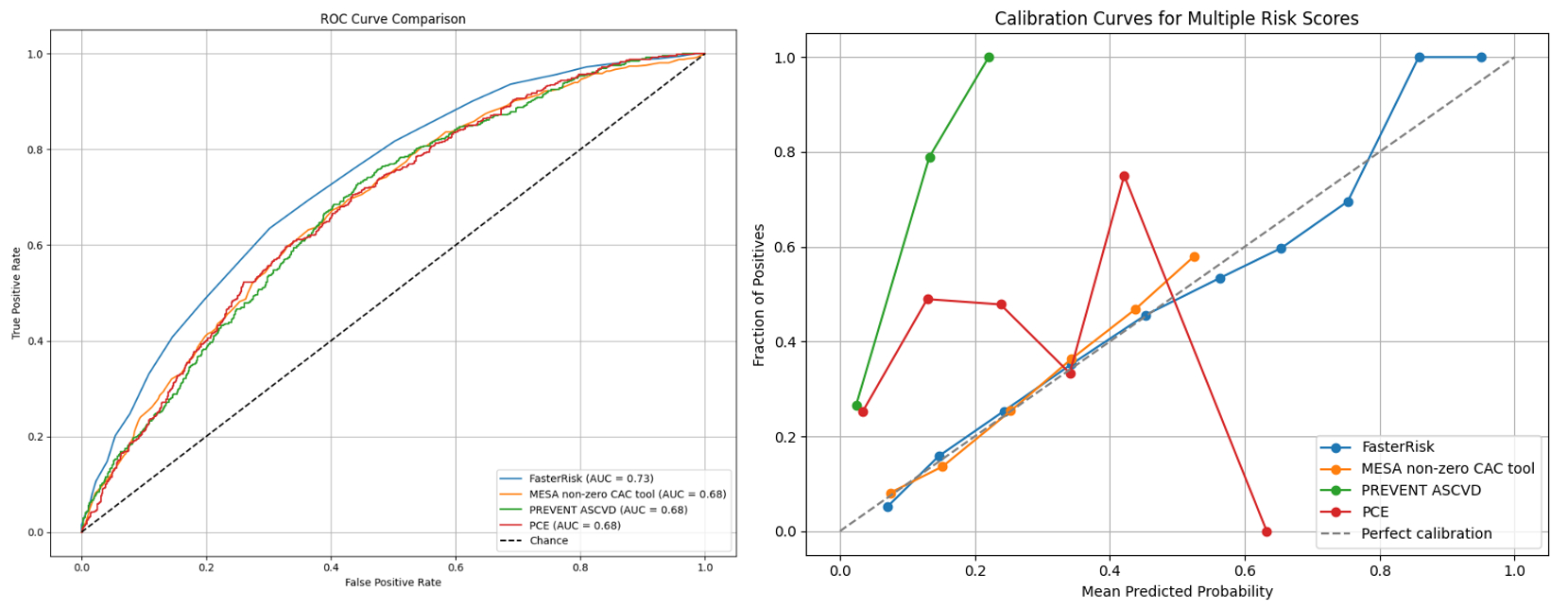
Abstract Body (Do not enter title and authors here): Background: A positive coronary artery calcium (CAC) scan (Agatston score >0) establishes the presence of subclinical coronary artery disease. Currently, atherosclerotic cardiovascular disease (ASCVD) risk scoring tools, such as the Pooled Cohort Equations (PCE) and PREVENT, are not designed for predicting positive CAC. Additionally, the Multi-Ethnic Study of Atherosclerosis (MESA) CAC calculator relies on age, sex, and race/ethnicity, with a particular emphasis on age. Hypothesis: We hypothesized that using an artificial intelligence (AI) model with additional data beyond age, sex and race/ethnicity will enhance the prediction of a positive CAC in the middle-aged population. Method: We analyzed data from MESA baseline men 45-55 and women 45-65 years. Variable selection was conducted using A) a forward feature selection, building on a base logistic regression model with age, sex, race, followed by B) an embedded feature selection technique. We used FasterRisk, an interpretable AI method, to develop a risk score for estimating the likelihood of CAC>0. We compared the AI’s performance with the MESA CAC calculator, PCE, and PREVENT ASCVD, using the area under the receiver operating characteristic curve (AUC), DeLong’s test, and calibration analysis. Results: Among 2,139 MESA middle-aged participants, 581 individuals (27.2%) had a positive CAC. The predictors included age, sex, race, family history of heart attack, hypertension, waist/hip ratio, smoking, non–high-density lipoprotein cholesterol, and use of medications for diabetes, hypertension, or dyslipidemia. The AI achieved an AUC of 0.73 (95% CI: 0.71-0.75), which was significantly higher than that of the MESA CAC calculator (AUC: 0.68, CI: 0.66-0.70, P for difference < 0.001), PCE (AUC: 0.68, CI:0.65-0.70, P < 0.001), and PREVENT ASCVD (AUC: 0.68, CI:0.65-0.70, P < 0.001). Based on the calibration curve, only the MESA CAC calculator and the AI model demonstrated acceptable performance, with the AI outperforming the MESA tool in individuals at higher risk. Conclusion: We have developed an AI model that outperforms the MESA CAC calculator, PCE, and PREVENT risk scores for prediction of a positive CAC in the middle-aged population. These findings must be validated in other cohorts to substantiate their clinical utility. Nonetheless, the AUC range of 0.65 to 0.75 remind us that regardless of risk scoring tools, a large portion of middle-aged CAC positive cases are missed by relying on traditional risk factors.
Mcconnell, Mike
(
Stanford University
, Stanford , California , United States )
Mirjalili, Seyed Reza
(
HeartLung Technologies
, Houston , Texas , United States )
Atlas, Kyle
(
HeartLung Technologies
, Houston , Texas , United States )
Zhang, Chenyu
(
HeartLung Technologies
, Houston , Texas , United States )
Azimi, Amir
(
HeartLung Technologies
, Houston , Texas , United States )
Reeves, Anthony
(
Cornell University
, Ithaca , New York , United States )
Wong, Nathan
(
University of California, Irvine
, Irvine , California , United States )
Maron, David
(
Stanford University
, Stanford , California , United States )
Naghavi, Morteza
(
HeartLung Technologies
, Houston , Texas , United States )
Author Disclosures:
Mike McConnell:No Answer
| Seyed Reza Mirjalili:DO have relevant financial relationships
;
Researcher:HeartLung:Active (exists now)
| Kyle Atlas:No Answer
| Chenyu Zhang:DO have relevant financial relationships
;
Employee:HeartLung Corporation:Active (exists now)
; Individual Stocks/Stock Options:HeartLung Corporation:Active (exists now)
| Amir Azimi:No Answer
| Anthony Reeves:DO have relevant financial relationships
;
Individual Stocks/Stock Options:HeartLung Technologies:Active (exists now)
| Nathan Wong:DO have relevant financial relationships
;
Research Funding (PI or named investigator):Amgen, Novartis, Ionis:Active (exists now)
; Consultant:Ionis:Past (completed)
; Speaker:Novartis:Past (completed)
; Consultant:Heart Lung, Amgen, Novartis:Active (exists now)
; Research Funding (PI or named investigator):Novo Nordisk, Regeneron:Past (completed)
Morteza Naghavi:DO have relevant financial relationships
;
Ownership Interest:HeartLung.AI:Active (exists now)