
Logo

American Heart Association

  17
  0


Final ID: MP1379

Co-existence And Prognosis of 18FDG-avidity And Genetic Cardiomyopathies

Abstract Body (Do not enter title and authors here): Introduction: 18FDG-PET scan has emerged as a modality for identifying inflammatory cardiomyopathies such as cardiac sarcoidosis (CS) by detecting glucose uptake. Guidelines allow for diagnosis of CS based on clinical presentation and 18FDG-avidity without requiring tissue biopsy. However, patients with genetic cardiomyopathies can be 18FDG-avid, potentially leading to misdiagnosis as isolated CS.
Objectives: To evaluate the prevalence of pathogenic and likely pathogenic (P/LP) variants in 18FDG-avid cardiomyopathy and assess the association between FDG-avidity, genetic variants, and heart failure outcomes.
Methods: A multi-center retrospective cohort study combined patients from three centers who underwent both a cardiac 18FDG-PET scan and commercial genetic testing for genetic cardiomyopathies. We excluded patients with biopsy-proven sarcoidosis, as well as those with incomplete 18FDG suppression. Chi-square tests were used to compare between group characteristics, and Kaplan-Meier survival analyses were performed to evaluate time to event outcomes, including a composite of death, LVAD implantation, or heart transplant, based on 18FDG-avidity and genetic status.
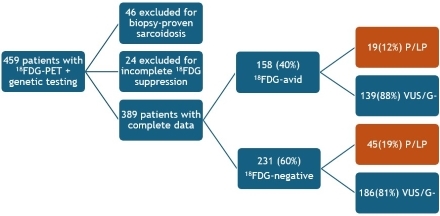
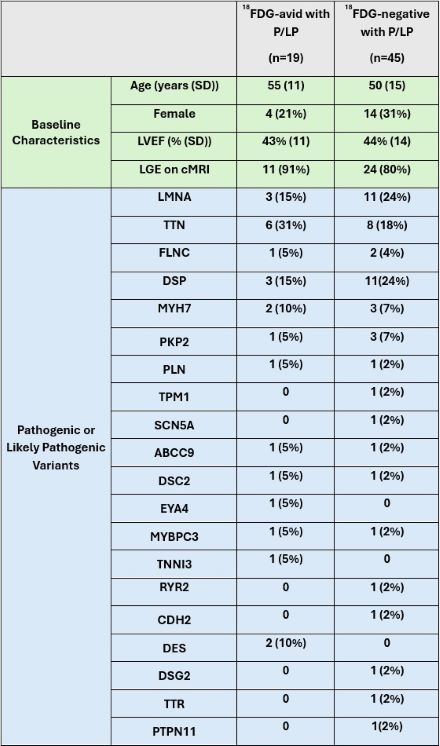
Results: Among 459 patients who underwent both a cardiac 18FDG-PET scan and genetic testing, 389 (33% female; mean age 54 years) met the inclusion criteria. 18FDG-avidity was identified in 158 (40%). Within this subgroup, 19 (12%) had a P/LP variant compared with 19% of the 18FDG-negative patients (p=0.051; Figure 1). Baseline characteristics were similar, and a wide array of genes was implicated in 18FDG-avid cardiomyopathy (Figure 2).
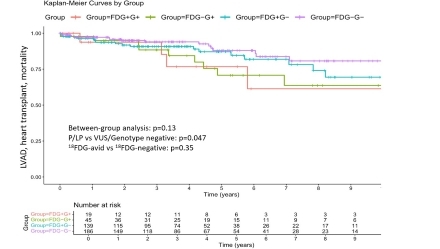
Survival analysis revealed no significant difference between the four genotype-FDG subgroups (p=0.13, Figure 3), and 18FDG-avidity was not significantly associated with the composite endpoint in the overall cohort (p=0.35), nor within the subset of patients with P/LP variants (p=0.84), suggesting that 18FDG-avidity did not predict clinical outcomes. The presence of a P/LP variant was associated with an increased incidence of the composite endpoint (p=0.047).
Conclusion: 18FDG-avidity is frequently noted in patients with genetic cardiomyopathy, but was not associated with adverse clinical outcomes, suggesting it may not reflect clinically relevant inflammation. P/LP variants were significantly associated with survival outcomes, highlighting the value of genetic testing in patients with suspected inflammatory cardiomyopathy.
  • Tabaghi, Shiva  ( University of Washington , Seattle , Washington , United States )
  • Di Carli, Marcelo  ( Brigham and Women's Hospital , Boston , Massachusetts , United States )
  • Chatterjee, Neal  ( University of Washington , Seattle , Washington , United States )
  • Cheng, Richard  ( University of Washington , Seattle , Washington , United States )
  • Stempien-otero, April  ( University of Washington , Seattle , Washington , United States )
  • Levin, Benjamin  ( Oregon Health & Science University , Portland , Oregon , United States )
  • Divakaran, Sanjay  ( Brigham and Women's Hospital , Boston , Massachusetts , United States )
  • Nazer, Babak  ( University of Washington , Seattle , Washington , United States )
  • Bevan, Graham  ( University of Washington , Seattle , Washington , United States )
  • Hankinson, Stephen  ( Brigham and Women's Hospital , Boston , Massachusetts , United States )
  • Lal, Mallika  ( Oregon Health & Science University , Portland , Oregon , United States )
  • Pico, Madison  ( Oregon Health & Science University , Portland , Oregon , United States )
  • Lakdawala, Neal  ( Brigham and Women's Hospital , Boston , Massachusetts , United States )
  • Sauer, William  ( Brigham and Women's Hospital , Boston , Massachusetts , United States )
  • Tedrow, Usha  ( Brigham and Women's Hospital , Boston , Massachusetts , United States )
  • Blankstein, Ron  ( Brigham and Women's Hospital , Boston , Massachusetts , United States )
  • Author Disclosures:
    Shiva Tabaghi: DO NOT have relevant financial relationships | MARCELO DI CARLI: No Answer | Neal Chatterjee: No Answer | Richard Cheng: No Answer | April Stempien-Otero: No Answer | Benjamin Levin: No Answer | Sanjay Divakaran: DO NOT have relevant financial relationships | Babak Nazer: DO NOT have relevant financial relationships | Graham Bevan: DO NOT have relevant financial relationships | Stephen Hankinson: No Answer | Mallika Lal: DO NOT have relevant financial relationships | Madison Pico: No Answer | Neal Lakdawala: DO have relevant financial relationships ; Consultant:BMS:Active (exists now) ; Advisor:Neuvocore:Active (exists now) ; Consultant:Gemma:Active (exists now) ; Advisor:Kardigan:Active (exists now) ; Consultant:Tenaya:Active (exists now) ; Consultant:Cytokinetics:Active (exists now) ; Consultant:Pfizer:Past (completed) ; Consultant:Alexion:Active (exists now) | William Sauer: No Answer | Usha Tedrow: DO have relevant financial relationships ; Speaker:Biosense Webster:Past (completed) ; Speaker:Abbott Medical:Past (completed) ; Advisor:Boston Scientific:Past (completed) | Ron Blankstein: DO have relevant financial relationships ; Consultant:Heartflow:Active (exists now) ; Researcher:Nanox AI:Active (exists now) ; Researcher:Heartflow:Active (exists now) ; Researcher:Amgen:Active (exists now) ; Researcher:Novartis Inc:Active (exists now) ; Consultant:Siemens Inc:Past (completed) ; Consultant:Caristo:Active (exists now) ; Consultant:Nanox AI:Active (exists now)
Meeting Info:

Scientific Sessions 2025

2025

New Orleans, Louisiana

Session Info:
More abstracts on this topic:
Association Between In-hospital Cardiac Arrest Incidence and Survival in Older Patients

Nathani Rohit, Li Qiang, Nguyen Cathy, Koshy Thomas, Hall Hurst, Mentias Amgad, Chan Paul, Girotra Saket

A Beta Tubulin Mutation Suppresses Arrhythmias and Improves Connexin 43 Localization in Heart of Duchenne Muscular Dystrophy Mice

Zhou Delong, Liu Tong, Yehia Ghassan, Romanienko Peter, Rodney George, Wehrens Xander, Lampe Paul, Gourdie Robert, Xie Lai-hua, Fraidenraich Diego, Nouet Julie, Mesa Elam, Yegneshwaran Vasisht, Geukgeuzian Geovanni, Adibemma Ifeanyichukwu, Nandakumar Swetha, Ramirez Edwin, Li Hong

More abstracts from these authors:
Prevalence of FDG-avidity in genetic cardiomyopathy and prediction of arrhythmic free survival

Bevan Graham, Nazer Babak, Tabaghi Shiva, Lal Mallika, Memar Kimia, Pico Madison, Cheng Richard, Stempien-otero April, Chatterjee Neal, Levin Benjamin

Prevalence and Characteristics of Hypertrophic Cardiomyopathy Phenotype in Patients with Cardiac Sarcoidosis

Zia Abdul, Lal Mallika, Nazer Babak, Levin Benjamin, Masri Ahmad

You have to be authorized to contact abstract author. Please, Login
Not Available