Trends and Disparities in Metabolic Syndrome-related Mortality in the United States (2000–2019): A Nationwide Analysis
Abstract Body (Do not enter title and authors here): Background Metabolic syndrome (MetS) is a well-established risk factor for cardiovascular events and is associated with increased all-cause mortality. Given limited data available, this study aims to explore the contemporary MetS -related mortality trends among patients ≥25 years in the United States.
Methods We conducted an analysis of death data using CDC WONDER, extracting age-adjusted mortality rates (AAMR) per 100,000 population. MetS was identified using ICD-10 codes E10–E14, E66, E78, E88, and I10. Trends by year, sex, race and ethnicity, census region, and metropolitan status were analyzed. Joinpoint regression was used to calculate the annual percent change (APC) in AAMR with 95% confidence intervals.
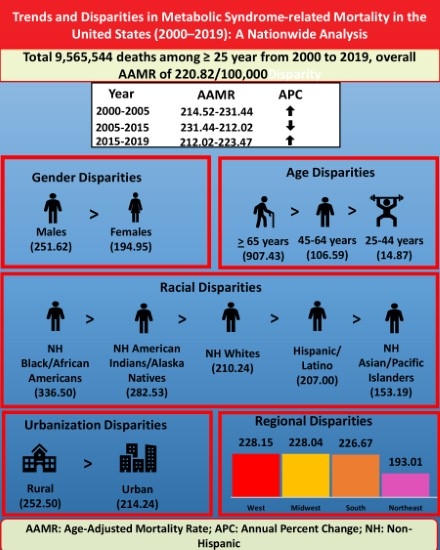
Results From 2000 to 2019, 9,565,544 deaths occurred related to MetS with an overall AAMR of 220.82/100,000. The AAMR increased from 214.52 in 2000 to 223.47 in 2019, showing an increasing trend from 2000 to 2005(APC: 1.37, p-value=0.002) followed by a decreasing trend from 2005 to 2015 (APC: -0.82, p-value=<0.001), and a rising trend again from 2015 to 2019 (APC: 1.30, p-value=0.005). Men had higher AAMR (251.62) than women (194.95). Black/African American population had the highest AAMR (336.50), followed by American Indian/Alaska Native (282.53), White (210.24), Hispanics/Latino (207.00), and Asian/Pacific Islander (153.19) population. Significant geographic variation was observed, with the West (228.15) and Midwest (228.04) regions exhibiting the highest AAMR. Additionally, nonmetropolitan areas had a higher AAMR (252.50) compared to metropolitan areas (214.24).
Conclusion The rising MetS-related mortality since 2015, along with persistent disparities across demographic and regional groups, highlights the need for targeted interventions to address the growing burden of multimorbidity on mortality.
Tabassum, Shehroze
(
The Wright Center for GME
, Scranton , Pennsylvania , United States )
Naeem, Aroma
(
The Wright Center for GME
, Scranton , Pennsylvania , United States )
Nadeem, Amna
(
Punjab Medical College
, Faisalabad , Pakistan )
Azhar, Faraz
(
Allama Iqbal Medical College
, Lahore , Pakistan )
Haider, Syed
(
King Edward Medical Univeristy
, Lahore , Pakistan )
Klamp, Douglas
(
The Wright Center for GME
, Scranton , Pennsylvania , United States )
Thomas Hemak, Linda
(
The Wright Center
, Scranton , Pennsylvania , United States )
Abramov, Dmitry
(
Loma Linda University Health
, Redlands , California , United States )
Author Disclosures:
Shehroze Tabassum:DO NOT have relevant financial relationships
| Aroma Naeem:DO NOT have relevant financial relationships
| Amna Nadeem:DO NOT have relevant financial relationships
| Faraz Azhar:DO NOT have relevant financial relationships
| Syed Haider:DO NOT have relevant financial relationships
| Douglas Klamp:No Answer
| Linda Thomas Hemak:DO NOT have relevant financial relationships
| Dmitry Abramov:DO have relevant financial relationships
;
Speaker:astra zeneca:Active (exists now)
; Advisor:bridgebio:Past (completed)
; Speaker:bayer:Active (exists now)