Intervention to Improve Medication Adherence and Symptom Perception in Patients with Heart Failure
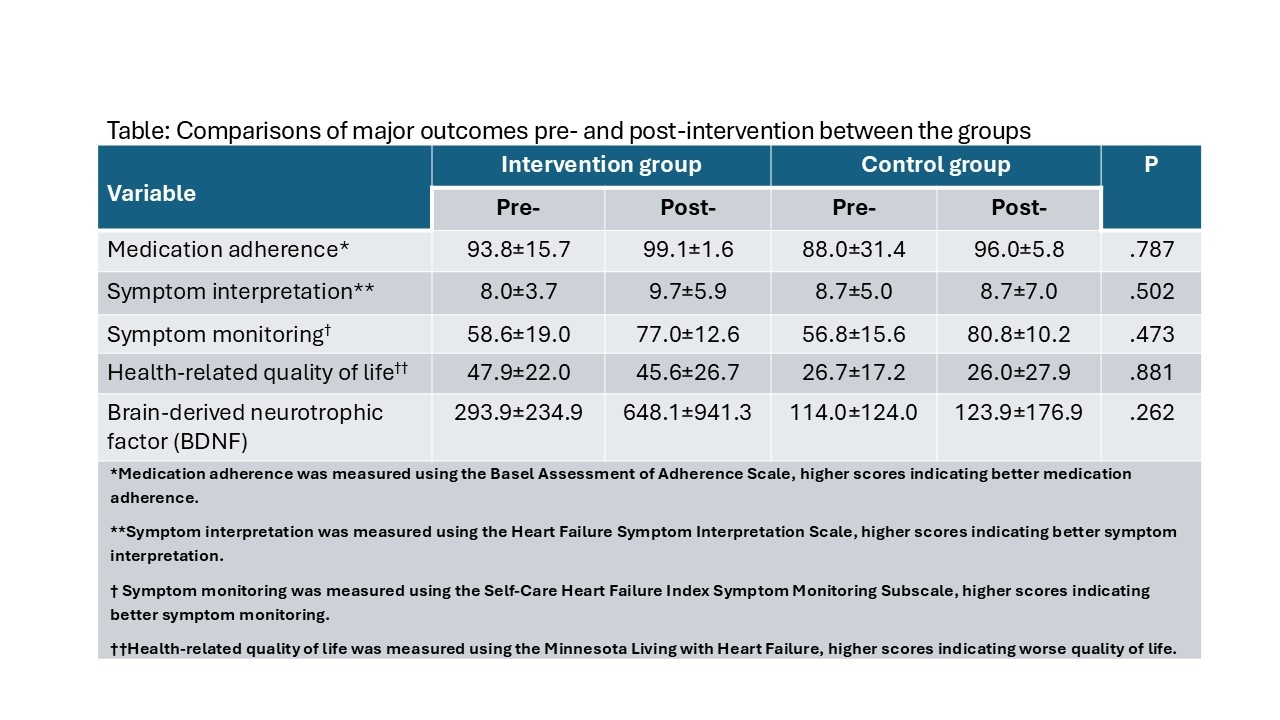
Abstract Body (Do not enter title and authors here): Background: Self-care is key to optimal outcomes in patients with heart failure (HF) which includes adhering to prescribed medications and regular symptom monitoring. While medical therapy helps reduce hospitalizations and death, poor medication adherence and symptom perception are pervasive. Current interventions focus either on improving medication adherence or training to improve symptom perception (symptom monitoring, recognition, interpretation) show limited benefits, suggesting that a combined approach may lead to better outcomes. Objectives: To test the feasibility (retention, efficacy, and satisfaction) of an intervention in which we integrated training to improve both medication adherence and symptom perception (iMASTER) among patients with HF. Methods: Patients with HF were enrolled and randomized to receive iMASTER or attention-only intervention (i.e., 6 bi-weekly sessions), and followed for 6 months. We measured medication adherence, symptom perception, health-related quality of life, and brain-derived neurotrophic factor (BDNF) as outcomes pre- and post-intervention. Repeated measures analysis of variance was used to compare outcomes between the groups. Results: Twenty-three patients with HF were enrolled and 19 completed the study with the retention rate of 83%. After the 3-month intervention, patients in the iMASTER intervention group showed improvements in medication adherence, symptom perception (monitoring, interpretation), health-related quality of life, and BDNF, though these changes were not statistically significant. Conversely, control group patients showed worse, little, or no change after intervention (Table). The majority of patients in the intervention group (≥90%) were “very satisfied” and “satisfied” with the iMASTER intervention (e.g., quality and easy to understand content and material) and all (100%) would recommend the intervention to their relatives/friends if they have same health condition. Conclusion: An intervention to improve both medication adherence and symptom perception was feasible, acceptable to patients and not only improved medication adherence and symptom perception but also quality of life and BDNF. A larger trial of the intervention is warranted.
Wu, Jia-rong
(
University of TENNESSEE KNOXVILLE
, Knoxville , Tennessee , United States )
Latimer, Abigail
(
Univ of Kentucky
, Lexington , Kentucky , United States )
Lin, Chin-yen
(
Auburn University
, Auburn , Alabama , United States )
Moser, Debra
(
UNIVERSITY OF TENNESSEE, KNOXVILLE
, Knoxville , Tennessee , United States )
Author Disclosures:
Jia-Rong Wu:DO NOT have relevant financial relationships
| Abigail Latimer:DO NOT have relevant financial relationships
| Chin-Yen Lin:DO NOT have relevant financial relationships
| Debra Moser:DO NOT have relevant financial relationships