
Logo

American Heart Association

  18
  0


Final ID: MP36

Mortality Prediction in Cardiogenic Shock Using a Time Series Machine Learning Foundation Model

Abstract Body (Do not enter title and authors here): Introduction: Traditional risk models predicting mortality in cardiogenic shock (CS) rely on static data snapshots, failing to capture the temporal dynamics represented in electronic health records. Conventional machine learning (ML) models can incorporate some temporal information but often struggle to model the complex, non-linear, and long-range relationships present in clinical time series data. Foundation models, pretrained on large, diverse time series datasets, offer a powerful alternative by capturing richer temporal patterns and making predictions in dynamic clinical settings.
Hypothesis: We hypothesized that a ML approach using a pretrained multi-task time series model (UniTS) could be fine-tuned to predict mortality in patients with CS admitted to the cardiac intensive care unit (CICU) using high-resolution, multivariable clinical time series data.
Methods: We performed a retrospective analysis of patients with CS admitted to the Brigham and Women’s Hospital CICU (2015-2024). Patients were split into training (80%) and validation (20%) cohorts. For each observation, 24h of clinical data were used to fine-tune a pretrained UniTS model to develop: (1) a dynamic model generating rolling 24h mortality predictions every 6h, and (2) a static model predicting overall in-hospital mortality after the first 24h of CICU admission. Validation performance was evaluated using area under the curve (AUC). The static model was compared to the IABP-Shock II risk score and SCAI shock stages for the same task using the DeLong test.
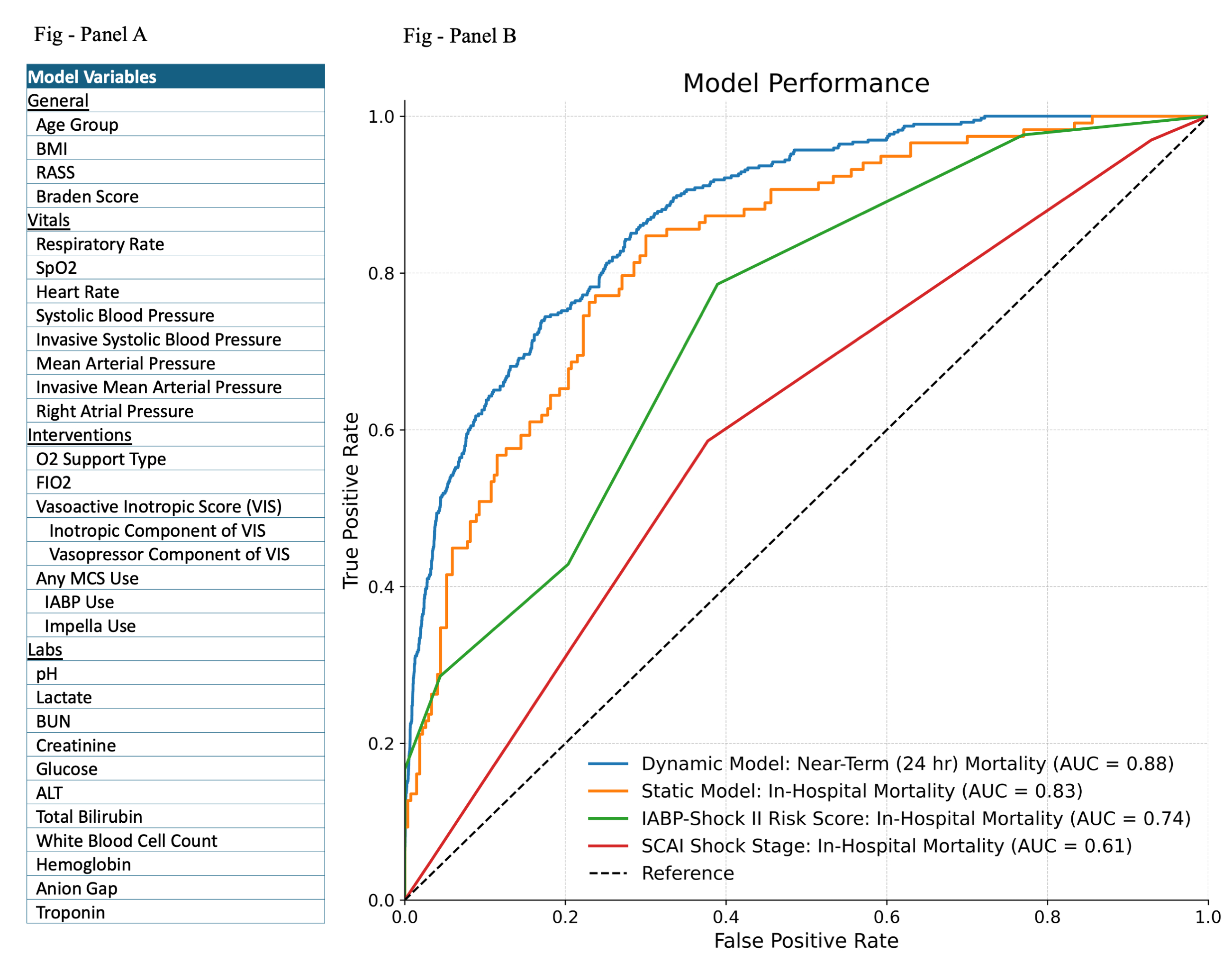
Results: Among 2,109 admissions with CS (median age 68 years, 38% women), 25% were AMI-related, and 39% received temporary mechanical circulatory support. In-hospital mortality was 37%, with a median time to death of 3.0 days following CICU admission. The final model included 31 clinical variables (Fig A). The dynamic model achieved a per-prediction AUC of 0.88 for 24-hour mortality. The static model achieved an AUC of 0.83 for in-hospital mortality, significantly outperforming the IABP-Shock II risk score (AUC 0.74; p = 0.03) and SCAI Shock stage (AUC 0.61; p < 0.001) (Fig B).
Conclusion: Leveraging the full temporal and multivariable complexity of CICU time series clinical data, fine-tuned ML foundation models accurately predict both very early and in-hospital mortality. By substantially outperforming traditional risk stratification methods, this time series modeling approach offers a promising tool for dynamic risk assessment in CS.
  • Ginder, Curtis  ( Brigham and Women's Hospital , Boston , Massachusetts , United States )
  • Gao, Shanghua  ( Harvard Medical School , Boston , Massachusetts , United States )
  • Patel, Siddharth  ( Brigham and Women's Hospital , Boston , Massachusetts , United States )
  • Bohula, Erin  ( Brigham and Women's Hospital , Boston , Massachusetts , United States )
  • Berg, David  ( Brigham and Women's Hospital , Boston , Massachusetts , United States )
  • Zamani, Sepahrad  ( Brigham and Women's Hospital , Boston , Massachusetts , United States )
  • Zitnik, Marinka  ( Harvard Medical School , Boston , Massachusetts , United States )
  • Morrow, David  ( Brigham and Women's Hospital , Boston , Massachusetts , United States )
  • Author Disclosures:
    Curtis Ginder: DO have relevant financial relationships ; Consultant:AIwithCare:Expected (by end of conference) | Shanghua Gao: No Answer | Siddharth Patel: DO have relevant financial relationships ; Consultant:Janssen:Active (exists now) | Erin Bohula: No Answer | David Berg: DO have relevant financial relationships ; Research Funding (PI or named investigator):AstraZenea:Active (exists now) ; Other (please indicate in the box next to the company name):CEC - CeleCor Therapeutics:Active (exists now) ; Other (please indicate in the box next to the company name):CEC - Beckman Coulter:Active (exists now) ; Other (please indicate in the box next to the company name):CEC - Novo Nordisk:Active (exists now) ; Other (please indicate in the box next to the company name):CEC - Tosoh Biosciences:Active (exists now) ; Other (please indicate in the box next to the company name):CEC - Kowa Pharmaceuticals:Past (completed) ; Speaker:USV Private Limited:Past (completed) ; Speaker:Pri-Med:Past (completed) ; Speaker:Metabolic Endocrine Education Foundation:Past (completed) ; Consultant:Youngene Therapeutics:Past (completed) ; Consultant:Pfizer:Active (exists now) ; Consultant:AstraZeneca:Active (exists now) ; Research Funding (PI or named investigator):Merck:Active (exists now) ; Research Funding (PI or named investigator):Pfizer:Active (exists now) | Sepahrad Zamani: DO NOT have relevant financial relationships | Marinka Zitnik: No Answer | David Morrow: DO have relevant financial relationships ; Research Funding (PI or named investigator):Abbott:Active (exists now) ; Consultant:Roche:Active (exists now) ; Consultant:Regeneron:Active (exists now) ; Consultant:Merck & Co:Active (exists now) ; Consultant:Abbott:Past (completed) ; Research Funding (PI or named investigator):Roche:Active (exists now) ; Research Funding (PI or named investigator):Pfizer:Active (exists now) ; Research Funding (PI or named investigator):Novartis:Active (exists now) ; Research Funding (PI or named investigator):Merck & Co:Active (exists now) ; Research Funding (PI or named investigator):4TEEN4:Active (exists now) ; Research Funding (PI or named investigator):Daiichi-Sankyo:Active (exists now) ; Research Funding (PI or named investigator):AstraZeneca:Active (exists now) ; Research Funding (PI or named investigator):Anthos Therapeutics:Active (exists now) ; Research Funding (PI or named investigator):Amgen:Active (exists now) ; Research Funding (PI or named investigator):Abiomed:Active (exists now)
Meeting Info:

Scientific Sessions 2025

2025

New Orleans, Louisiana

Session Info:

Redefining Risk: Machine Learning, Molecular Targets, and Mortality in Cardiovascular Emergencies.

Saturday, 11/08/2025 , 09:15AM - 10:15AM

Moderated Digital Poster Session

More abstracts on this topic:
Artificial Intelligence Assessment of Diastolic Dysfunction by Electrocardiogram: Outcomes in Cardiac Intensive Care Unit Patients

Hillerson Dustin, Jentzer Jacob, Lee Eunjung, Attia Zachi, Kane Garvan, Lopez-jimenez Francisco, Noseworthy Peter, Friedman Paul, Oh Jae

An Electronic Health Record Multimodal Data Integration Platform for Comprehensive Analysis of Single Ventricle Physiology

Xu Hang, Aboulhosn Jamil, Christodoulou Anthony, Finn Paul, Hsu William, Nguyen Kimlien, Zhang Hinn, Sisniega Carlos, Renella Pierangelo, Morris Connor, Husain Majid, Satou Gary, Zhu Bing, Van Arsdell Glen

More abstracts from these authors:
Mechanical Circulatory Support Device Related Complications in Contemporary North American Cardiac Intensive Care Units

Kochar Ajar, Park Jeong-gun, Berg David, Patel Siddharth, Bohula Erin, Morrow David

Biomarkers in Cardiac Arrest: An Analysis from the Critical Care Cardiology Trials Network

Morrow Sarah, Berg David, Zamani Sepahrad, Bellavia Andrea, Bohula Erin

You have to be authorized to contact abstract author. Please, Login
Not Available