The Relationship between Reported Fish Oil Supplement Use and Health Outcomes in the UK Biobank
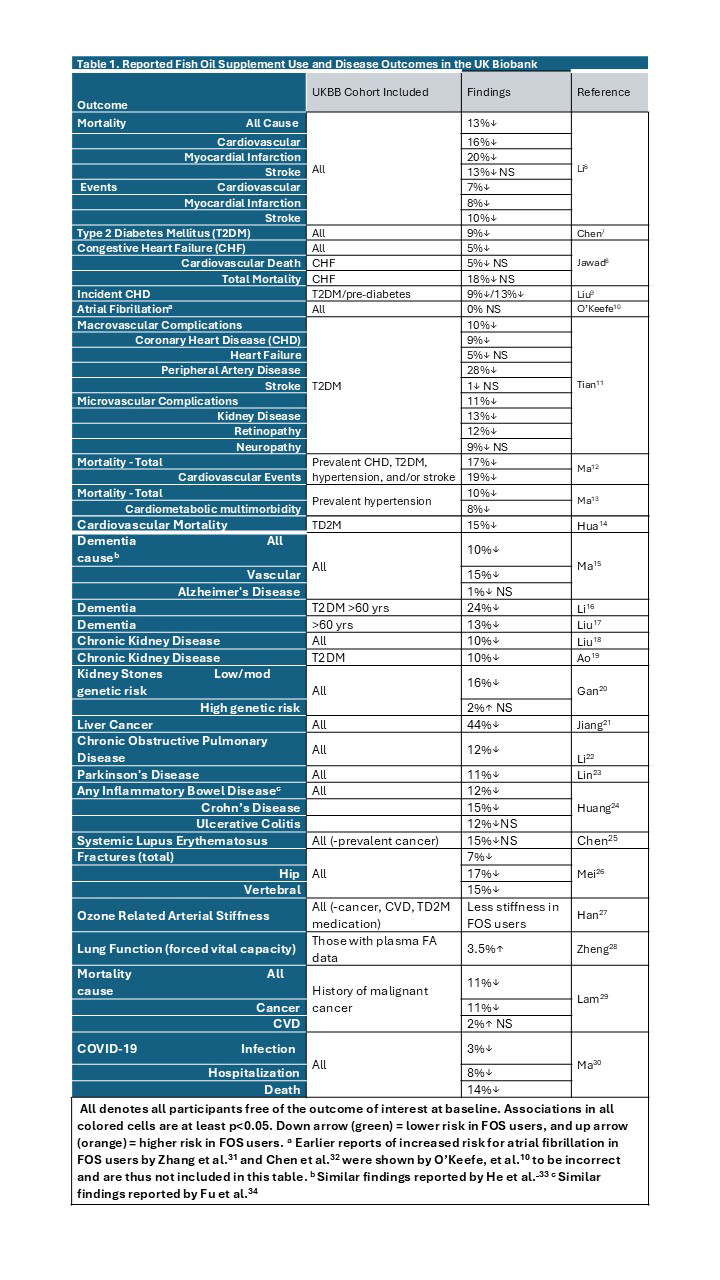
Abstract Body (Do not enter title and authors here): Introduction: Recent headlines citing UK Biobank (UKBB) data (Chen et al. BMJ-Med 2024;3:e000451) reported that fish oil supplement (FOS) use increased risk for atrial fibrillation (AF) in the general population. This was consistent with the findings of meta-analyses of several randomized trials using high doses of pharmaceutical omega-3 products in high-risk cardiovascular patients. Together, these data raised concerns that FOS use may not be as innocuous as long believed. Methods: We undertook a re-analysis of the FOS-AF UKBB study, and in addition, surveyed the wider literature on published associations between reported FOS use in the UKBB and risk for a wide variety of diseases. Results: A re-analysis of Chen et al. found statistical flaws which, when corrected, revealed no relationship between FOS use and AF risk. Beyond these studies, we identified 25 additional UKBB studies examining the associations between FOS use (Table 1) and incident diseases. Collectively, these studies reported 54 FOS–disease associations, 42 of which were statistically significant and favorable for FOS use. No statistically significant adverse associations were reported. Among the outcomes favorably associated with FOS use were incident CVD, myocardial infarction, heart failure, CHD in patients with type 2 diabetes mellitus, dementia, chronic kidney disease, liver cancer, kidney stones, fractures, Parkinson’s disease, inflammatory bowel disease, ozone-related lung dysfunction, COVID-19 infection and mortality – all cause, CVD, and cancer. Conclusions: Acknowledging that reported FOS use is a crude measure of omega-3 fatty acid exposure and that associations do not infer causation, these findings, all of which were derived from multi-variable adjusted models, nevertheless support the hypothesis that chronic FOS use by the general population is not only safe, but may reduce risk for a wide variety of human ailments, many of which are tied to chronic inflammation. The associations across virtually all body systems suggest that higher (vs lower) omega-3 fatty acid levels are biologically active, not simply a marker of a “healthy lifestyle.”
Harris, William
(
Fatty Acid Research Institute
, Sioux Falls , South Dakota , United States )
Abuknesha, Nada
(
Fatty Acid Research Institute
, Sioux Falls , South Dakota , United States )
Author Disclosures:
William Harris:DO have relevant financial relationships
;
Ownership Interest:OmegaQuant Analytics, LLC:Active (exists now)
| Nada Abuknesha:DO NOT have relevant financial relationships
Ali Muhammad Faizan, Khan Muhammad, Sharif Aleena, Hossain Mohammad, Ahmad Husnain, Eltawansy Sherif, Faizan Muhammad, Ahmed Ashraf, Abdul Malik Mohammad Hamza Bin, Pahwani Ritesh, Patel Rahul, Mehdi Hassan