Long-Term Efficacy and Safety of a Novel Low-Dose Triple Single-Pill Combination for the Treatment of Hypertension
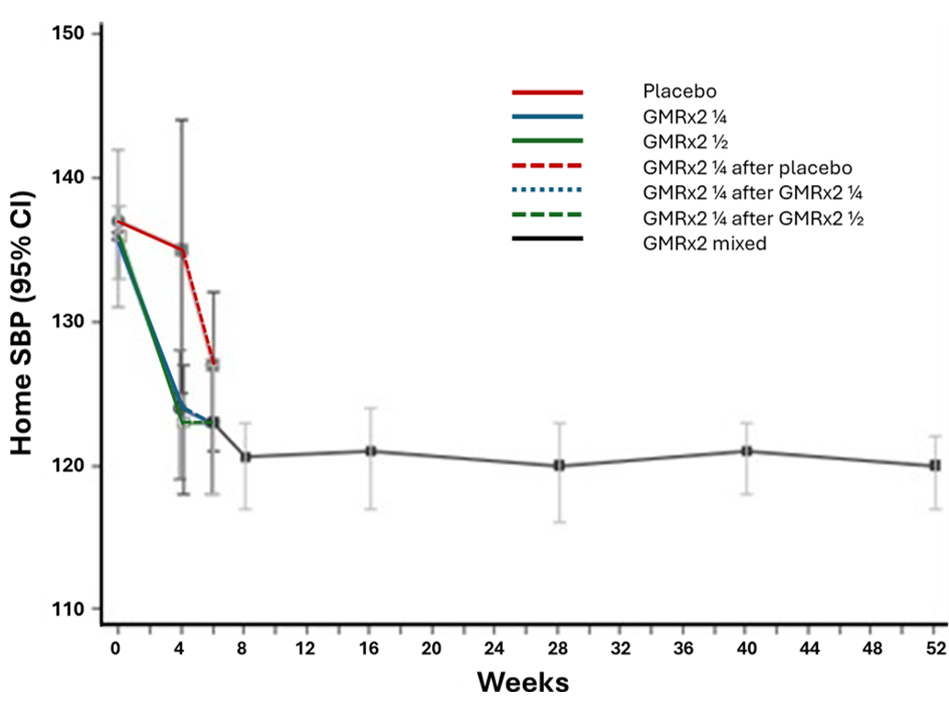
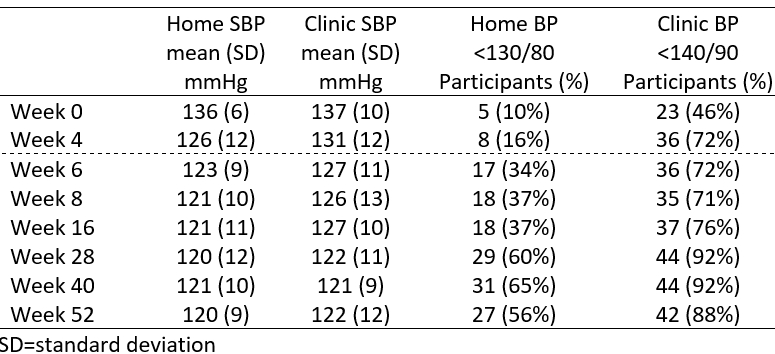
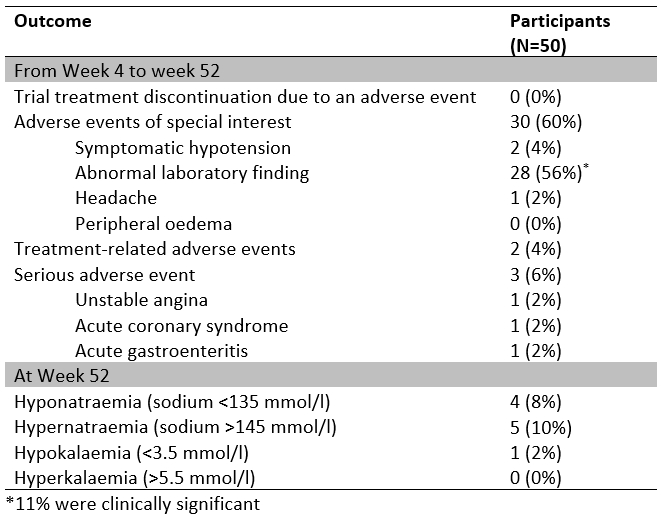
Abstract Body (Do not enter title and authors here): Background A new low-dose triple single-pill combination (SPC) of antihypertensive drugs (GMRx2, in three strengths: ¼, ½, and standard, containing telmisartan/amlodipine/indapamide [10/1.25/0.625 mg, 20/2.5/1.25 mg, and 40/5/2.5 mg]) has demonstrated superior blood pressure (BP)-lowering efficacy compared to placebo and dual combinations in double-blind, short-term trials. Objectives To evaluate the long-term BP-lowering efficacy and safety of GMRx2-based treatment for BP lowering when used in usual clinical care. Methods After a 4-week double-blind placebo-controlled randomized phase, participants from Sri Lanka and Nigeria were enrolled into an open-label extension (OLE) phase with follow-up to one year. The randomized phase compared GMRx2 ¼ dose vs. GMRx2 ½ dose vs. placebo in a 2:2:1 ratio. In the OLE phase, participants were switched to GMRx2 ¼, then, if needed, up-titrated to higher doses of GMRx2, and then by the addition of telmisartan 40 mg and amlodipine 5 mg SPC, and finally the addition of spironolactone 25 mg to achieve a target home BP <130/80 mmHg. The primary outcome was the percentage of participants with home BP control (<130/80 mmHg) at week 52. Results From 21 August 2023 to 20 August 2024, 50 participants participated in the OLE phase, of whom 48 (96%) completed it. The mean age of participants was 49 years, and 60% were female. At baseline entry to the randomized phase, with all participants on no active treatment, mean home and clinic BP levels were 137/85 mmHg and 136/85 mmHg. At entry to the OLE phase, with 4/5 of the participants receiving treatment, baseline mean home and clinic BP were 129/79 mmHg and 131/83 mmHg, respectively. Mean home BP was reduced to 121/78 mmHg 4 weeks into the OLE and was 120/78 at week 52 (Figures 1 and 2). For clinic BP, the corresponding values were 126/79 mmHg and 122/77 mmHg. At one year, home BP control (<130/80 mmHg) was 56%, and clinic BP control (<140/90 mmHg) was 88%. At week 52, the proportions of participants receiving GMRx2 ¼, GMRx2 ½, and GMRx2 standard doses were 53%, 27%, and 22%, respectively, and only three (6%) participants required add-on therapy. Tolerability was good (Figure 3), and none of the participants discontinued trial treatment due to an adverse event. Conclusions In a population with mild-to-moderate hypertension, long-term therapy with GMRx2-based treatment achieved high levels of sustained BP control out to one year, with good tolerability and low treatment discontinuation.
Rodgers, Anthony
(
The George Institute for Global Health
, Newtown , New South Wales , Australia )
Author Disclosures:
Anthony RODGERS:DO have relevant financial relationships
;
Other (please indicate in the box next to the company name):George Medicines Pty Ltd:Active (exists now)
Jiang Chao, Dong Jianzeng, Cai Jun, Anderson Craig, Du Xin, Tang Yangyang, Han Rong, Song Yanna, Wang Chi, Lin Xiaolei, Yi Yang, Rodgers Anthony, Ma Changsheng