Patient-Level Factors Associated with Frequent, Intense, and Nocturnal Lower Extremity Pain Experience Prior Revascularization in Patients with Chronic Limb-Threatening Ischemia
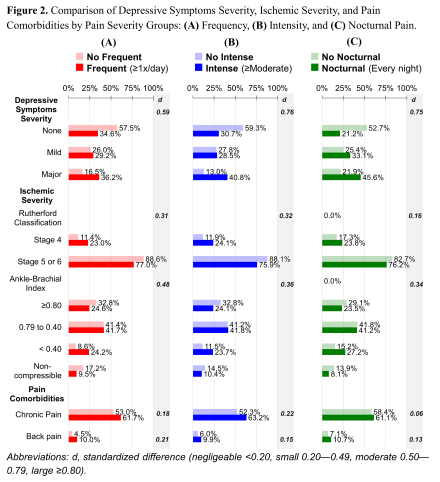
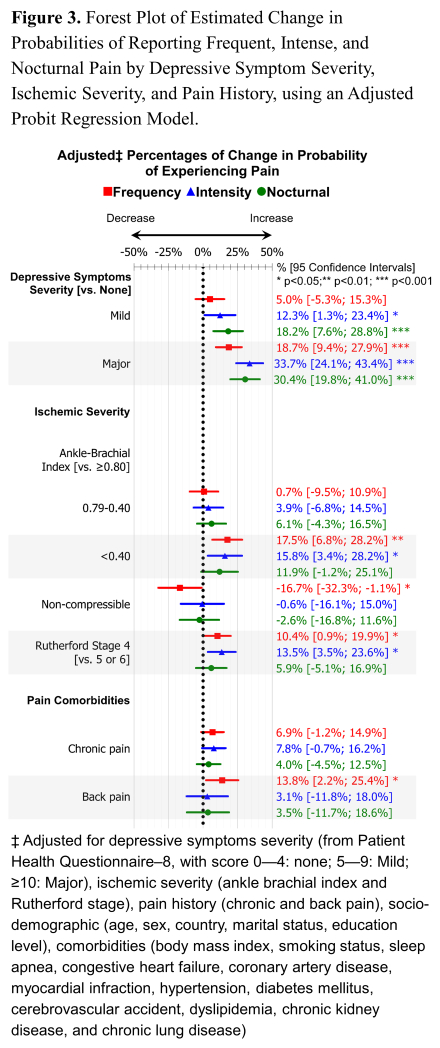
Abstract Body (Do not enter title and authors here): Background: Pain is a primary symptom of chronic limb-threatening ischemia (CLTI), yet its association with patient-level factors is unclear. Identifying the key characteristics of pain in CLTI may guide personalized pain management. Hypothesis: The frequency, intensity, and amount of nocturnal pain in CLTI correlate with depressive symptoms, ischemic severity, and other pain comorbidities. Methods: Patients with CLTI were enrolled in the SCOPE-CLI registry at 13 U.S. and Australian centers (11/2020–04/2024). Pain severity—frequency, intensity, nocturnal pain—was derived from the Peripheral Artery Questionnaire. Patient characteristics, encompassing depressive symptoms, ischemic severity (ABI and Rutherford), pain comorbidities (duration, and back pain), were compared across pain severity groups using standardized difference (d: negligible <0.20, small 0.20—0.49, moderate 0.50—0.79, large ≥0.80). An adjusted multivariate probit model, accounting for correlations between pain severity groups, examined the probabilities of experiencing pain for each severity group by patient characteristics. Results: Of 462 patients (mean age 68.1±10.1 years; 32.5% female), 71.4% reported frequent pain, 63.6% intense pain, and 36.4% nocturnal pain, with 20.3% reported neither (Figure 1). Most of the patients faced depressive symptoms, ankle-brachial index ≥0.40, Rutherford stage 5, and had chronic pain (≥6 months) (58.8%, 68.7%, 73.4%, and 59.4%, respectively). Those with (vs. without) frequent, intense, or nocturnal pain more likely to exhibit major depressive symptoms (36.2%, 40.8%, 45.6% vs. 16.5%, 13.0%, 22.0%, respectively; d=0.59 to 0.76), while other characteristics, including ischemic severity and pain comorbidities, showed negligeable-to-small differences (all d≤0.50, Figure 2). Probability of worsening pain increased highly with major depressive symptoms (frequent +20% [95% confidence interval: 9–28]), intense +34% [24–43], nocturnal +30% [20–41]). ABI≤0.40 and Rutherford stage 4 were modestly associated with increased probabilities of frequent and intense pain (+10.4% [0.9–19.9] to +17.5% [6.8–28.2], all p<0.001; Figure 3). Conclusion: Nearly 80% of patients with CLTI report frequent, intense, or nocturnal pain, most of which is chronic. Pain severity, along with ischemic severity, is strongly associated with depressive symptoms. These findings highlight the need for further research into multimodal pain management strategies for CLTI.
Romain, Gaelle
(
Yale School of Medicine
, Branford , Connecticut , United States )
Mena-hurtado, Carlos
(
Yale School of Medicine
, Branford , Connecticut , United States )
Tehan, Peta
(
School of Clinical Sciences, Faculty of Medicine, Monash University
, Clayton , Victoria , Australia )
Vashist, Aseem
(
Yale School of Medicine
, Branford , Connecticut , United States )
Smolderen, Kim
(
Yale University
, New Haven , Connecticut , United States )
Author Disclosures:
Gaelle Romain:DO NOT have relevant financial relationships
| Carlos Mena-Hurtado:DO have relevant financial relationships
;
Consultant:Novonordisk:Active (exists now)
; Consultant:Terumo:Active (exists now)
| Peta Tehan:DO NOT have relevant financial relationships
| Aseem Vashist:No Answer
| Kim Smolderen:DO have relevant financial relationships
;
Employee:Yale University:Active (exists now)
; Ownership Interest:BoboDream LLC:Active (exists now)
; Consultant:Novo Nordisk:Active (exists now)
; Consultant:Merck:Active (exists now)
; Consultant:Terumo:Active (exists now)
; Consultant:Happify:Active (exists now)