Disparities and Trends of Myocardial Infarction-Associated Hospitalizations in the United States
Abstract Body (Do not enter title and authors here): Background: Cardiovascular disease is one of the leading causes of hospitalizations in the United States. However, the prevalence of those hospitalized due to myocardial infarction (MI) amongst different demographics remains largely unexplored.
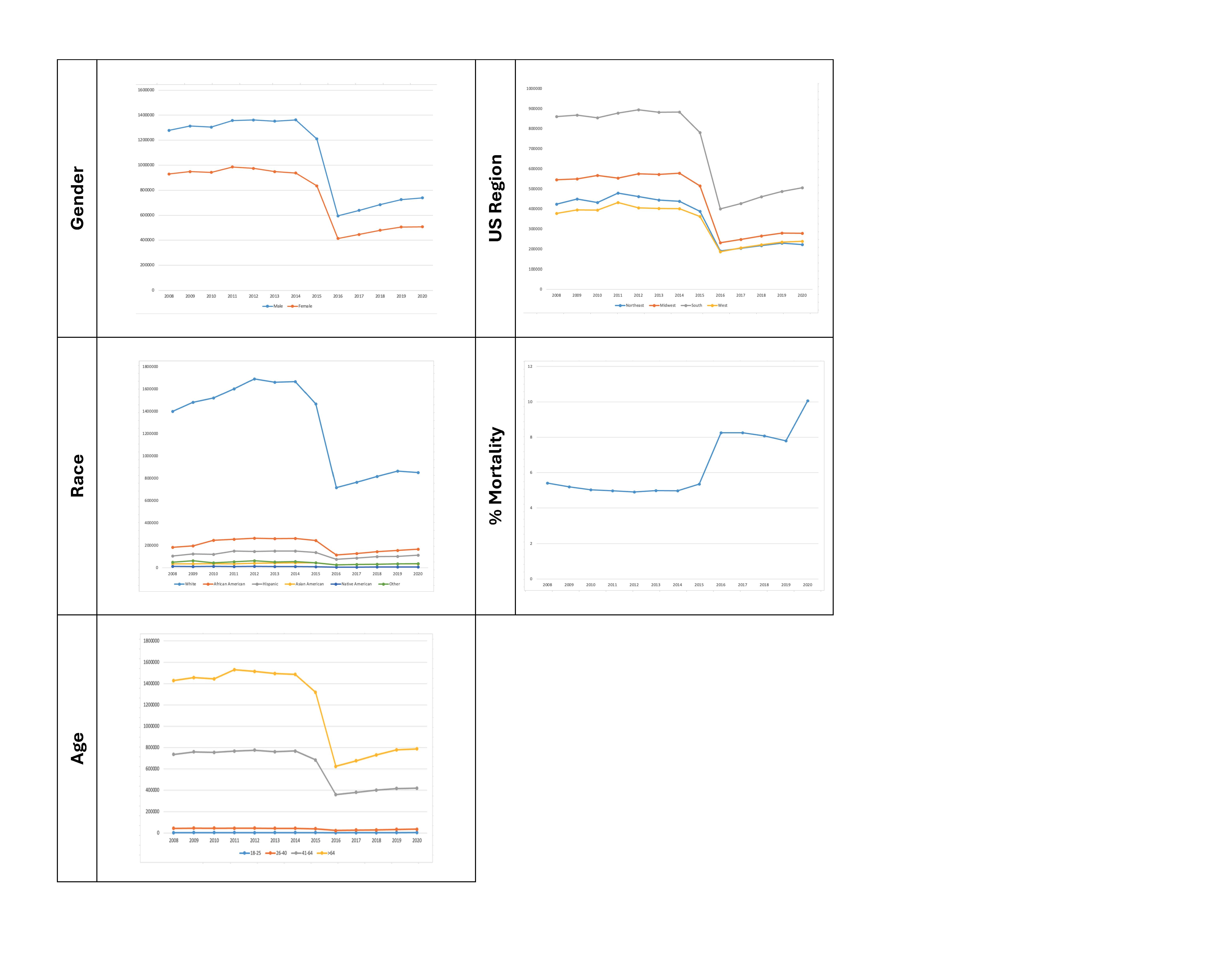
Objective: To evaluate trends and demographic disparities in myocardial infarction hospitalizations in the United States, with a focus on differences by sex, race/ethnicity, age group, geographic region, and in-hospital mortality. Methods: Cross-sectional data of MI-related hospitalizations for US adults from 2008-2020 were analyzed using ICD9 and ICD10 code-based records of hospital admissions. An MI related hospitalization is defined with any of the following codes for acute MI or old MI: 410,412 (ICD9) or I21, I22, I25.2 (ICD10). National estimates were generated using sampling weights. Linear trend analysis and Cochran-Armitage trend tests assessed annual changes. Subgroup analyses were conducted by sex, race/ethnicity, age, region, and mortality status. Results: From 2008 to 2020, myocardial infarction hospitalizations in the U.S. declined by 44%. Male and female admissions decreased by approximately 42% and 45%, respectively (p<0.01). Racial disparities were evident, with MI hospitalizations decreasing by 39% among White patients (p<0.01) and 9% among African American patients (p<0.01), while increasing by 6% among Hispanic individuals (p=0.16). Age-wise, MI admissions rose by 52% in the 18–25 group ((p=0.29)) and 17% in the 26–40 group (p<0.01), but declined significantly among those aged 41–64 (43% decrease, p<0.01) and 65+ (45% decrease) (p<0.01). Regionally, the Midwest and Northeast experienced the steepest declines (49% and 47%, respectively, p<0.01), followed by the South 41% (p<0.01) and West 37% (p<0.01). In-hospital mortality rose by 5% (p=0.09), despite the overall decline in MI admissions.
Conclusions: Despite cardiovascular disease affecting such a large proportion of United States citizens, hospitalizations due to MI effects have decreased in prominence from 2008-2020. Those that are male, white, >64 years old, and from the South make up the largest demographic of those affected, aligning with the basis that risk of MI is increased with lifestyle and aging factors. Even though hospitalizations reached a low in 2020, percent mortality is higher than in 2008, indicating increased severity of MIs that do require hospitalization.
Brooke, Scardino
(
LSU Health Shreveport
, Shreveport , Louisiana , United States )
Bhuiyan, Md Shenuarin
(
LSU Health Shreveport
, Shreveport , Louisiana , United States )
Conrad, Steven
(
LSU Health Shreveport
, Shreveport , Louisiana , United States )
Vanchiere, John
(
LSU Health Shreveport
, Shreveport , Louisiana , United States )
Orr, Wayne
(
LSU HEALTH SCIENCES CENTER
, Shreveport , Louisiana , United States )
Kevil, Chris
(
LSU HEALTH SHREVEPORT
, Shreveport , Louisiana , United States )
Bhuiyan, Mohammad
(
LSU Health Shreveport
, Shreveport , Louisiana , United States )
Author Disclosures:
Scardino Brooke:DO NOT have relevant financial relationships
| Md Shenuarin Bhuiyan:DO NOT have relevant financial relationships
| Steven Conrad:DO NOT have relevant financial relationships
| John Vanchiere:DO have relevant financial relationships
;
Research Funding (PI or named investigator):Pfizer:Active (exists now)
; Research Funding (PI or named investigator):Innoviva/Tetraphase:Active (exists now)
; Research Funding (PI or named investigator):Enanta:Active (exists now)
; Research Funding (PI or named investigator):Biocryst:Active (exists now)
; Research Funding (PI or named investigator):ExThera:Active (exists now)
; Research Funding (PI or named investigator):Merck:Active (exists now)
| Wayne Orr:DO NOT have relevant financial relationships
| Chris Kevil:No Answer
| Mohammad Bhuiyan:DO NOT have relevant financial relationships