Internet Addiction and Early-Life Risk Indicators for Cardiometabolic and Mental Health Disorders
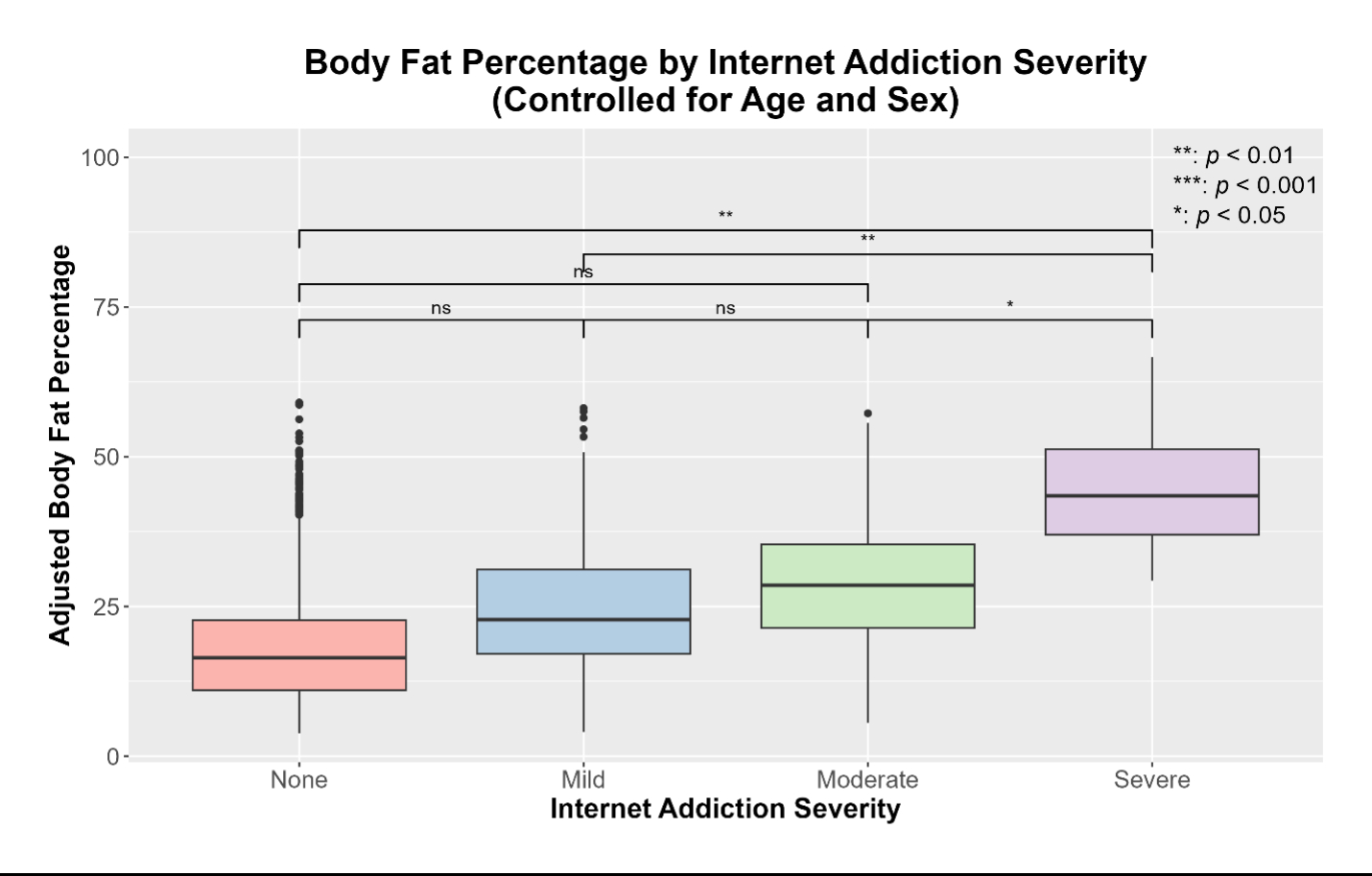
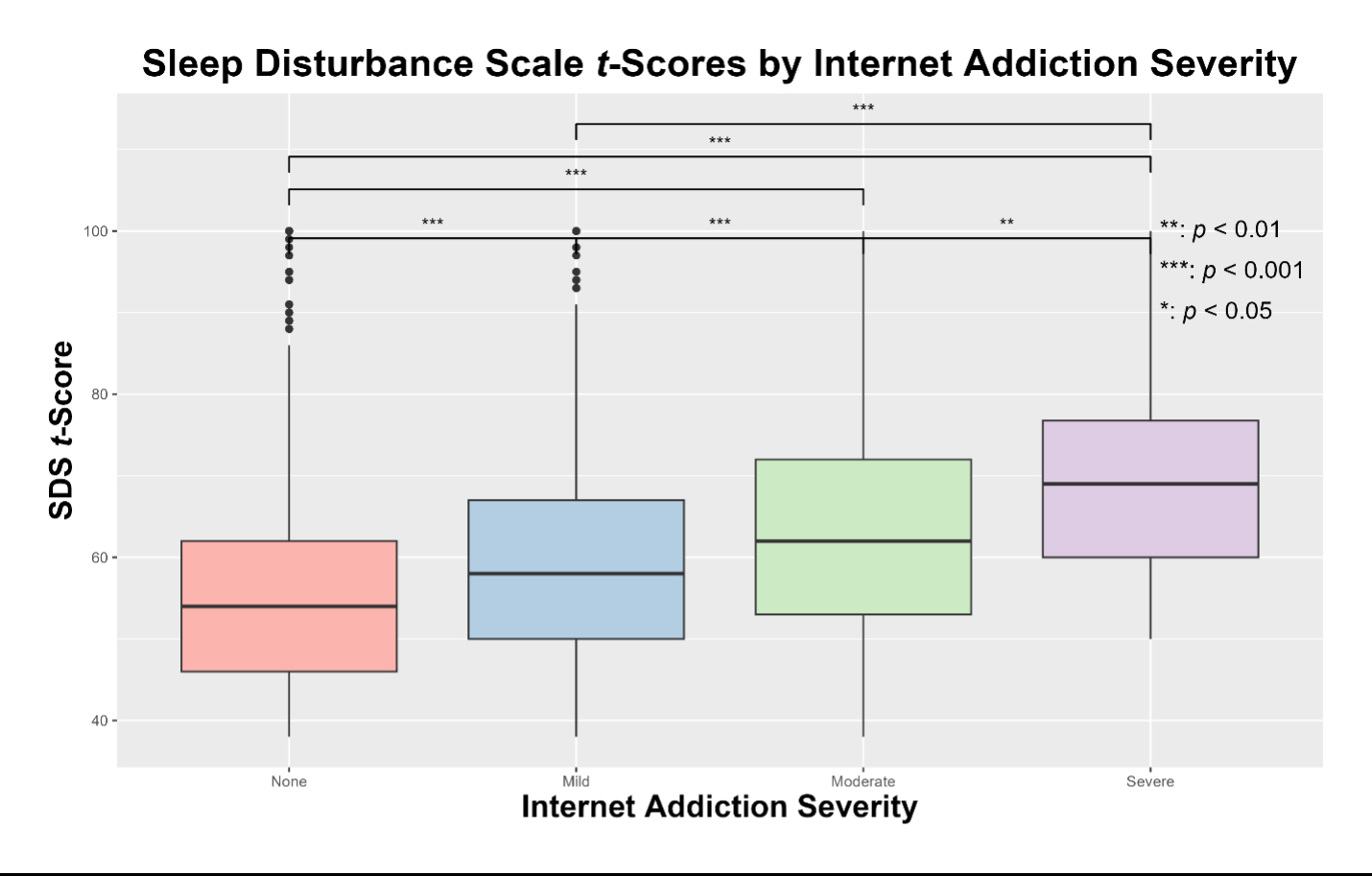
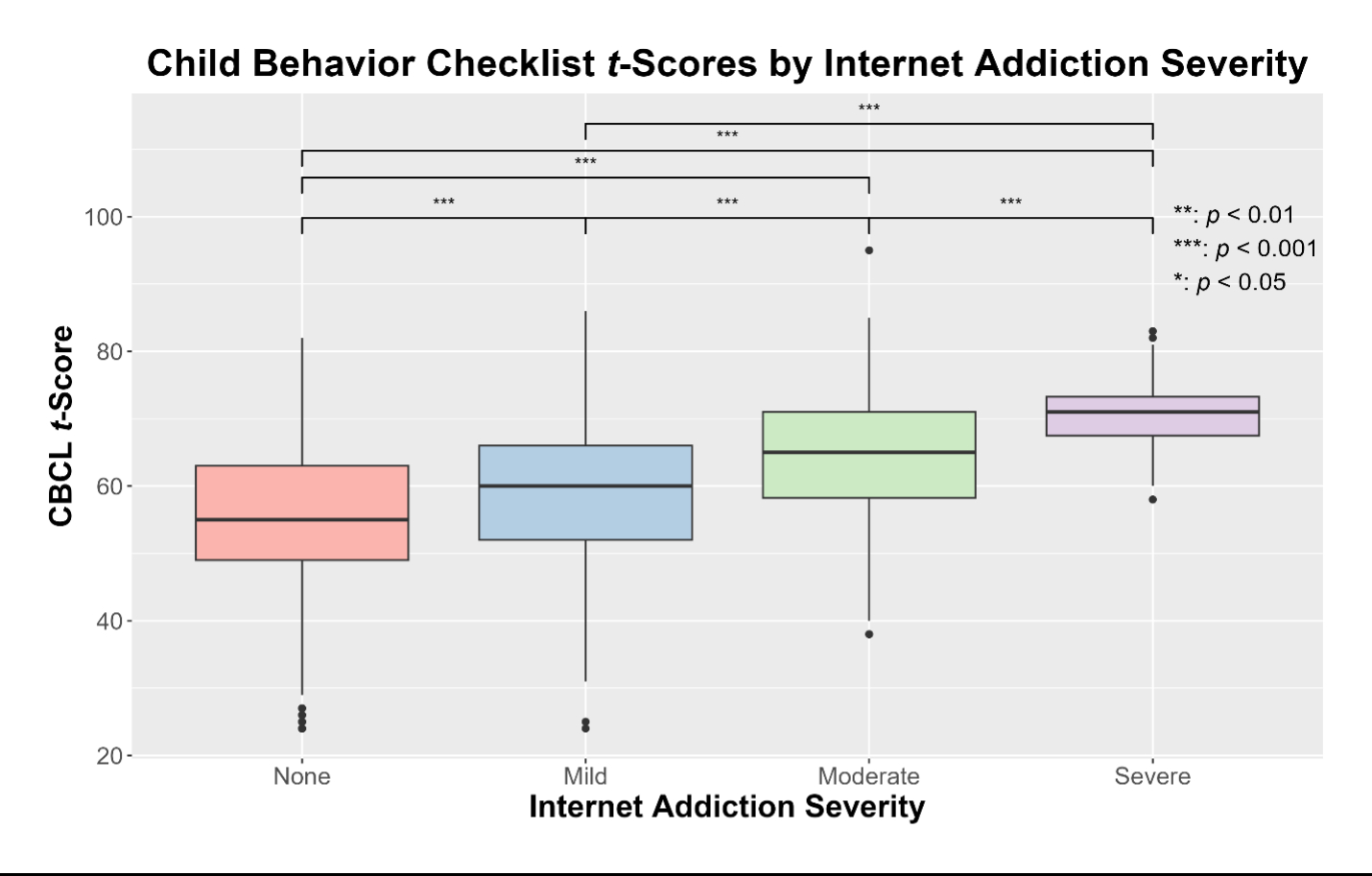
Abstract Body (Do not enter title and authors here): Background 94% of US adolescents ages 9-18 experience internet use (IU), averaging 5-7 hours of entertainment use daily. Studies have linked IU and internet addiction (IA) to obesity, poor sleep, and mental health disorders, but few studies have synthesized the impact of IA on mental, cognitive, and physical health, especially in adolescence—a period when behaviors that shape long-term cardiometabolic health are established. This study assesses the impact of IA on mental and physical health, using Body Mass Index (BMI) percentile and body fat percentage (BFP) to measure adolescent obesity more accurately. Hypothesis We hypothesize that increasing IA will negatively impact adolescent health. Methods We selected Healthy Brain Network study participants with an available parent-child internet addiction test (PCIAT) result (n=4,260), assigning none, mild, moderate, or severe categories of IA severity (IAS). Outcomes included BMI percentile, BFP (via bioelectric impedance analysis), sleep disturbance scale (SDS) t-score, and Child Behavior Checklist (CBCL) t-score (measures behavioral, emotional, and social function). ANCOVA models adjusted for age and sex followed by Tukey-adjusted pairwise comparisons were used to compare outcomes among IAS groups. Results Participants (mean age 10.2) were 64% male, 54% White, 13% Black, 9.3% Hispanic, 3.1% Asian, 0.9% Native American/Alaskan Native, 17% multiracial, 1.6% other race, and 0.5% unknown. Severe IA was associated with higher BMI percentile (75th vs. 62nd, p<0.05) and significantly higher BFP (45%) than none (18%, p<0.01), mild (24%, p<0.01), and moderate (29%, p<0.05) (Image 1). SDS t-scores (Image 2) worsened with increasing IAS—56 (none), 59 (mild), 63 (moderate), and 70 (severe), with all comparisons significant (p<0.001, except moderate vs. severe: p<0.01). CBCL t-score (Image 3) progressively worsened with IAS: 56 (none), 59 (mild), 64 (moderate), and 71 (severe), with all comparisons significant (p<0.001). Conclusion Our findings highlight the negative impact of IA during a critical developmental period. Sleep patterns, behavior, and obesity in youth often remain in adulthood, increasing long-term cardiovascular risk. Severe IA was associated with higher BMI percentile and a stepwise increase in BFP with increasing IAS. IA also worsened sleep, behavior, and mental health, with higher SDS and CBCL scores with increasing IAS. Future studies should examine different types of IU and long-term impact.
Xing, Diensn
(
LSU Health Shreveport
, Shreveport , Louisiana , United States )
Laird, Colin
(
LSU Health Shreveport
, Shreveport , Louisiana , United States )
Bhuiyan, Md Shenuarin
(
LSU Health Shreveport
, Shreveport , Louisiana , United States )
Rom, Oren
(
LSU Health Shreveport
, Shreveport , Louisiana , United States )
Orr, Wayne
(
LSU HEALTH SCIENCES CENTER
, Shreveport , Louisiana , United States )
Conrad, Steven
(
LSU Health Shreveport
, Shreveport , Louisiana , United States )
Vanchiere, John
(
LSU Health Shreveport
, Shreveport , Louisiana , United States )
Kevil, Chris
(
LSU HEALTH SHREVEPORT
, Shreveport , Louisiana , United States )
Bhuiyan, Mohammad
(
LSU Health Shreveport
, Shreveport , Louisiana , United States )
Author Disclosures:
Diensn Xing:DO have relevant financial relationships
;
Individual Stocks/Stock Options:United Healthcare:Active (exists now)
| Colin Laird:DO NOT have relevant financial relationships
| Md Shenuarin Bhuiyan:DO NOT have relevant financial relationships
| Oren Rom:No Answer
| Wayne Orr:DO NOT have relevant financial relationships
| Steven Conrad:DO NOT have relevant financial relationships
| John Vanchiere:DO have relevant financial relationships
;
Research Funding (PI or named investigator):Pfizer:Active (exists now)
; Research Funding (PI or named investigator):Innoviva/Tetraphase:Active (exists now)
; Research Funding (PI or named investigator):Enanta:Active (exists now)
; Research Funding (PI or named investigator):Biocryst:Active (exists now)
; Research Funding (PI or named investigator):ExThera:Active (exists now)
; Research Funding (PI or named investigator):Merck:Active (exists now)
| Chris Kevil:No Answer
| Mohammad Bhuiyan:DO NOT have relevant financial relationships