
Peripheral Oxygen Extraction Is Impaired in Adults with Fontan Circulation
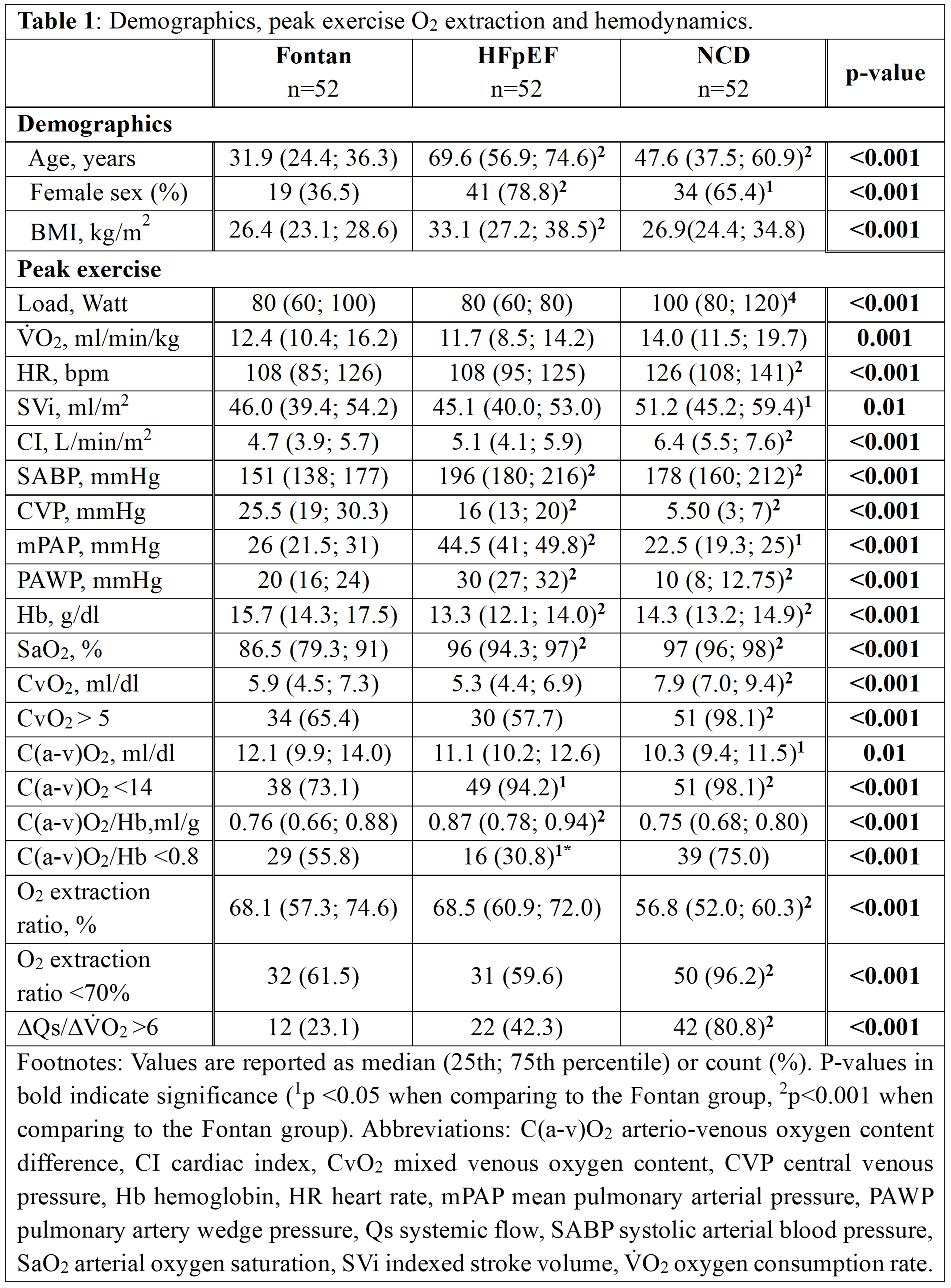
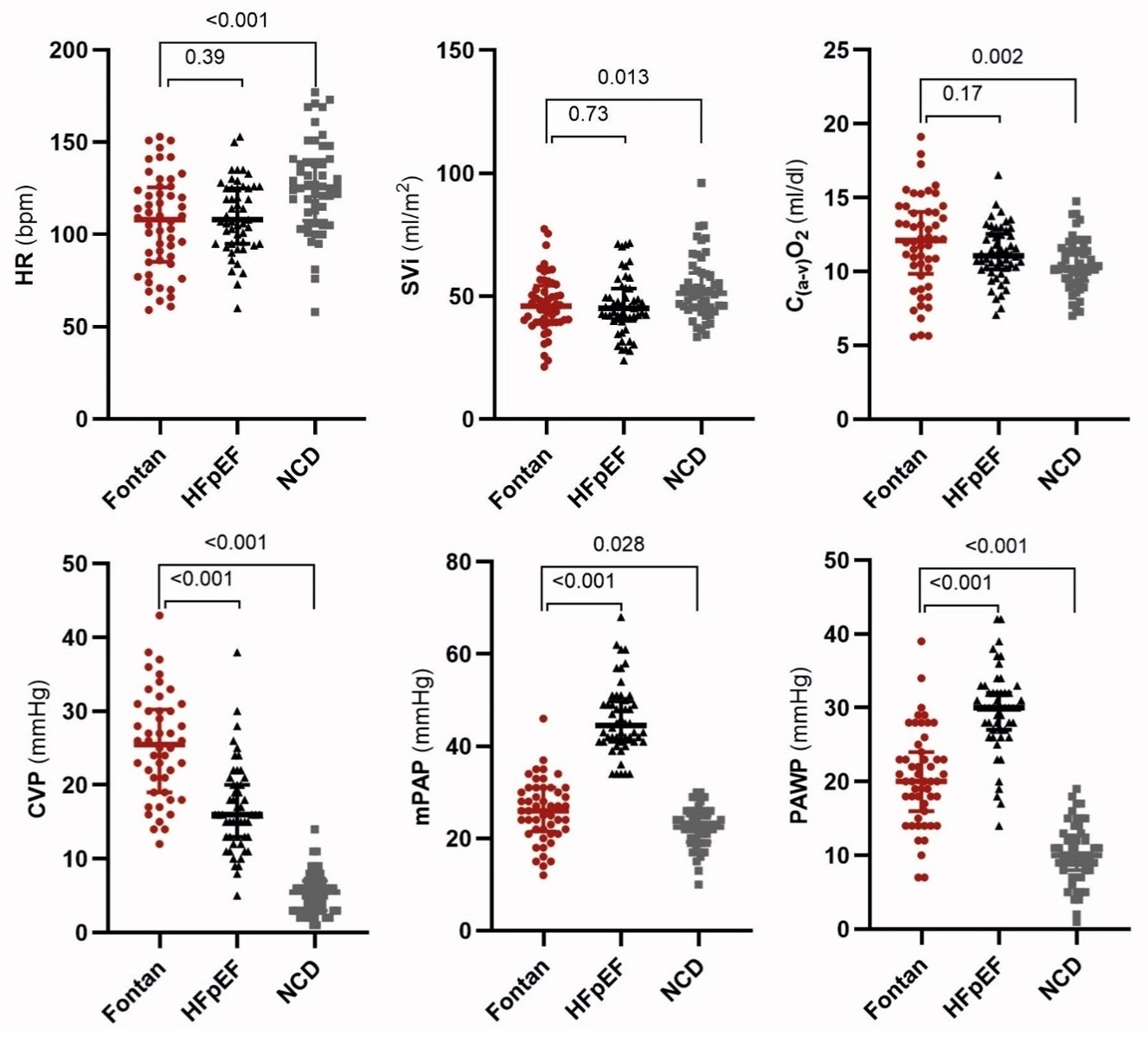
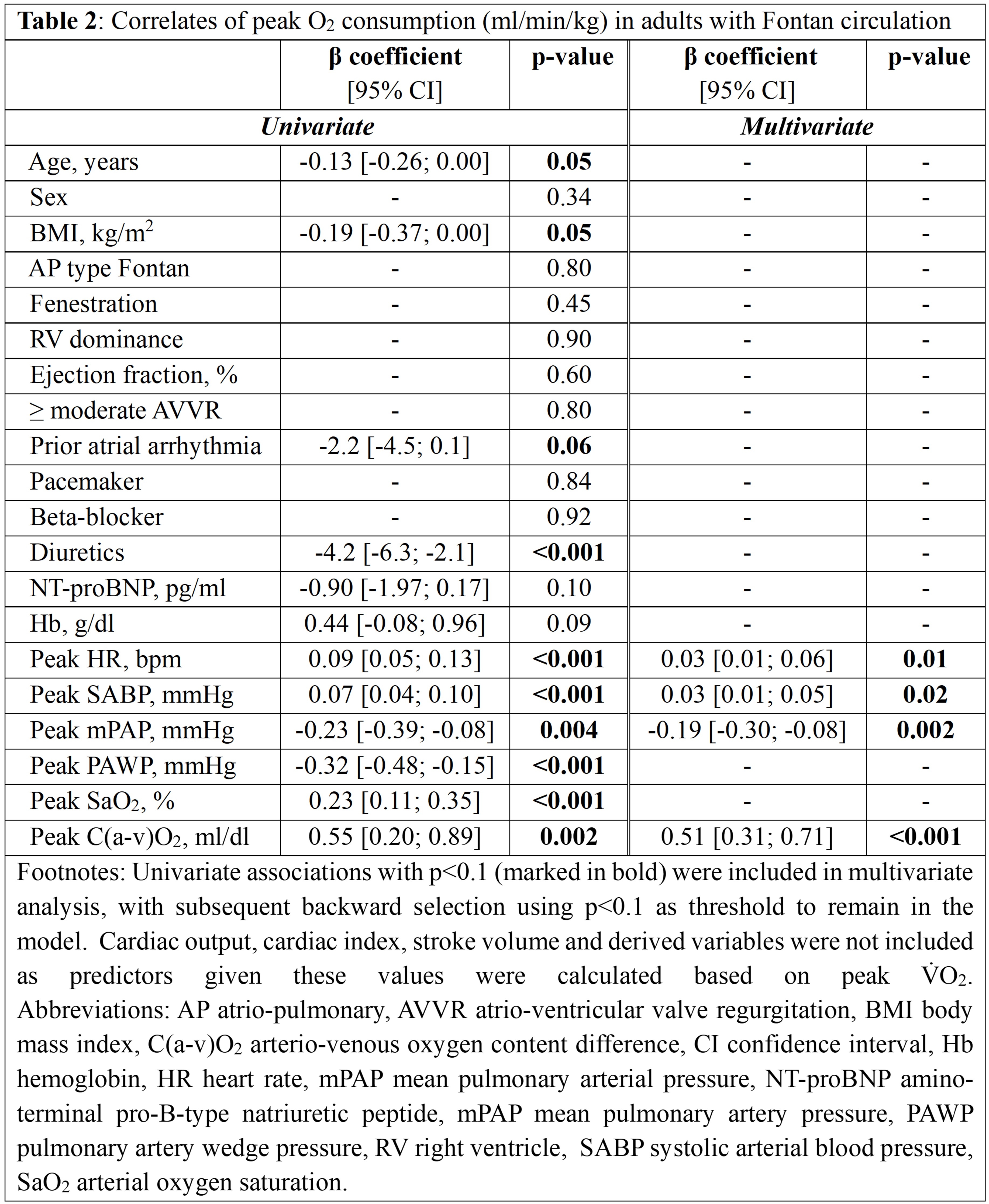
Abstract Body (Do not enter title and authors here): Background: Fontan circulation is characterized by the absence of a subpulmonary ventricle with resultant systemic venous hypertension. Despite exercise intolerance being nearly universal in this population, the determinants of exercise capacity in this population are still poorly understood. Research question: We investigated the prevalence of peripheral impairment and assessed the contribution of peripheral O2 extraction versus central hemodynamics to peak O2 consumption (pVO2) post-Fontan palliation. Methods: This single-center retrospective cross-sectional study compared 52 consecutive adults post-Fontan procedure who underwent exercise catheterization to patients with heart failure with preserved ejection fraction (HFpEF) and non-cardiac dyspnea (NCD) at 1:1 ratio. Several previously reported measures for peripheral O2 extraction were evaluated in the absence of a golden standard. Correlates of pVO2 were identified by multivariate linear regression analyses using the backward selection method. Results: Patients with Fontan circulation were younger [age 32 (24;36) years] and tended to have a lower body mass index [26 (23; 29) kg/m2] compared to patients with HFpEF [70 (57; 75) years, p<0.001 and 33 (27; 39) kg/m2, p<0.001] and NCD [48 (38; 61) years, p<0.001 and 27 (24; 35) kg/m2, p=0.08]. Peak heart rate [108 (85;126) vs 108 (95;125) bpm] and indexed stroke volume [46 (39;54) vs 45 (40;53) ml/m2] were similar in the Fontan and HFpEF groups but lower compared to NCD [126 (108;141) bpm, p<0.001 and 51 (45;59) ml/m2, p<0.001]. Peak mean pulmonary artery pressures were highest in HFpEF [45 (41;50) mmHg, p<0.001], followed by Fontan and NCD [26 (22;31) vs 23 (19;25) mmHg, p=0.03]. Median peak O2 extraction post-Fontan was comparable to HFpEF [12 (10;14) vs 11 (10;13) ml/dl, p=0.17] but higher than in NCD [10 (9;12) ml/dl, p<0.001]. It was <14 ml/dl in 73% compared to 94% and 98% of patients with HFpEF and NCD [p<0.001]. O2 extraction ratio was <70% in 62% compared to 60% in HFpEF and 96% in NCD [p<0.001]. Correlates of pVO2 post-Fontan were peak O2 extraction [β 0.5±0.1 per ml/dl; p<0.001], mean pulmonary artery pressures [β -0.2±0.05 per mmHg; p=0.002], heart rate [β 0.03±0.01 per bpm; p=0.01], and systolic arterial blood pressure [β 0.03±0.01 per mmHg; p=0.02]. Conclusion: Impaired O2 extraction is prevalent amongst adults post-Fontan. Whether exercise can modulate this important determinant of exercise capacity post-Fontan merits further investigation.
Van Belle, Hannah
(
Mayo Clinic
, Rochester , Minnesota , United States )
Van De Bruaene, Alexander
(
UZ Leuven
, Leuven , Belgium )
Jain, C.
(
Mayo Clinic
, Rochester , Minnesota , United States )
Reddy, Yogesh
(
Mayo Clinic
, Rochester , Minnesota , United States )
Egbe, Alexander
(
Mayo Clinic
, Rochester , Minnesota , United States )
Larson, Kathryn
(
Mayo Clinic
, Rochester , Minnesota , United States )
Budts, Werner
(
UZ Leuven
, Leuven , Belgium )
Connolly, Heidi
(
Mayo Clinic
, Rochester , Minnesota , United States )
Miranda, William
(
Mayo Clinic
, Rochester , Minnesota , United States )
Author Disclosures:
Hannah Van Belle:DO NOT have relevant financial relationships
| Alexander Van De Bruaene:No Answer
| C. Jain:No Answer
| Yogesh Reddy:DO NOT have relevant financial relationships
| Alexander Egbe:No Answer
| Kathryn Larson:No Answer
| Werner Budts:No Answer
| Heidi Connolly:DO NOT have relevant financial relationships
| William Miranda:DO NOT have relevant financial relationships
Vijayakumar Keerthika, Miranda William, Hortegal Renato, Amir Rawan, Egbe Alexander, Anderson Jason, Reddy Yogesh, Jain C., Connolly Heidi, Madhavan Malini