Logo

American Heart Association

  16
  0


Final ID: MP2067

Evaluating ChatGPT as a Patient Education Tool for Cardiovascular Medications: High Quality, Low Accessibility

Abstract Body (Do not enter title and authors here): Introduction: Cardiovascular diseases (CVDs) are the leading cause of death globally, yet medication nonadherence remains high. Artificial intelligence (AI) tools may help improve adherence by counseling patients about their medications. However, concerns about usability and general mistrust of AI-generated health content remain. Assessing AI responses to common patient questions can inform future patient education strategies.
Research Question: How does ChatGPT perform in accuracy, completeness, and readability when responding to patient questions about medications used for CVDs?
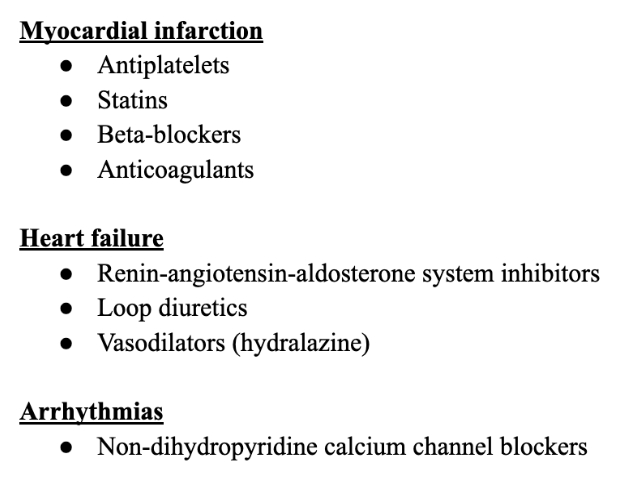
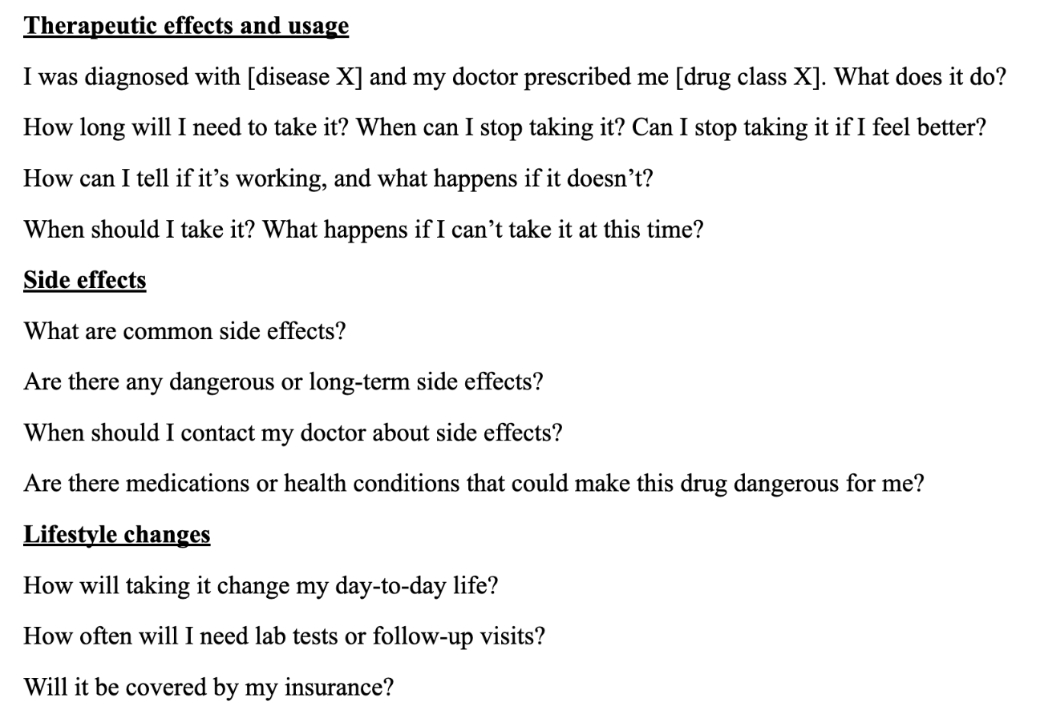
Methods: A standardized set of 11 questions was developed across three categories: therapeutic effects/usage, side effects, and lifestyle changes (Figure 1). Questions were sequentially input into ChatGPT-4o for commonly prescribed CVD drug classes (Figure 2). The AI-generated responses were compiled into a Qualtrics survey and evaluated independently by an internal medicine attending, a board-certified cardiologist, and a cardiac ICU pharmacist. Each rated accuracy and completeness on an 8-point Likert scale (1 = “not at all accurate/complete”; 8 = “extremely accurate/complete”). Flesch-Kincaid Grade Level and Reading Ease scores were calculated to provide accuracy-independent metrics of response quality. Group-wise comparisons evaluated differences in accuracy, completeness, and readability between categories.
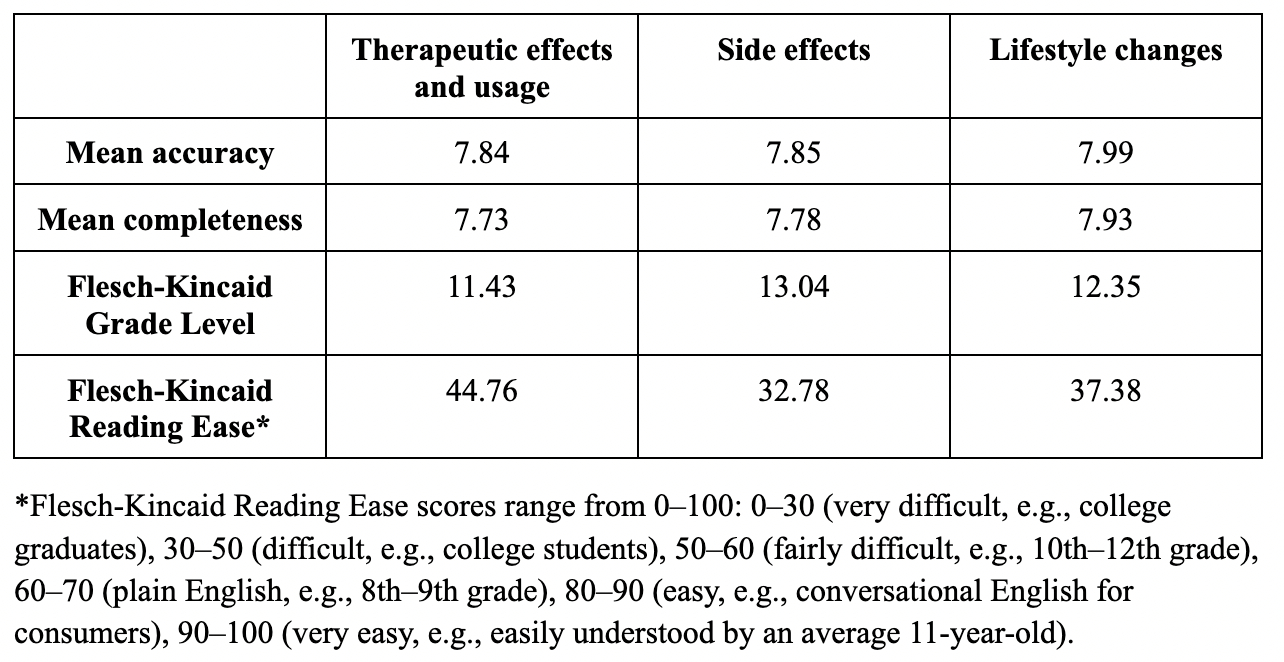
Results: ChatGPT-generated responses were rated highly for accuracy (mean = 7.89) and completeness (mean = 7.80) across all questions (Table 1). However, the average reading level was at college-grade, far above the recommended 6th-8th grade level for patient materials, indicating a mismatch with typical health literacy levels and poor overall readability. Category-specific analyses yielded that questions regarding therapeutic effects/usage were significantly easier (p< .001) to read than those on side effects or lifestyle changes, potentially due to the relatively subjective nature of the latter two categories. Reviewers also noted key features missing from some responses, including pre-procedural medication counseling, dosing guidance, and layperson-friendly language.
Conclusion: ChatGPT responses were overall considered accurate and complete, but low readability scores suggest the information may be inaccessible for the average patient. Future AI tools should prioritize plain language and patient-centered design to enhance accessibility without sacrificing content quality.
  • Agarwal, Rishab  ( Albert Einstein College of Medicine , New York , New York , United States )
  • Zhang, Serena  ( Albert Einstein College of Medicine , New York , New York , United States )
  • Cheng, Angela  ( Montefiore Medical Center , Bronx , New York , United States )
  • Waqar, Hassan  ( Montefiore Medical Center , Bronx , New York , United States )
  • Menegus, Mark  ( Montefiore Medical Center , Bronx , New York , United States )
  • Author Disclosures:
    Rishab Agarwal: DO NOT have relevant financial relationships | Serena Zhang: DO NOT have relevant financial relationships | Angela Cheng: DO NOT have relevant financial relationships | Hassan Waqar: No Answer | MARK MENEGUS: DO NOT have relevant financial relationships
Meeting Info:

Scientific Sessions 2025

2025

New Orleans, Louisiana

Session Info:

Biological, Social, and Psychosocial Determinants of Cardiovascular Risk and Health Disparities

Monday, 11/10/2025 , 10:45AM - 11:55AM

Moderated Digital Poster Session

More abstracts on this topic:
A community-engaged approach to culturally tailoring a dietary intervention to improve cardiometabolic health among Black adults with obesity in Los Angeles County

Adeyemo Mopelola, Thorpe Roland

A Polypill Strategy for Heart Failure with Reduced Ejection Fraction: The POLY-HF Trial

Pandey Ambarish, Wang Thomas, Keshvani Neil, Rizvi Syed Kazim, Jain Anand, Coellar Juan David, Drazner Mark, Gupta Deepak, Chandra Alvin, Zaha Vlad

More abstracts from these authors:
Association of Iron Deficiency with Pre-Heart Failure in the Hispanic/Latino Population: Results from the Echocardiographic Study of Latinos (ECHO-SOL)

Agarwal Rishab, Rodriguez Carlos, Duran Luciano Priscilla, Swett Katrina, Lash James, Isakova Tamara, Cai Xuan, Daviglus Martha, Cai Jianwen, Mehta Rupal

Restrictive or Liberal Blood Transfusion in Patients with Myocardial Infarction and Renal Insufficiency

Strom Jordan, Alsweiler Caroline, Gupta Rajesh, Ritt Luiz Eduardo, Menegus Mark, Alexander John, Lopes Renato, Chaitman Bernard, Carson Jeffrey, Bertolet Marnie, Herbert Brandon, Malik Shahbaz, Lemesle Gilles, Madan Mina, Steg Philippe, Traverse Jay, White Harvey

You have to be authorized to contact abstract author. Please, Login
Not Available