Logo

American Heart Association

  25
  0


Final ID: MP2724

Overexpression of Connexin-43 Improves Electrical Conduction between hiPSC-derived Cardiomyocytes

Abstract Body (Do not enter title and authors here): Introduction
Therapy implanting cardiomyocytes (CMs) derived from human induced pluripotent stem cells (hiPSCs) is a promising technique to treat damaged myocardium. However, electrophysiological compatibility between the implanted tissue graft and the host heart remains a central challenge. Recent studies have demonstrated that electrical conduction within hiPSC-derived graft is substantially slower than that in the surrounding host myocardium, highlighting the risk of post-implantation arrhythmia. The slow electrical conduction is likely attributable to the immature phenotype of the hiPSC-derived CMs, including low density of gap junctions.
Hypothesis
Overexpressing (OE) the gap junction protein, connexin-43 (CX43/GJA1) will enhance electrical conduction across hiPSC-derived CMs.
Methods
Lentiviral vectors (LVVs) encoding the human gap junction alpha-1 gene (hGJA1), driven by the elongation factor 1 alpha (EF1α) promoter, were packaged following established protocols. Two batches of hiPSC-derived CMs, aged 3-5 weeks, were used. In each batch, CMs were seeded into a pair of microelectrode array (MEA) culture wells (M384-tMEA-6W) at a final seeding density of 2×10⁵ cells/cm2. During seeding, the cell suspension was gently agitated to ensure homogeneous seeding density.
Three days post-seeding, the CMs formed electrically coupled monolayers. The culture medium was then changed every two days. In the wells designated for CX43 OE, LVV (5×10⁵ IFU) were added following each medium change.
Conduction velocity (CV) was measured both at baseline and 11-12 days post-transfection. CV assessment was performed using a MEA system (Maestro Edge) during focal pacing from one of the corners of the MEA, at a fixed rate of 1.5 Hz (90 bpm).
Results
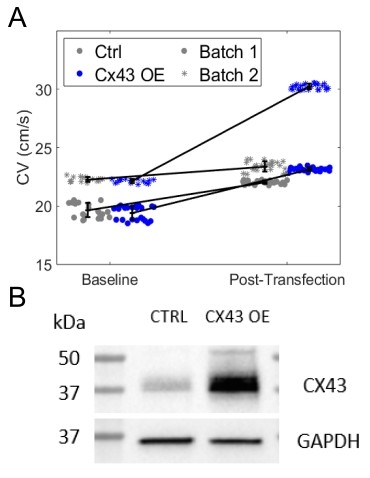
CV increased over the 11-12 day observation period in both control and CX43 OE cultures. However, the increase was significantly greater in the CX43 OE cultures than controls (5.7 vs. 1.7 cm/s, p<0.01, t-test). This indicates that the increased CV in CX43 OE cultures was not solely due to the CM maturation during the observation period. Figure shows the increased CV by CX43 OE of the two culture batches, along with the validation of CX43 protein OE.
Conclusion
CX43 OE improves electrical conduction across hiPSC-derived CMs, suggesting that increasing the gap junction density may be a viable strategy to improve the electrophysiological compatibility of hiPSC-derived cardiac tissue with the host myocardium for regenerative therapies.
  • Zhang, Hanyu  ( University of Alabama at Birmingham , Birmiham , Alabama , United States )
  • Guragain, Bijay  ( University of Alabama at Birmingham , Birmiham , Alabama , United States )
  • Wei, Yuhua  ( University of Alabama at Birmingham , Birmiham , Alabama , United States )
  • Ye, Lei  ( University of Alabama at Birmingham , Birmiham , Alabama , United States )
  • Rogers, Jack  ( University of Alabama at Birmingham , Birmiham , Alabama , United States )
  • Zhang, Jianyi  ( University of Alabama at Birmingham , Birmiham , Alabama , United States )
  • Author Disclosures:
    Hanyu Zhang: DO NOT have relevant financial relationships | Bijay Guragain: DO NOT have relevant financial relationships | Yuhua Wei: DO NOT have relevant financial relationships | Lei Ye: DO NOT have relevant financial relationships | Jack Rogers: DO NOT have relevant financial relationships | Jianyi Zhang: DO NOT have relevant financial relationships
Meeting Info:

Scientific Sessions 2025

2025

New Orleans, Louisiana

Session Info:

Molecular Mechanisms in Cardiac Regeneration

Monday, 11/10/2025 , 10:45AM - 11:55AM

Moderated Digital Poster Session

You have to be authorized to contact abstract author. Please, Login
Not Available