
Lung Injury Following Stent Implantation in Adult Patients with Pulmonary Artery Stenosis
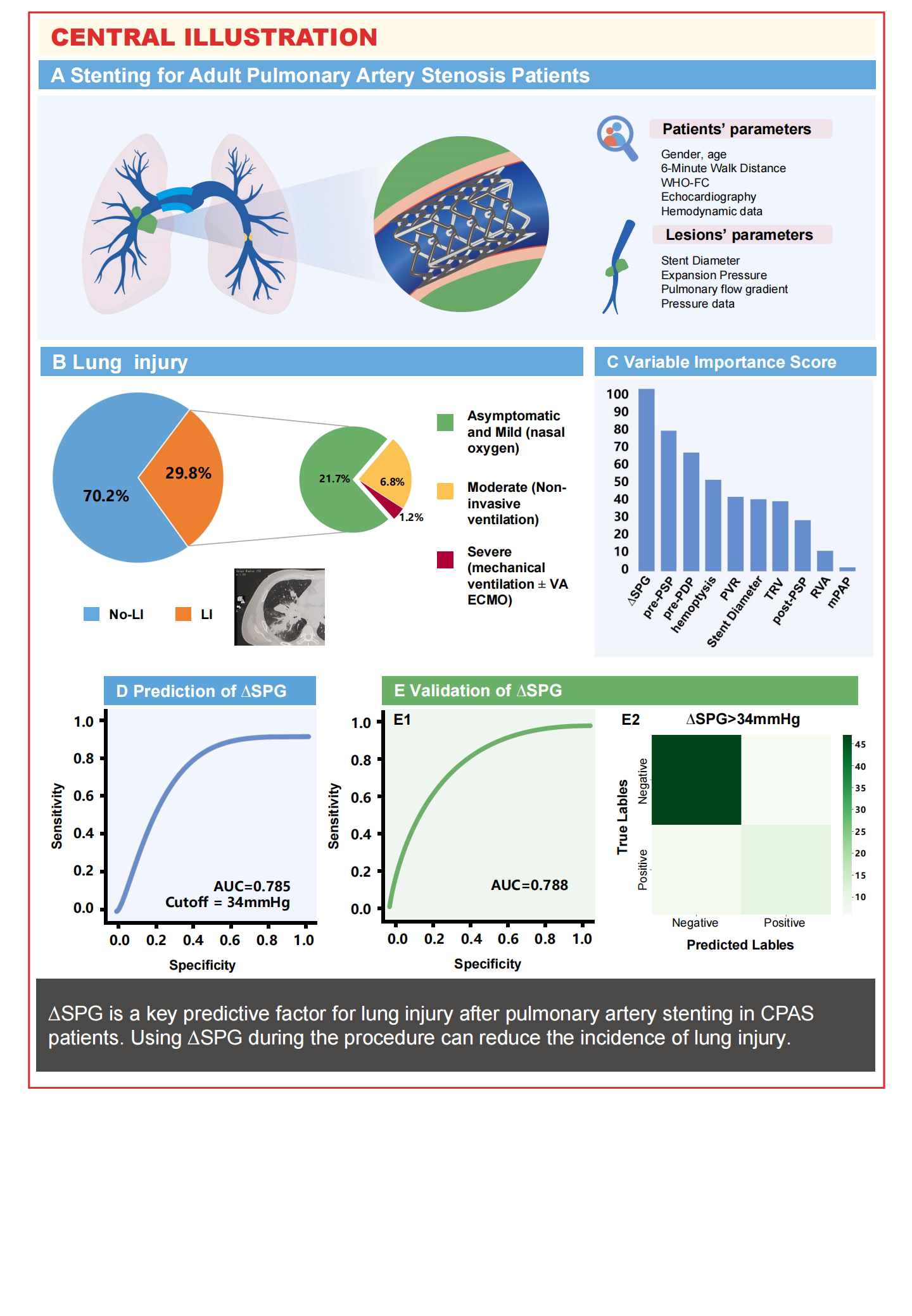
Abstract Body (Do not enter title and authors here): Backgrounds: Pulmonary artery stenosis in adults presents a therapeutic challenge Although percutaneous transluminal pulmonary angioplasty has emerged as an effective treatment, lung injury remains a significant complication with poorly understood predictive factors. Methods: We analyzed 90 initial stenting procedures in 90 adult PAS patients, comparing clinical and procedural characteristics between those who developed lung injury and those who did not. Variable selection incorporated near-zero variance assessment and collinearity screening. A random forest model was developed to predict post-stenting lung injury and underwent prospective external validation in 71 subsequent stent implantation procedures. Results: In this total cohort of 152 patients undergoing 161 stenting procedures, lung injury occurred in 48 procedures (29.8%), of which 11 procedures (6.8%) required non-invasive positive pressure ventilation, and 2 procedures (1.2%) progressed to severe respiratory failure requiring mechanical ventilation, including one death (0.6%). The final model incorporated 10 key variables, with the change in systolic pressure gradient (ΔSPG) identified as the most important predictor. ΔSPG effectively predicted lung injury risk in both development and validation cohorts (AUC: 0.785 and 0.788, respectively). In the validation cohort, ΔSPG >34 mmHg predicted lung injury with specificity of 88.68% and sensitivity of 61.11%. Conclusions: ΔSPG represents a key predictor of post-stenting lung injury in adult PAS patients. Maintaining ΔSPG below 34 mmHg during the procedure may reduce lung injury risk.
Dong, Wenjie
(
Heart, Lung and Vessels Center, Sic
, Chengdu , China )
Cao, Yunshan
(
Heart, Lung and Vessels Center, Sic
, Chengdu , China )
Su, Hongling
(
Pulmonary Vascular Disease Center
, Lanzhou , China )
Jiang, Kaiyu
(
Pulmonary Vascular Disease Center
, Lanzhou , China )
Wang, Aqian
(
Pulmonary Vascular Disease Center
, Lanzhou , China )
Li, Bo
(
Pulmonary Vascular Disease Center
, Lanzhou , China )
Zhu, Hai
(
Pulmonary Vascular Disease Center
, Lanzhou , China )
Zhang, Fu
(
Pulmonary Vascular Disease Center
, Lanzhou , China )
Sun, Xuechun
(
Heart, Lung and Vessels Center, Sic
, Chengdu , China )
Xie, Dili
(
Heart, Lung and Vessels Center, Sic
, Chengdu , China )
Zhang, Yunhe
(
Heart, Lung and Vessels Center, Sic
, Chengdu , China )
Liang, Ting
(
Heart, Lung and Vessels Center, Sic
, Chengdu , China )
Author Disclosures:
Wenjie Dong:DO NOT have relevant financial relationships
| Dili Xie:No Answer
| Yunhe Zhang:No Answer
| Ting Liang:No Answer
| YUNSHAN CAO:No Answer
| Hongling Su:No Answer
| Kaiyu Jiang:No Answer
| Aqian Wang:No Answer
| Bo Li:No Answer
| Hai Zhu:No Answer
| Fu Zhang:No Answer
| Xuechun Sun:No Answer
Liu Chao, Huang Wei, Li Xian-mei, Xu Xi-qi, Jing Zhi-cheng, Wang Li-ting, Dai Hai-long, Li Jiang, Cao Yunshan, Wu Bing-xiang, Yao Hua, Yu Zai-xin, Zhang Rui-feng
4366018_File000000.jpg
You have to be authorized to contact abstract author. Please, Login