Colchicine Reduces Cardiovascular Events in Patients with Increased High-sensitivity C-reactive protein
Abstract Body (Do not enter title and authors here): Background Atherosclerosis is increasingly recognized as a chronic inflammatory process. High-sensitivity C-reactive protein (hs-CRP) is a well-established predictor of major adverse cardiac and cerebrovascular events (MACCE). Colchicine has shown cardiovascular benefit in chronic CAD and post myocardial infarction. However, baseline hs-CRP was not used to guide colchicine therapy in prior trials, and its utility as a predictive biomarker remains unclear. We hypothesize that colchicine’s cardioprotective effect varies by baseline hs-CRP levels in patients with inflammatory gout.
Methods We conducted a retrospective cohort study of patients with inflammatory gout treated at Kaiser Permanente Southern California from January 2010 to June 2024. Colchicine users were propensity score-matched 1:2 to non-users based on demographics, comorbidities, and medication use. The primary outcome was MACCE, defined as a composite of acute coronary syndrome, heart failure, stroke, percutaneous coronary intervention, arrhythmia, and all-cause mortality. Conditional logistic regression was used to estimate adjusted odds ratios. Effect modification by baseline hs-CRP was assessed using stratified analysis across predefined hs-CRP categories.
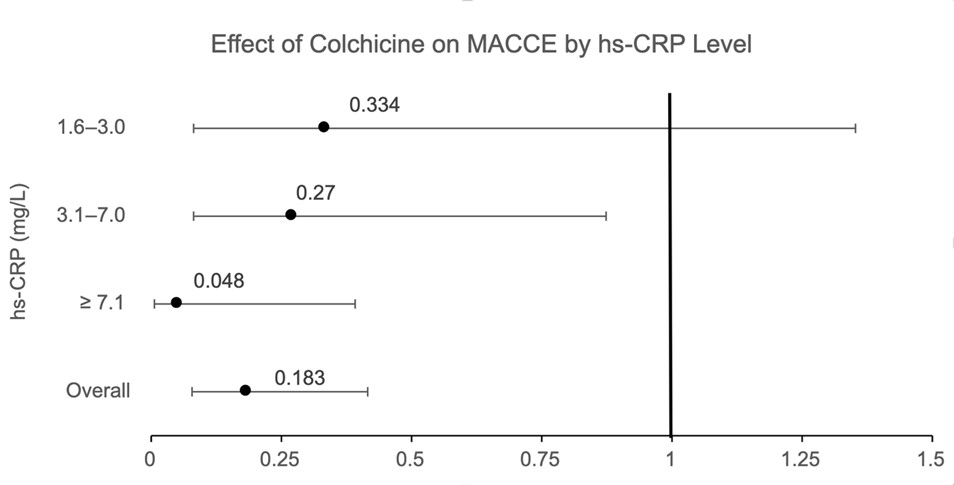
Results Among 2,367 matched patients (867 colchicine users, 1,500 non-users), MACCE occurred in 0.92% of users versus 4.33% of non-users. Colchicine use was associated with significantly lower MACCE risk (adjusted OR 0.183, 95% CI 0.080–0.417, p<0.0001). The strongest effect was observed in patients with hs-CRP ≥7.1 mg/L (OR 0.048, 95% CI 0.006–0.392, p=0.005). Protective effects persisted in the 3.1–7.0 mg/L group (OR 0.270, 95% CI 0.083–0.876, p=0.029), but were not significant in the 1.6–3.0 mg/L group.
Conclusion Colchicine use significantly reduced MACCE in patients with inflammatory gout, with the greatest benefit seen in those with elevated hs-CRP. These findings highlight hs-CRP as a potential biomarker to guide anti-inflammatory therapy for cardiovascular risk reduction.
Khattab, Moemen
(
SCPMG
, Fontana , California , United States )
Huang, Bryan
(
SCPMG
, Fontana , California , United States )
Park, Eunice
(
SCPMG
, Fontana , California , United States )
Wei, Xing
(
SCPMG
, Fontana , California , United States )
Shi, Jiaxiao
(
SCPMG
, Fontana , California , United States )
Lin, Anthony
(
SCPMG
, Fontana , California , United States )
Ren, Jie
(
SCPMG
, Fontana , California , United States )
Author Disclosures:
Moemen Khattab:DO NOT have relevant financial relationships
| Bryan Huang:No Answer
| Eunice Park:DO NOT have relevant financial relationships
| Xing Wei:DO NOT have relevant financial relationships
| jiaxiao shi:No Answer
| Anthony lin:No Answer
| Jie Ren:DO NOT have relevant financial relationships