Association of Albuminuria with Cognition in Midlife: The CARDIA study
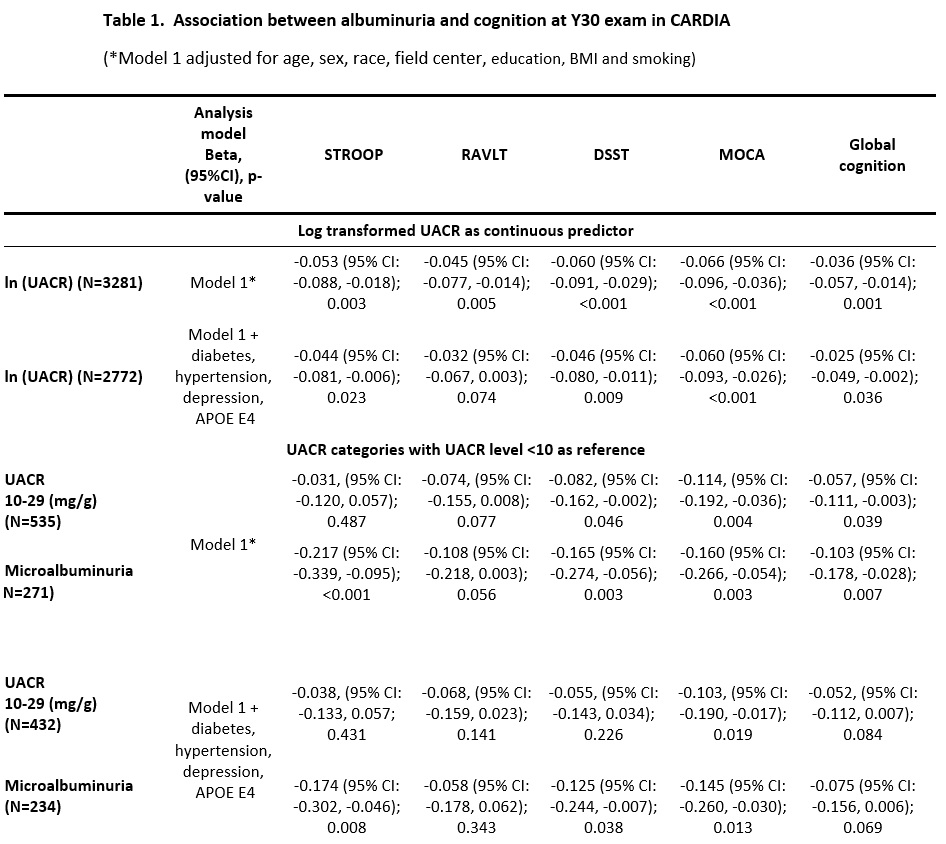
Abstract Body (Do not enter title and authors here): Background: Chronic kidney disease (CKD) has been associated with late-life cognitive decline. We aim to evaluate whether an early marker of kidney damage, measured by urinary albumin-creatinine ratio (UACR), is associated with midlife cognition. Methods: We analyzed data from 3,281 CARDIA Year 30 participants (mean age = 55±3.6 years). A global cognition score was calculated by summing standardized z-scores from Montreal Cognitive Assessment (MoCA), Digit Symbol Substitution Test (DSST), Stroop (reverse-coded), Rey Auditory Verbal Learning Test (RAVLT), and letter/category fluency tests. UACR was assessed continuously (log-transformed) and categorically (<10, 10–29, ≥30 mg/g; with ≥30 mg/g defined as microalbuminuria). Cross-sectional associations with cognitive scores were evaluated using multivariable linear regression, adjusting for demographics, education, BMI, smoking, and further for diabetes, hypertension, depression, and APOE ε4. Sensitivity analyses were conducted among normotensive participants. Results: Higher UACR was associated with poorer cognitive performance, including lower scores on MoCA (β= –0.06, p< 0.001), Stroop (β= –0.04, p= 0.02), DSST (β= –0.05, p= 0.01), and global cognition (β= –0.03, p= 0.04). A graded inverse association was observed across UACR categories (Table1), with microalbuminuria linked to lower MoCA (β= –0.15, p= 0.01), Stroop (β= –0.17, p= 0.01), and DSST (β= –0.13, p= 0.04); and even moderate UACR levels (10–29 mg/g) linked to reduced MoCA performance (β= –0.10, p= 0.02). Most findings remained consistent in normotensive participants (data not shown). Conclusions: Elevated UACR is associated with poorer midlife cognition, independent of cardiovascular risk factors, and may serve as an early marker of cognitive decline, supporting the importance of kidney health monitoring in dementia prevention.
Chang, Ning-shan
(
Advanced Research Diagnostic Labora
, Minneapolis , Minnesota , United States )
Yaffe, Kristine
(
University of California, San Francisco
, San Francisco , California , United States )
Guan, Weihua
(
Univ Minnesota
, Minneapolis , United States Minor Outlying Islands )
Launer, Lenore
(
National Institute on Aging
, Washington , District of Columbia , United States )
Seegmiller, Jesse
(
University of Minnesota
, Minneapolis , Minnesota , United States )
Schreiner, Pamela
(
UNIV MINNESOTA
, Minneapolis , Minnesota , United States )
Sedaghat, Sanaz
(
University of Minnesota
, Minneapolis , Minnesota , United States )
Shlipak, Michael
(
UNIV OF CALIFORNIA, SAN FRANCISCO
, San Francisco , California , United States )
Jacobs, David
(
University of Minnesota
, Minnetonka , Minnesota , United States )
Vivek, Sithara
(
University of Minnesota
, Minneapolis , Minnesota , United States )
Author Disclosures:
Ning-Shan Chang:DO NOT have relevant financial relationships
| Sithara Vivek:DO NOT have relevant financial relationships
| Kristine Yaffe:DO NOT have relevant financial relationships
| Weihua Guan:DO NOT have relevant financial relationships
| Lenore Launer:No Answer
| Jesse Seegmiller:DO have relevant financial relationships
;
Consultant:Abbott Laboratories :Active (exists now)
; Consultant:Nephrolyx:Active (exists now)
| Pamela Schreiner:DO NOT have relevant financial relationships
| Sanaz Sedaghat:DO NOT have relevant financial relationships
| Michael Shlipak:No Answer
| David Jacobs:DO NOT have relevant financial relationships