
Logo

American Heart Association

  12
  0


Final ID: Mo2108

Circulating Angiopoietin-Like Protein 3 in Response to Statin Therapy in Acute Coronary Syndrome and Stable Coronary Artery Disease

Abstract Body (Do not enter title and authors here): Background:
Anti-atherosclerotic response to statin has been shown to differ in patients with ACS and stable CAD. Statin induced a greater reduction of subsequent cardiac events’ risks and more plaque regression in ACS patients. This observation suggests the property of statin to more favorably modulate other proatherogenic drivers in the setting of ACS. Angiopoietin-like protein 3 (ANGPTL3) is a glycoprotein associated with lipid metabolism and vascular inflammation. However, how statins modulate ANGPTL3 levels in patients with ACS and stable CAD remains unknown.
Hypothesis:
Statin therapy may modulate ANGPTL3 levels, especially in ACS patients.
Aim:
To investigate serial changes in ANGPTL3 after statin therapy in patients with ACS and stable CAD.
Methods:
The current study prospectively enrolled 108 statin naïve patients with CAD. Blood samples were collected at baseline, and 1 and 3 months after statin therapy. ANGPTL3 level was measured by using a commercially available human enzyme-linked immunosorbent assay (Immuno-Biological Laboratories, Gunma, Japan). Clinical characteristics and percent changes in ANGPTL3 were compared in patients with ACS and stable CAD.
Results:
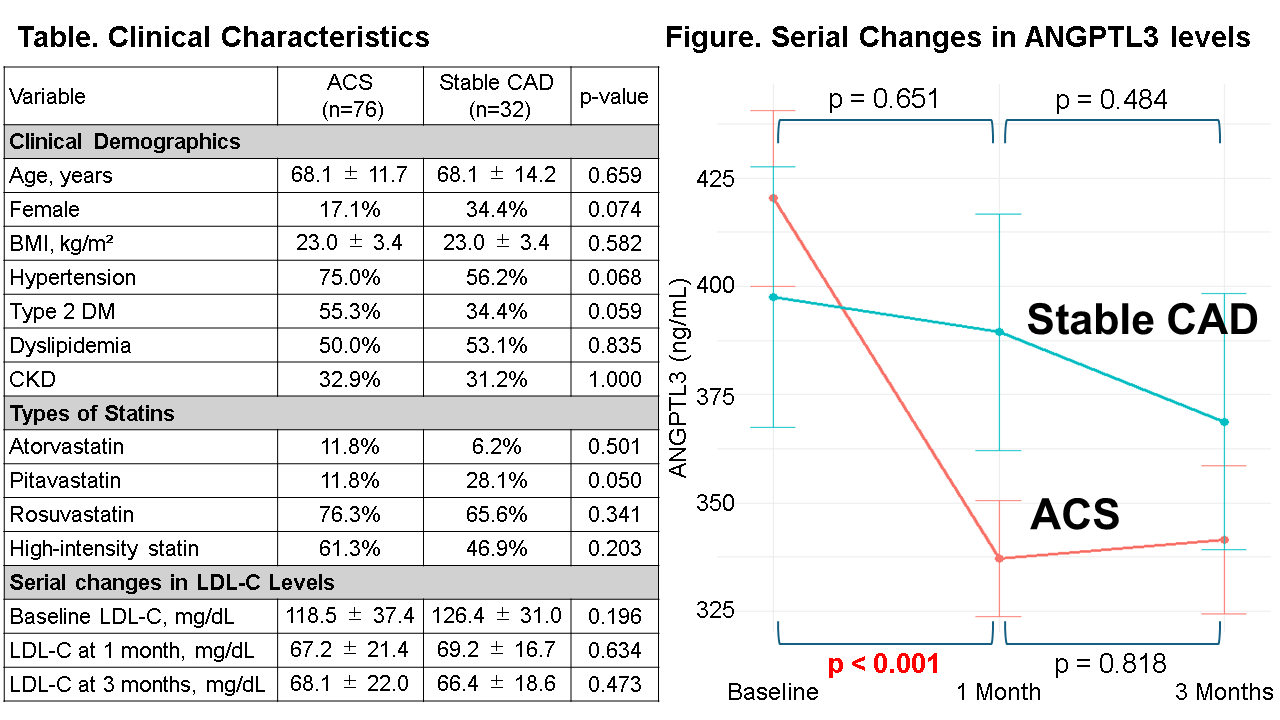
Baseline ANGPTL3 levels were 420±177ng/mL and 398±171 ng/mL in ACS and stable CAD patients, respectively (p=0.532). In ACS patients, a higher ANGPTL3 level was observed in patients with STEMI compared to those with NSTEMI (449 vs. 328, p=0.001). Following the commencement of statins (high-intensity statin: 61 vs. 47%, p=0.203), LDL-C levels were significantly lowered at 1 month in both two groups (Table). There was no significant difference in on-treatment LDL-C level at 1 and 3 months between ACS and stable CAD (Table). Despite lowering LDL-C with statin, ANGPTL3 levels in stable CAD patients did not change during the course of the study (Figure). By contrast, ACS patients exhibited significant reduction of ANGPTL3 levels at 1 month after statin therapy (Figure). Of note, this greater reduction of ANGPTL3 was more evident in patients with STEMI (percent change in ANGPTL3 = -15.4%, p = 0.001 vs. baseline) rather than NSTEMI (percent change in ANGPTL3 = +4.8%, p = 0.569 vs. baseline).
Conclusion:
Greater reduction of ANGPTL3 levels after statin therapy was observed in ACS patients. This statin-mediated effect on ANGPTL3 may account for more favorable response in cardiovascular events and plaque regression in ACS patients receiving a statin.
  • Fujita, Shuhei  ( National Cerebral and Cardiovascular Center , Suita-shi , Japan )
  • Kataoka, Yu  ( National Cerebral and Cardiovascular Center , Suita-shi , Japan )
  • Naoto, Kuyama  ( KUMAMOTO UNIV , Kumamoto , Japan )
  • Tsujita, Kenichi  ( KUMAMOTO UNIV , Kumamoto , Japan )
  • Noguchi, Teruo  ( National Cerebral and Cardiovascular Center , Suita-shi , Japan )
  • Author Disclosures:
    Shuhei Fujita: DO NOT have relevant financial relationships | Yu Kataoka: No Answer | Kuyama Naoto: DO NOT have relevant financial relationships | Kenichi Tsujita: DO NOT have relevant financial relationships | Teruo Noguchi: No Answer
Meeting Info:

Scientific Sessions 2025

2025

New Orleans, Louisiana

Session Info:

Lipid Management Today: Living Up to the Promise?

Monday, 11/10/2025 , 01:00PM - 02:00PM

Abstract Poster Board Session

More abstracts from these authors:
Effects of lactate production caused by acetylcholine provocation tests on ketone bodies concentration in coronary artery spasm.

Ikebe Sou, Ishii Masanobu, Otsuka Yasuhiro, Arima Yuichiro, Matsuzawa Yasushi, Yamamoto Eiichiro, Tsujita Kenichi

Finerenone Attenuates Cardiac Hypertrophy in a Mouse Model of HFpEF by Modulating Glucocorticoid and Mineralocorticoid Receptor Signaling

Morikawa Kei, Nagakura Takumi, Fujiyama Akira, Yuquing Xu, Hanatani Shinsuke, Izumiya Yasuhiro, Arima Yuichiro, Tsujita Kenichi

You have to be authorized to contact abstract author. Please, Login
Not Available