Trends in Adoption of the Familial Hypercholesterolemia Diagnostic Code E78.01 in U.S. Healthcare Settings from 2016 to 2024
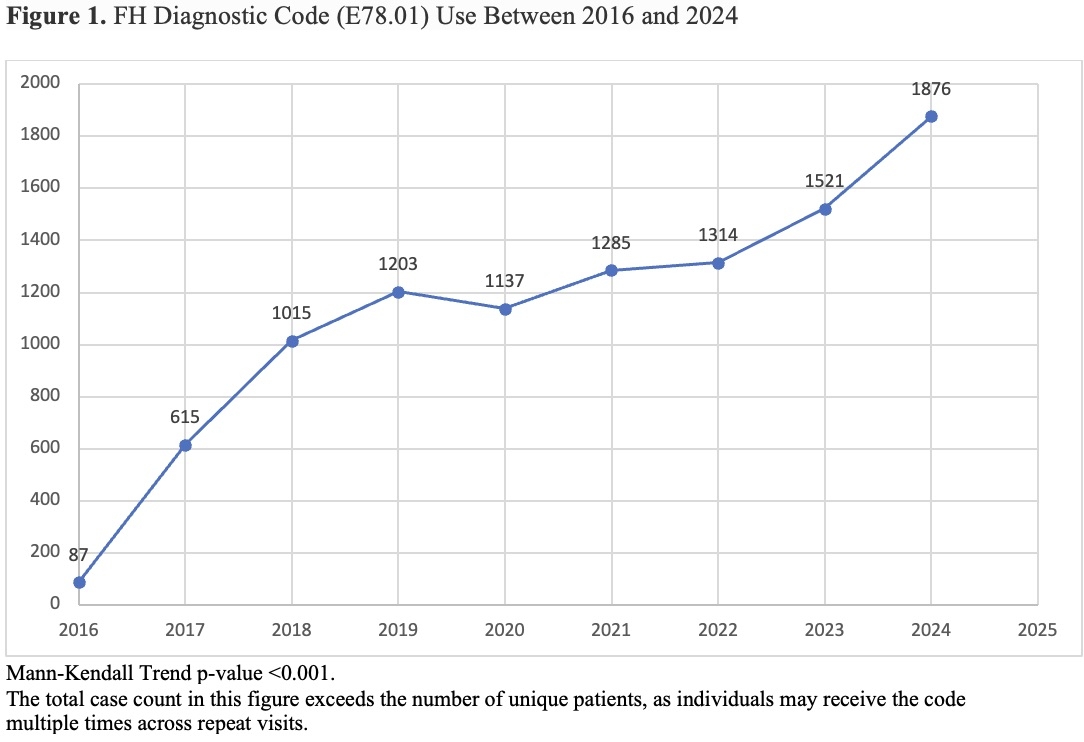
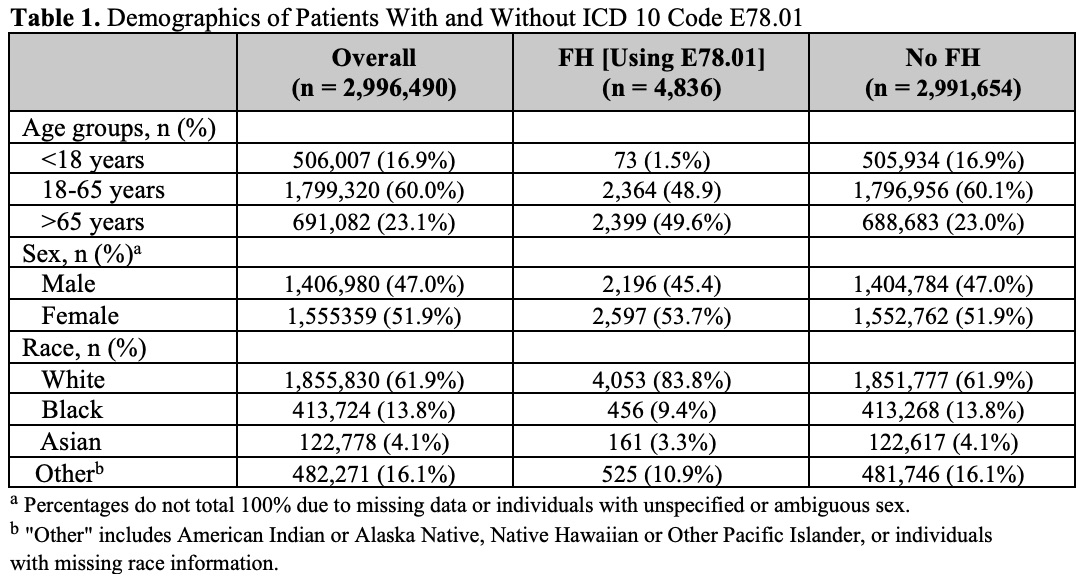
Abstract Body (Do not enter title and authors here): Background: The ICD-10 code for Familial Hypercholesterolemia (FH), E78.01, was introduced in 2016 to improve FH identification and care delivery. Real-world adoption of this code across healthcare systems and the clinical characteristics of patients assigned this code have not been well characterized. Research Question: What proportion of patients in the United States (US) healthcare database have been diagnosed with E78.01, and what is the demographic and lipid-lowering therapy (LLT) use among this patient group? Methods: Data from Epic Cosmos, a nationwide electronic health record (EHR) database comprising a representative sample of patients receiving care across the US, was used for this study. Among 2,996,490 individuals with recorded encounters between October 1, 2016, and December 31, 2024, patients with a final billing code E78.01 were queried. Prevalence and trends in code use were assessed using the Mann-Kendall test. Demographics and LLT use were compared between patients with and without the FH code. Results: The number of patients diagnosed with FH using E78.01 has increased substantially since 2016 (Figure 1). A total of 4,836 patients (1.6 per 1,000) were billed with E78.01 within this period, representing 40.3% of the expected total FH cases (n = 11,986), assuming a prevalence of 1 per 250 individuals. Patients with the diagnosis code E78.01 were older, more likely to be female, and predominantly White individuals, compared with those without the code (Table 1). Among patients with FH identified using the E78.01 code, 3,756 (77.7%) were prescribed at least one LLT. Including those treated with a combination of therapies, overall statin use in this population was 75%, ezetimibe 16%, and PCSK9 inhibitors 11%. Conclusions: Despite increasing use of ICD-10 code E78.01, less than half of expected FH cases were captured across US healthcare systems. These findings underscore the need to further expand code adoption, which may improve FH identification, follow-up, and LLT use in this high-risk population. Additional research is needed to evaluate the sensitivity, specificity, and predictive value of the FH code in clinical practice.
Osei, Jeffery
(
Emory University
, Atlanta , Georgia , United States )
Sperling, Laurence
(
Emory University
, Atlanta , Georgia , United States )
Khoury, Muin
(
Emory University
, Atlanta , Georgia , United States )
Sun, Yan
(
Emory University
, Atlanta , Georgia , United States )
Author Disclosures:
Jeffery Osei:DO NOT have relevant financial relationships
| Laurence Sperling:DO NOT have relevant financial relationships
| Muin Khoury:DO NOT have relevant financial relationships
| Yan Sun:DO NOT have relevant financial relationships