Logo

American Heart Association

  13
  0


Final ID: MP2426

Genetic Evaluation of Familial Hypercholesterolemia in a Pediatric Cardiology Clinic

Abstract Body (Do not enter title and authors here): Background: Familial hypercholesterolemia (FH) is an autosomal dominant disorder characterized by elevated low density lipoprotein cholesterol (LDL-C) and increased lifetime risk of atherosclerotic cardiovascular disease (ASCVD). While clinical criteria have been established to diagnose FH, genetic testing is now widely available providing an additional avenue for diagnosis. We aimed to describe the yield of genetic testing for FH in children evaluated in a dedicated pediatric cardiology clinic.

Methods: We conducted a retrospective cohort study based on the initial evaluation of children in a dyslipidemia clinic between 2017 and 2024. Genetic testing for FH was performed based on assessment of clinical criteria by the attending preventive cardiologist. The cohort was divided into three categories based on genetic testing: genotype positive, genotype negative and phenotype negative (genetic testing not ordered). Patient characteristics and lab parameters (fasting LDL-C and triglycerides, and lipoprotein(a) in mg/dL) were compared between the three groups using descriptive statistics, chi-squared, or Kruskal-Wallis tests.

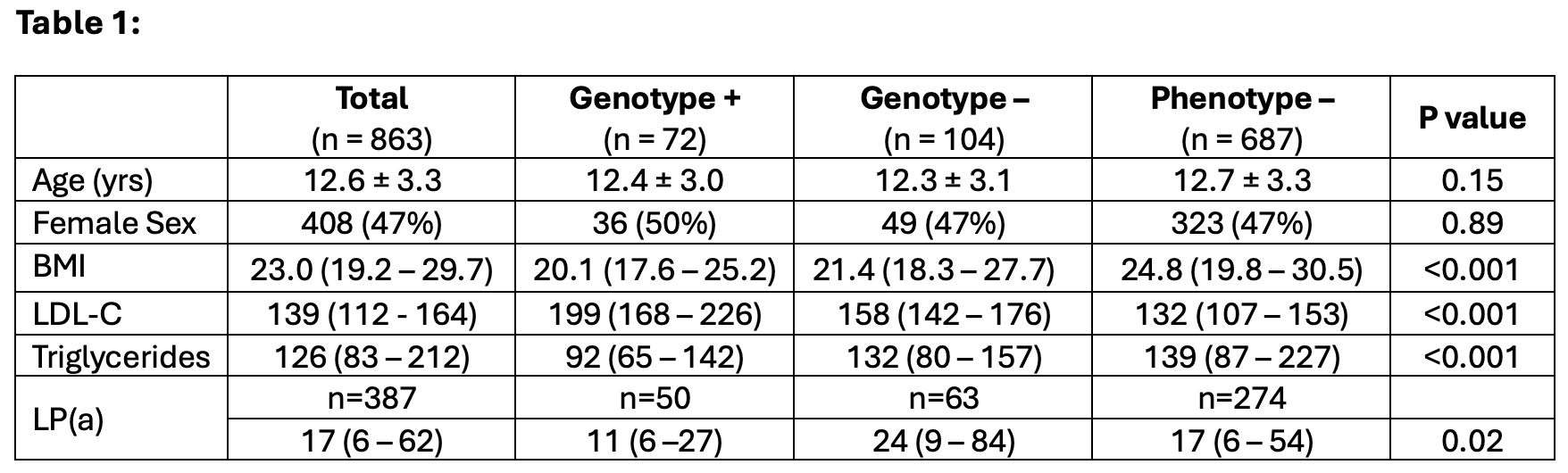
Results: Of 863 pediatric patients evaluated (47% female, mean age 12.6 ± 3.3 years) genetic testing was performed in 176 probands. A pathogenic or likely pathogenic variant was identified in 72 (41%) including 58 LDLR (81%), 12 APOB (17%), 2 PCSK9 (2%) variants. Data are summarized in Table 1. The genotype positive cohort had higher LDL-C compared to the phenotype negative and genotype negative cohorts. Genotype negative patients had higher lipoprotein (a). The phenotype negative group had higher triglyceride levels and BMI. An additional 304 patients (164 adult patients) underwent cascade family screening that yielded 169 patients (87 adult patients) with pathogenic or likely pathogenic variants (137 LDLR [81.5%], 31 APOB [18%], 1 PCSK9 [0.5%]).

Conclusion: The diagnostic yield of genetic testing to confirm FH in clinically suspected pediatric patients is high and enables effective cascade screening. Lipoprotein (a) should be considered in all patients, especially those with negative FH genetic testing. Systematic implementation of pediatric lipid screening and targeted genetic testing may enhance early diagnosis of FH in children and family members, enabling timely interventions in this high-risk cohort.
  • Anjewierden, Scott  ( University of Utah , Salt Lake City , Utah , United States )
  • Sawyer, Brianna  ( University of Utah , Salt Lake City , Utah , United States )
  • Kawasaki, Joshua  ( Intermountain Primary Children's Hospital , Salt Lake City , Utah , United States )
  • Tristani, Martin  ( University of Utah , Salt Lake City , Utah , United States )
  • Ware, Adam  ( University of Utah , Salt Lake City , Utah , United States )
  • Author Disclosures:
    Scott Anjewierden: DO NOT have relevant financial relationships | Brianna Sawyer: No Answer | Joshua Kawasaki: DO NOT have relevant financial relationships | Martin Tristani: No Answer | Adam Ware: DO NOT have relevant financial relationships
Meeting Info:

Scientific Sessions 2025

2025

New Orleans, Louisiana

Session Info:

From Risk to Response: Implementing Preventive and Systems-Based Strategies in Cardiovascular Care

Monday, 11/10/2025 , 09:15AM - 10:15AM

Moderated Digital Poster Session

More abstracts on this topic:
A Delayed Diagnosis of Anti-HMG-CoA Reductase Immune-Mediated Necrotizing Myopathy

Jadhav Reshma, Shekar Arush, Westenhaver Zack, Skandhan Amith

Characterization of Severe Hypercholesterolemia Phenotype within Electronic Health Records

Sondhi Kunal, Nalbandyan Marine, Tattersall Matthew, Mathew Jomol

You have to be authorized to contact abstract author. Please, Login
Not Available