Logo

American Heart Association

  21
  0


Final ID: MP704

Longitudinal Associations of Dual-Energy Xray Absorptiometry-measured Total Body Fat Mass and Trunk Fat Mass with Cardiac Changes in 1803 Adolescents - A 7-year Mediation Study

Abstract Body (Do not enter title and authors here): Background: Adolescence has been identified as a critical time point when physiological adaptations deviate into pathological cardiometabolic disease processes. Large-scale prospective evidence on the direct impact of increasing fat mass from adolescence with alterations in cardiac structure among apparently healthy adolescents is limited. Adolescent dyslipidaemia and elevated blood pressure (BP) have been established as independent predictors of premature cardiac damage. However, understanding the mechanism through which fat mass alters cardiac indices will be crucial for public health intervention and preventive cardiology.

Purpose: To examine the longitudinal associations of total fat mass and trunk fat mass with progressive cardiac remodelling and examine the role of low-density lipoprotein cholesterol (LDL-c), systolic BP, and inflammation on the relationships.

Methods: From the Avon Longitudinal Study of Parents and Children (ALSPAC), UK birth cohort, 1803 adolescents aged 17 years who had repeated dual-energy Xray absorptiometry-measured fat mass at ages 17 and 24 years clinic visits were included. Echocardiography at 17 and 24 years assessed left ventricular mass indexed for height2.7 (LVM). Repeated-measure longitudinal multivariate-adjusted analyses were conducted with generalized linear mixed-effect models with identity links. Structural equation model causal mediation analysis assessed the proportion of the association between fat mass and cardiac mass during ages 17 to 24 years mediated by LDL-c, systolic BP, or high-sensitivity C-reactive protein (hsCRP).

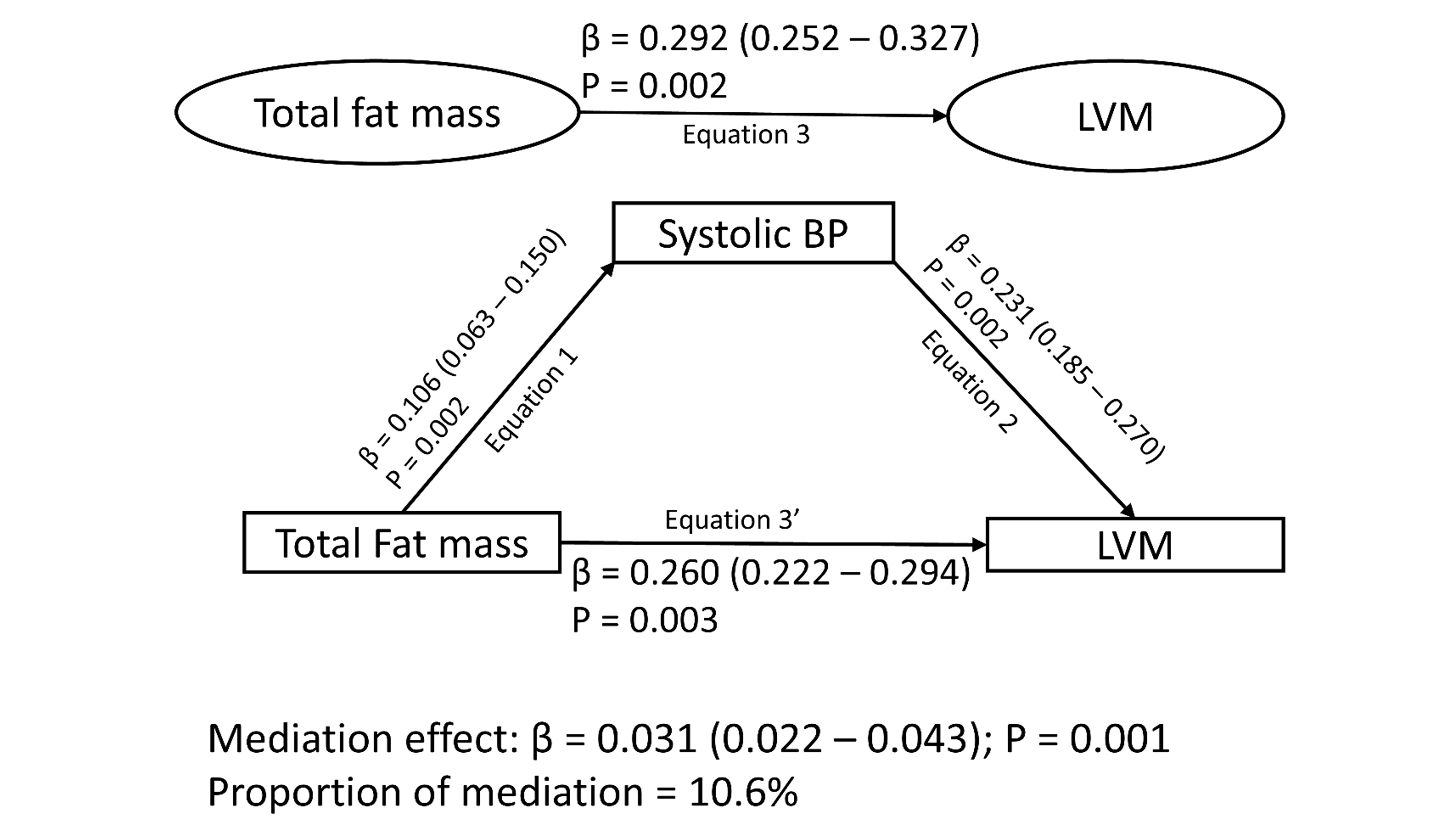
Results: Each unit increase of total fat mass from age 17–24 years (β = 0.12g/m2.7 [95% CI, 0.09 – 0.15], p<0.001) and trunk fat mass (0.23g/m2.7 [0.18 – 0.28], p<0.001) were independently associated with increased LVM over the 7-year growth period. Increased LDL-c, systolic BP, and hsCRP partly mediated (7.9%, 10.6%, and 7.4% mediation, respectively) the longitudinal associations between increased fat mass and increased cardiac mass during growth from adolescence to young adulthood (Figure 1).

Conclusions: Increased total and trunk fat mass in adolescence was associated with cardiac structural remodelling, partially explained by altered cardiometabolic and inflammatory indices. Trunk fat mass may have a two-fold worse deleterious effect on cardiac mass than total fat mass.
  • Agbaje, Andrew  ( University of Eastern Finland , Kuopio , Finland )
  • Author Disclosures:
    Andrew Agbaje: DO have relevant financial relationships ; Research Funding (PI or named investigator):Novo Nordisk Foundation:Active (exists now)
Meeting Info:

Scientific Sessions 2025

2025

New Orleans, Louisiana

Session Info:

Adult Congenital Heart Disease Across the Lifespan

Saturday, 11/08/2025 , 09:15AM - 10:30AM

Moderated Digital Poster Session

More abstracts on this topic:
84 Immune checkpoint profiling in major aortic diseases leads to identification of potential roles of CD155-CD206 pathway in suppressing inflammation and immune responses

Shao Ying, Saaoud Fatma, Xu Keman, Lu Yifan, Jiang Xiaohua, Wang Hong, Yang Xiaofeng

Adverse Childhood Experiences (ACEs) and Cardiovascular Health: Future of Families and Child Wellbeing Study (FFCWS)

__PRESENT

Pedamallu Havisha, Van Horn Linda, Stein James, Korcarz Claudia, Hansen Kristin, Mitchell Colter, Heard-garris Nia, Lloyd-jones Donald, Allen Norrina, Gauen Abigail, Ning Hongyan, Wilkins John, Goldman Noreen, Notterman Daniel, Hou Lifang, Zheng Yinan, Marma Amanda

You have to be authorized to contact abstract author. Please, Login
Not Available