Personal Care Product Usage Patterns And Hypertension In U.S. Women From The Sister Study
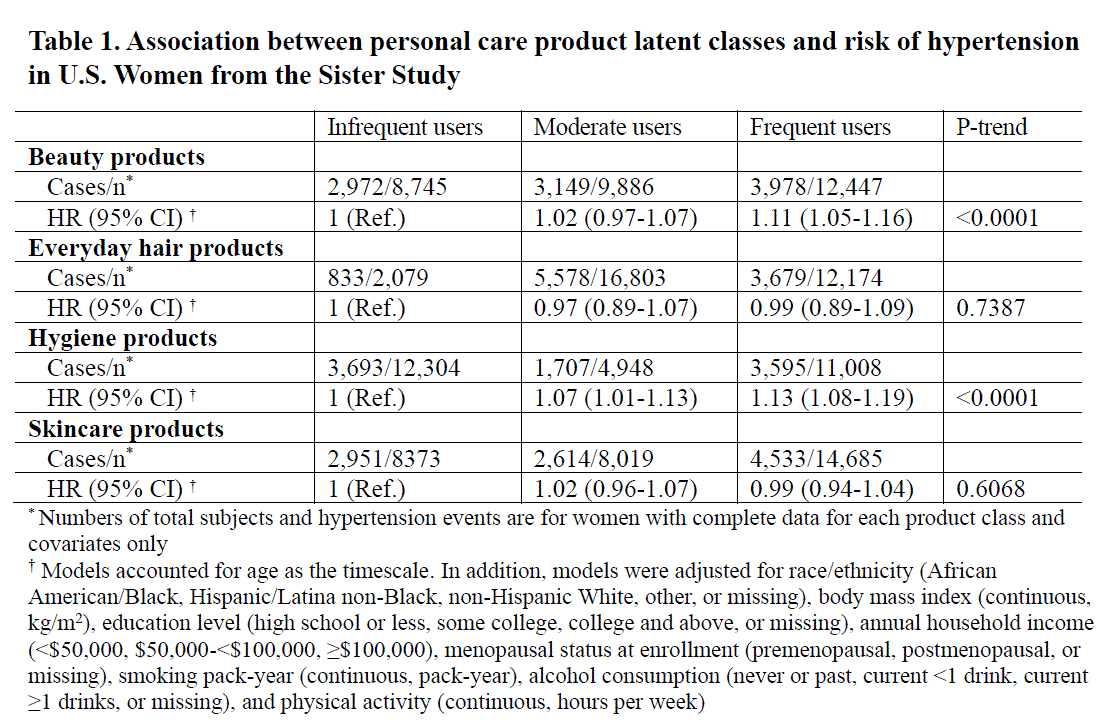
Abstract Body (Do not enter title and authors here): Introduction: Personal care products (PCPs) are complex chemical mixtures, which include endocrine disrupting chemicals linked to elevated risk of hormonally-responsive chronic diseases. Blood pressure is influenced by sex hormones; however, the relationship between PCPs and hypertension is unclear. Hypothesis: We investigated whether PCP usage patterns were associated with risk of hypertension in U.S. women. Methods: The Sister Study is a prospective cohort study of 50,884 women recruited in 2003-2009. The participants self-reported their usage frequency of 41 PCPs in the 12-month period before baseline and doctor’s diagnosis of incident hypertension. We analyzed individual PCPs and four product groups (i.e., beauty, everyday hair, hygiene, and skincare products). Among product groups, latent class analyses were used to identify PCP usage patterns (“infrequent”, “moderate”, or “frequent”). Multivariable Cox regression was used to estimate the associations between PCPs and hypertension risk, adjusted for potential confounders. The population attributable risk percentage contrasting “frequent” versus “infrequent” users was calculated using Levin's formula. Results: We found an increasing dose-response relationship between beauty products and incident hypertension (p-trend<0.0001; Table 1), with frequent users having a significantly higher risk compared with infrequent users (Hazard Ratio (HR)=1.11 (95% confidence intervals (CI):1.05,1.16)). A similar dose-response relationship was found for hygiene products (p-trend<0.0001), with elevated risks observed in moderate (HR=1.07 (95%CI:1.01,1.13) and frequent (HR=1.13 (95%CI:1.08,1.19) users. An estimated 6.1% and 5.8% reduction in hypertension incidence would be observed among U.S. women with decreased use of beauty and hygiene products, respectively. Our findings were largely consistent across different subgroups defined by age, menopausal status, race, and socioeconomic status. The use of several individual everyday hair and skincare products was associated with increased risk of hypertension; however, latent classes of either everyday hair or skincare product use were not. Conclusions: We found that use of certain PCPs contribute to future development of hypertension, a strong but modifiable risk factor for most cardiovascular diseases. Our findings support the need to identify the pathogenic constituents of PCPs that drive hypertension risk.
Lim, Jungeun
(
NHLBI
, Bethesda, MD , Maryland , United States )
Chang, Che-jung
(
National Institute of Environmental Health Sciences
, Research Triangle Park , North Carolina , United States )
White, Alexandra
(
National Institute of Environmental Health Sciences
, Research Triangle Park , North Carolina , United States )
Lo, Shelton
(
NHLBI
, Bethesda, MD , Maryland , United States )
Wang, Hantao
(
NHLBI
, Bethesda, MD , Maryland , United States )
Goodney, Gabriel
(
NHLBI
, Bethesda, MD , Maryland , United States )
Roger, Veronique
(
NHLBI
, Bethesda, MD , Maryland , United States )
Sandler, Dale
(
National Institute of Environmental Health Sciences
, Research Triangle Park , North Carolina , United States )
Wong, Jason
(
NHLBI
, Bethesda, MD , Maryland , United States )
Author Disclosures:
Jungeun Lim:DO NOT have relevant financial relationships
| Che-Jung Chang:DO NOT have relevant financial relationships
| Alexandra White:No Answer
| Shelton Lo:No Answer
| Hantao Wang:No Answer
| Gabriel Goodney:No Answer
| Veronique Roger:DO NOT have relevant financial relationships
| Dale Sandler:No Answer
| Jason Wong:DO NOT have relevant financial relationships
Leiser Claire, Spalt Elizabeth, Kaufman Joel, Quraishi Sabah, Biggs Mary Lou, Hart Jaime, Sandler Dale, Whitsel Eric, White Alexandra, Young Michael T, Szpiro Adam