
Logo

American Heart Association

  17
  0


Final ID: MP629

Discontinuation of PCSK9 Inhibitor Therapy and Its Impact on Cardiovascular Outcomes in a Japanese Cohort

Abstract Body (Do not enter title and authors here): Background
Proprotein convertase subtilisin-kexin type 9 (PCSK9) inhibitors have been shown to effectively lower low-density lipoprotein cholesterol (LDL-C) and reduce the risk of cardiovascular events. However, despite these benefits, some patients are unable to continue PCSK9 inhibitor therapy due to financial or other non-medical reasons. Clinical evidence regarding outcomes following discontinuation of PCSK9 inhibitors remains limited.

Purpose
This study aims to investigate patients who were unable to continue PCSK9 inhibitor therapy, with particular emphasis on those who discontinued treatment due to financial or other non-medical reasons. The primary objective is to evaluate the impact of therapy discontinuation on the incidence of major adverse cardiovascular events (MACE).

Methods
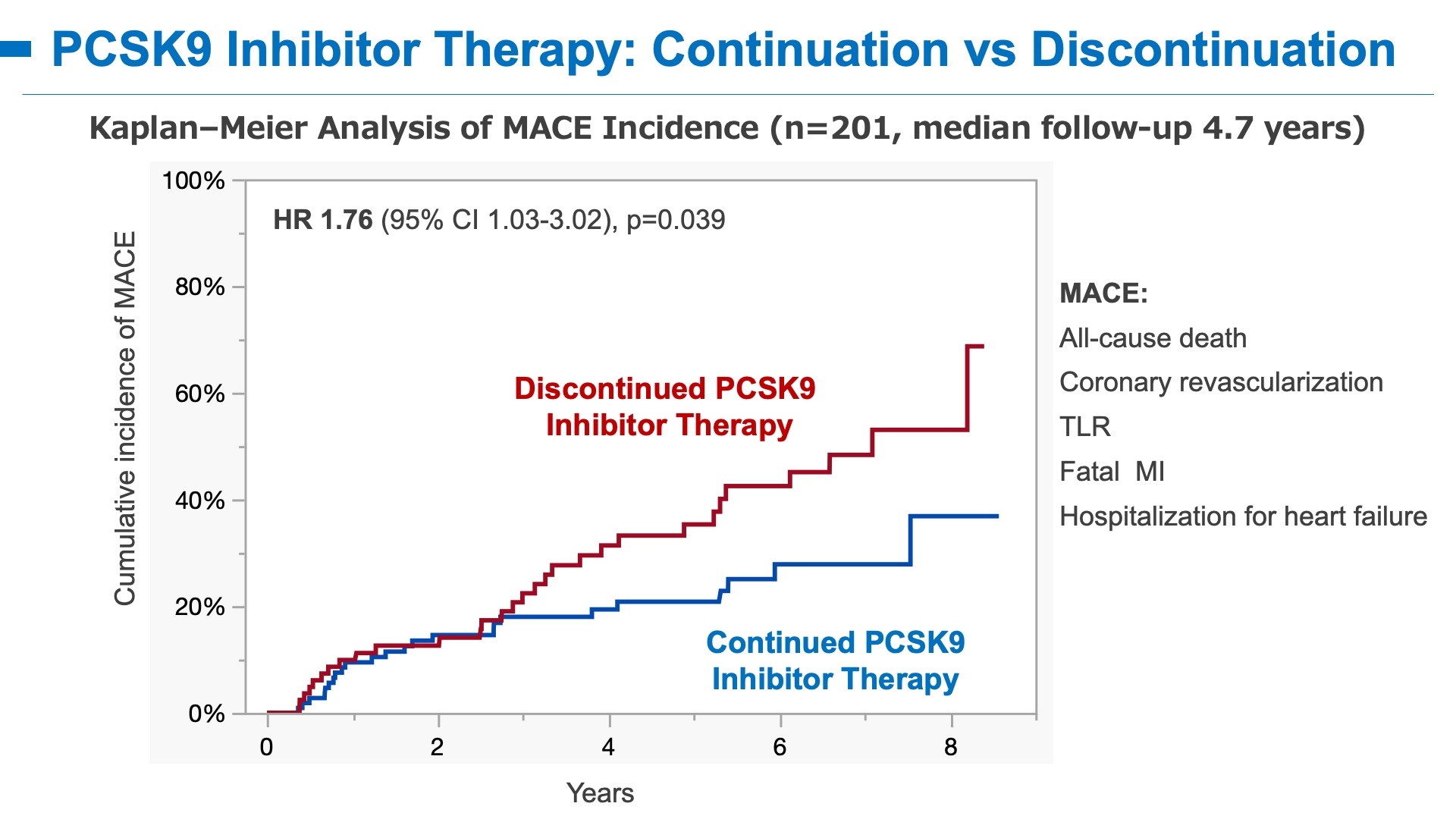
This study included 201 Japanese patients with coronary artery disease who received PCSK9 inhibitor therapy between July 2016 and December 2023. Clinical outcomes were compared between patients who continued therapy and those who discontinued. The primary endpoint was MACE, defined as a composite of all-cause mortality, coronary revascularization, target lesion revascularization (TLR), fatal or non-fatal myocardial infarction (MI), and hospitalization for heart failure.

Results
Among the 201 patients (median age: 69 years; interquartile range [IQR]: 59–75; 73% male), the median follow-up duration was 4.7 years (IQR: 2.2–6.4). At one year, the median LDL-C was 42 mg/dL, with 82% achieving LDL-C <70 mg/dL. During follow-up, 111 patients (55.2%) continued therapy, while 90 (44.8%) discontinued. Among those who discontinued, 33% cited financial difficulties, 23% clinical stability, and 21% patient preference. Multivariate Cox regression analysis showed that those who discontinued therapy had a significantly higher incidence of MACE compared to those who continued (hazard ratio: 1.76; 95% confidence interval: 1.03–3.02; p=0.039).

Conclusions
Discontinuation of PCSK9 inhibitors—particularly for financial or other non-medical reasons—is associated with an increased risk of MACE. These findings underscore the need for strategies to support long-term adherence and address socioeconomic barriers to therapy continuation. This insight has important implications for clinical decision-making and healthcare policy.
  • Tsubata, Hideo  ( Kyoto Prefectural University of Med , Kyoto , Japan )
  • Nakanishi, Naohiko  ( Kyoto Prefectural University of Med , Kyoto , Japan )
  • Matoba, Satoaki  ( Kyoto Prefectural University of Med , Kyoto , Japan )
  • Author Disclosures:
    Hideo Tsubata: DO NOT have relevant financial relationships | Naohiko Nakanishi: DO NOT have relevant financial relationships | Satoaki Matoba: No Answer
Meeting Info:

Scientific Sessions 2025

2025

New Orleans, Louisiana

Session Info:

Cutting-Edge Insights in Cardiovascular Care: From Precision Therapies to System-Level Outcomes

Saturday, 11/08/2025 , 01:45PM - 03:00PM

Moderated Digital Poster Session

More abstracts on this topic:
A RETRO-ENANTIOMER OF ANGIOTENSIN-(1-9) PREVENTS THE DEVELOPMENT OF HEART FAILURE WITH PRESERVED EJECTION FRACTION.

Ocaranza Maria Paz, Jimenez Veronica, Yanez Osvaldo, Jalil Jorge, Venegas Camilo, Candia Camila, Hermoso Marcela, Gabrielli Luigi, Morales Javier, Oyarzun Felipe, Torres Cristian, Lillo Pablo

A Qualitative Study of Perspectives on South Asian Dietary Practices: Exploring a Framework for Culturally Tailored Food-is-Medicine Interventions

Kaloth Srivarsha, Fitzgerald Nurgul, Bacalia Karen Mae, Kalbag Aparna, Setoguchi Soko

More abstracts from these authors:
Cognitive Impairment Impedes the Acquisition of Self-Care Management Skills in Patients with Heart Failure

Irie Daisuke, Kurimoto Ritsuko, Matoba Satoaki

Inhibition of TAOK1-mediated Cardiomyocyte Death Attenuates Doxorubicin-Induced Cardiotoxicity

Kogure Masaya, Kitani Tomoya, Suga Takaomi, Ogata Takehiro, Ikeda Koji, Matoba Satoaki

You have to be authorized to contact abstract author. Please, Login
Not Available