Logo

American Heart Association

  17
  0


Final ID: MP1760

Variation in Use of Pulmonary Hypertension Therapies among Acute Care Cardiology Units – a Pediatric Acute Care Cardiology Collaborative Registry Evaluation

Abstract Body (Do not enter title and authors here): Introduction/Background:
Pulmonary hypertension (PH) is a frequent complication of congenital heart disease (CHD) that is estimated to account for 30-50% of pediatric group 1 PH patients, as defined by the World Symposium on Pulmonary Hypertension. Despite advancements in the field, many of the targeted therapies are understudied in the pediatric CHD population. While prior studies examined practice patterns in dedicated PH programs, medication use across pediatric heart centers with varying access to PH specialists and resources remains unclear.
Research Questions/Hypothesis:
Institutional site membership to Pediatric Pulmonary Hypertension Network (PPHNet) influences practice patterns in PH medication use in acute care cardiology units at participating Pediatric Acute Care Cardiology Collaborative (PAC3) centers.
Methods/Approach:
PAC3 registry data (2019–present) were analyzed for patients admitted to a participating ACCU with a PH diagnosis or who received new or chronic PH therapy during a PAC3 encounter. Centers were grouped by institutional site membership to PPHNet. Summary and comparative statistics were performed.
Results/Data:
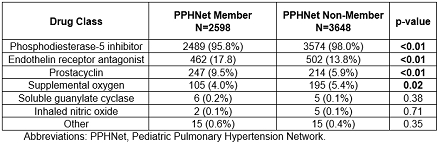
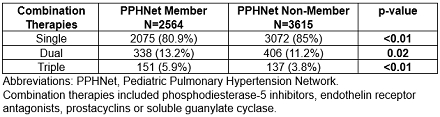
There were 10,223 encounters from 4,468 unique patients (94% with CHD) across 34 PAC3 centers; 9 centers (26%) were PPHNet members, accounting for 41% of encounters. Phosphodiesterase-5 inhibitors (PDE5-i) were the most used PH medication, followed by endothelin receptor antagonists (ERAs). PDE5-i monotherapy was the most common treatment regimen (81.7% of encounters), followed by dual therapy with PDE5-i + ERA (9.6%) and triple therapy with PDE5-i + ERA + prostacyclin (4.6%). Among patients with CHD, 2.4% involved triple therapy. Compared to non-PPHNet centers, PPHNet centers used fewer PDE5-i but more ERAs and prostacyclins (Table 1). PPHNet centers exhibited a higher frequency of dual and triple PH therapies compared to non-PPHNet centers, while monotherapy was more prevalent in non-PPHNet centers (Table 2).
Conclusions:
PH monotherapy was more common in non-PPHNet participating centers while multi-drug PH regimens were more frequently used at PPHNet participating centers. Practice variations exist in the use of PH medications in participating PAC3 centers who are PPHNet institutional site members compared to non-PPHNet members, suggesting differing practice patterns in centers with a larger PH presence.
  • Zoretic, Sarah  ( University of Texas Southwestern , Dallas , Texas , United States )
  • Patel, Sonali  ( University of Texas Southwestern , Dallas , Texas , United States )
  • Griffiths, Megan  ( University of Texas Southwestern , Dallas , Texas , United States )
  • Ivy, Dunbar  ( University of Colorado , Aurora , Colorado , United States )
  • Pettit, Kevin  ( University of Colorado , Aurora , Colorado , United States )
  • Miles, Kimberley  ( Cincinnati Children's Hospital , Cincinnati , Ohio , United States )
  • Handler, Stephanie  ( Medical College of Wisconsin , Milwaukee , Wisconsin , United States )
  • Sullivan, Rachel  ( Vanderbilt University Med Center , Nashville , Tennessee , United States )
  • Schiller, Amy  ( University of Michigan , Ann Arbor , Michigan , United States )
  • Young, Jared  ( Children's Health Dallas , Dallas , Texas , United States )
  • Author Disclosures:
    Sarah Zoretic: DO NOT have relevant financial relationships | Sonali Patel: DO NOT have relevant financial relationships | Megan Griffiths: DO NOT have relevant financial relationships | Dunbar Ivy: DO have relevant financial relationships ; Consultant:Merck:Active (exists now) ; Research Funding (PI or named investigator):Actelion:Active (exists now) ; Research Funding (PI or named investigator):Merck:Active (exists now) ; Consultant:Actelion:Active (exists now) | Kevin Pettit: No Answer | Kimberley Miles: DO NOT have relevant financial relationships | Stephanie Handler: No Answer | Rachel Sullivan: DO NOT have relevant financial relationships | Amy Schiller: DO NOT have relevant financial relationships | Jared Young: DO NOT have relevant financial relationships
Meeting Info:

Scientific Sessions 2025

2025

New Orleans, Louisiana

Session Info:

CTEPH and PH: Unlocking Clinical Challenges and Advances in Treatment Strategies

Sunday, 11/09/2025 , 03:15PM - 04:10PM

Moderated Digital Poster Session

More abstracts on this topic:
Angiotensin Converting Enzyme Gene Polymorphisms (ACE-I/D) Do Not Predict Exercise-Induced Cardiac Remodeling or Performance in Adolescent Male Athletes

Becker Kristian, Hardie William, Gubanich Paul, Hill Garick, Logan Kelsey, Martin Lisa, Powell Adam

Adult congenital heart disease (ACHD) as career? Examining encouraging and discouraging factors around the globe in the Global ACHD Survey.

Bravo-jaimes Katia, Elizari Maria Amalia, Valdez Ramos Miriam, Cupido Blanche, Zentner Dominica, Almasri Murad, Phillips Sabrina, Mcleod Christopher, Burchill Luke, Bullock-palmer Renee, Windram Jonathan, Srour Mhd Osama, Jenkins Petra, Luna-lopez Raquel, Tutarel Oktay, Kandavello Geetha, Guerrero Carlos, García Cruz Edgar, Ackerman Judith

More abstracts from these authors:
The Use of Gastrointestinal Reflux and Pro-Motility Medications in Hospitalized Infants with Congenital Heart Disease using the Pediatric Acute Care Cardiology Collaborative Registry

Alhousseiny Sara, Patel Sonali, Tiernan Kendra, Wehrmann Melissa, Harahsheh Ashraf, Frosch Olivia, Tindel Kaitlin, Plummer Sarah, Young Jared, Schiller Amy

Risk Factors for and Outcomes Following Tube Assisted Feeding in Neonates Undergoing Cardiac Surgery

Iguidbashian Kelsey, Plummer Sarah, Raymond Tia, Ware Adam, Patel Sonali, Buckley Jason, Church Jessica, Figueroa Mayte, Kipps Alaina, Young Jared, Kozak Nicole, Lisanti Amy, Schiller Amy

You have to be authorized to contact abstract author. Please, Login
Not Available