Logo

American Heart Association

  18
  0


Final ID: MP314

AI image analysis to aid echocardiographic surveillance in patients with breast cancer receiving cardiotoxic chemotherapies: A pilot proof-of-concept study

Abstract Body (Do not enter title and authors here): Background: Echocardiography (TTE) is used for cardiac surveillance in patients with breast cancer (BC) receiving potentially cardiotoxic therapies. There is significant variability in the assessment of TTE parameters which reduces diagnostic accuracy and may adversely affect patient care. Artificial intelligence (AI) tools have shown promise in improving TTE measurement standardization and reproducibility.

Research Question: We conducted a proof-of-concept study in patients with BC who underwent serial TTEs to 1) assess the agreement between AI-generated and clinical readers’ (human) measures of left ventricular ejection fraction (EF) and global longitudinal strain (GLS), and 2) analyze differences in meeting criteria for cancer therapy-related cardiac dysfunction (CTRCD) on follow-up TTE.

Methods: Using the medical record, we identified patients with BC who underwent baseline and surveillance TTE (within 6 months) from 2019 to 2024. DICOM images were analyzed using Us2.ai software. We compared Us2.ai (AI) measured EF and GLS with previously reported clinical results (human). Descriptive statistics included agreement rate, unweighted Cohen’s Kappa, Bland-Altman statistics. CTRCD was determined using the published ICOS criteria based on EF and GLS change.

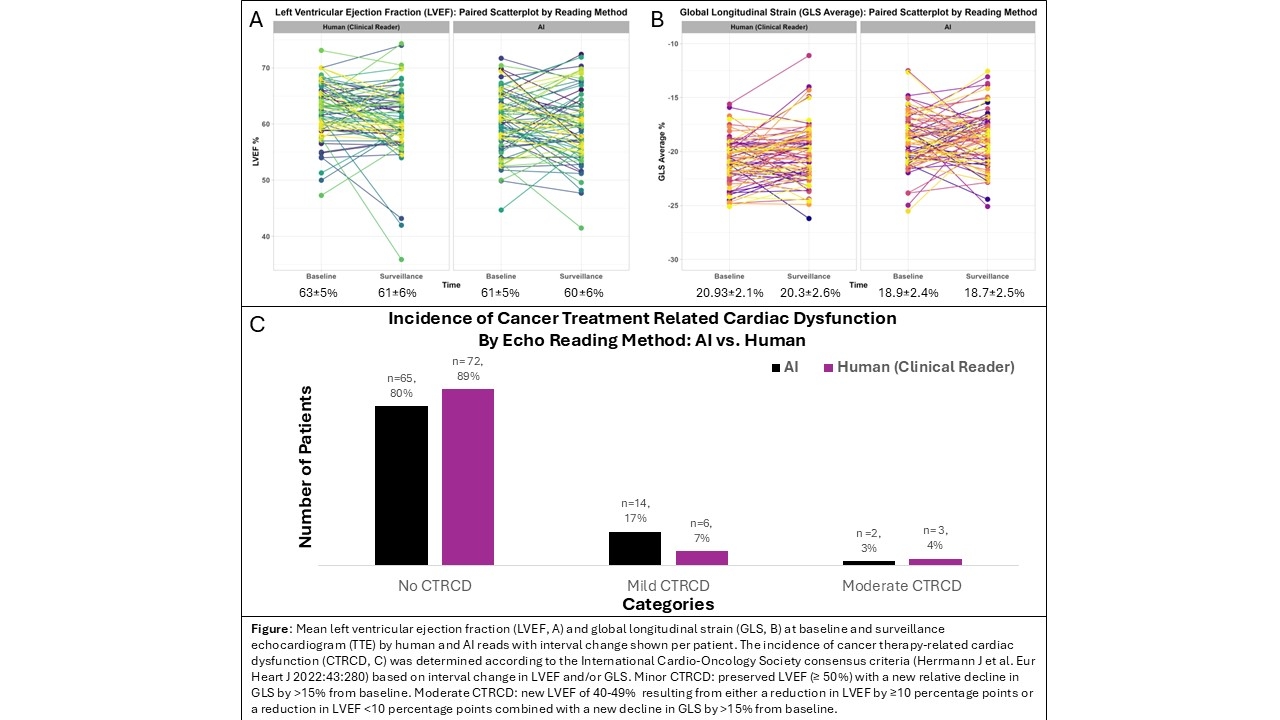
Results: With 162 TTE studies in 81 patients (mean age 54±4), the overall rates of agreement between AI and human for EF and GLS were 83% and 66%, respectively (Bland-Altman, p<0.00). The unweighted Cohen’s Kappa for baseline EF was 0.29 (95% CI 0.07-0.50, fair) and for GLS 0.07 (95% CI -0.08-0.22, slight). By the human read, the mean EF was 63±5% at baseline and 61±6% at surveillance. By AI read, the mean EF was 61±5% at baseline and 60±6% at surveillance (Figure). Mean GLS was 20.9±2.1% at baseline and 20.3±2.6% at surveillance by human and 18.9±2.4% at baseline and 18.7±2.5% at surveillance by AI. The per-patient interval changes in EF and GLS from baseline to surveillance TTE by human and AI are shown in the Figure. Based on the human read, 9 patients (11.1%) met CTRCD criteria (mild N=6, moderate N=3) compared to 16 patients (19.8%) by AI read (mild N=14, moderate N=2).

Conclusion: In this proof-of-concept study in patients with BC undergoing surveillance TTE, automated AI measurement of EF and GLS was feasible and showed fair to slight agreement with the human read. More studies met CTRCD criteria by AI compared to human, highlighting the need for research into AI’s ability to predict outcomes.
  • Brazile, Tiffany  ( Inova Schar Heart and Vascular , Falls Church , Virginia , United States )
  • Ramsey, Lolita  ( Inova Schar Heart and Vascular , Falls Church , Virginia , United States )
  • Lawrence, Humphrey  ( Inova Schar Heart and Vascular , Falls Church , Virginia , United States )
  • Frantzeskakis, Melina  ( Inova Schar Heart and Vascular , Falls Church , Virginia , United States )
  • Emaminia, Abbas  ( Inova Schar Heart and Vascular , Falls Church , Virginia , United States )
  • Slottow, Tina  ( Inova Schar Heart and Vascular , Falls Church , Virginia , United States )
  • Barac, Ana  ( Inova Schar Heart and Vascular , Falls Church , Virginia , United States )
  • Author Disclosures:
    Tiffany Brazile: DO NOT have relevant financial relationships | Lolita Ramsey: DO NOT have relevant financial relationships | Humphrey Lawrence: DO NOT have relevant financial relationships | Melina Frantzeskakis: DO NOT have relevant financial relationships | Abbas Emaminia: DO NOT have relevant financial relationships | Tina Slottow: DO NOT have relevant financial relationships | Ana Barac: No Answer
Meeting Info:

Scientific Sessions 2025

2025

New Orleans, Louisiana

Session Info:

Cardiac Imaging in Cancer Therapy: Risk Prediction, Detection, and AI-Driven Insight

Saturday, 11/08/2025 , 12:15PM - 01:25PM

Moderated Digital Poster Session

More abstracts on this topic:
A diagnostic challenge overcome with persistent clinical suspicion in a case of cardiac AL amyloidosis

Zimmerman Allison, Kuriakose Philip, Godfrey Amanda, Ananthasubramaniam Karthikeyan, Cowger Jennifer, Al-darzi Waleed

A Hemodynamic Warning Sign: Continuous Mitral Regurgitation and Normal Sinus Rhythm

Mahi Ishani, Chowdhury Mahdi, Madan Hritik, Garg Vaani

More abstracts from these authors:
Building a Women's Cardiovascular Health Program

Hayes Sharonne, Barac Ana, Reynolds Harmony, Mehta Puja

Building a Cardio-oncology Program

Asnani Aarti, Barac Ana, Clasen Suparna

You have to be authorized to contact abstract author. Please, Login
Not Available