Outcomes of Transcatheter Edge-to-Edge Repair of the Mitral Valve in Cirrhosis: A TriNetX Based Global Study
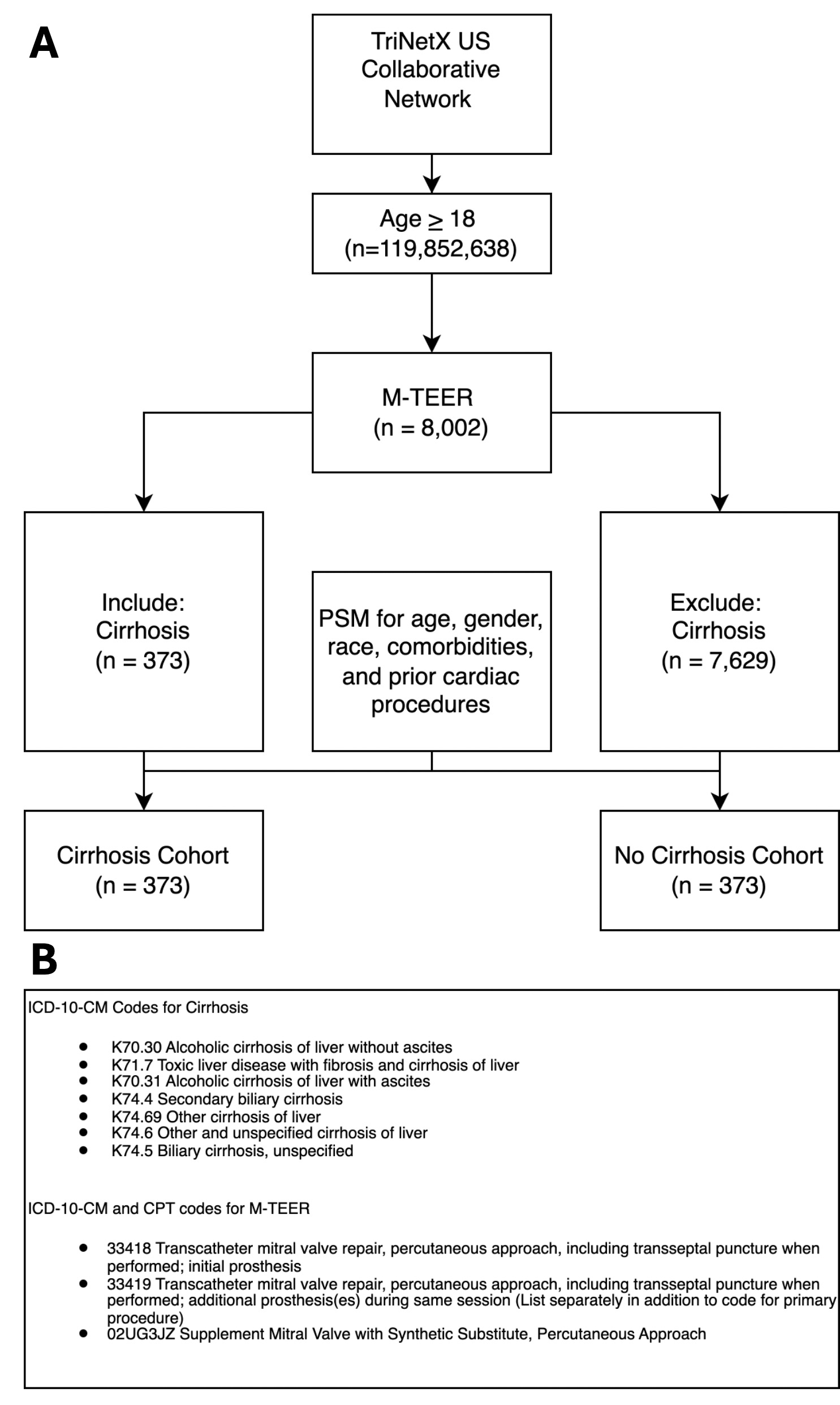
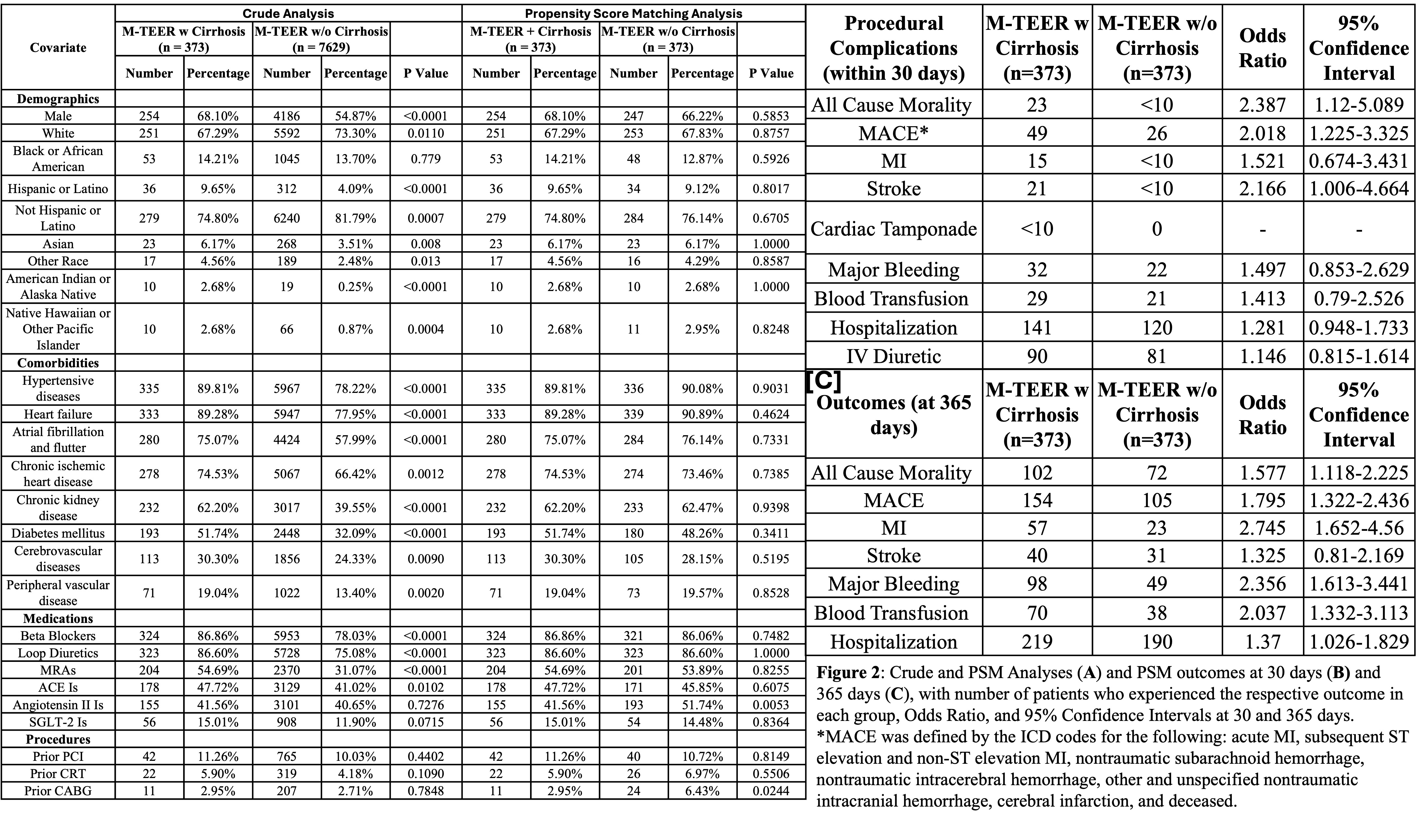
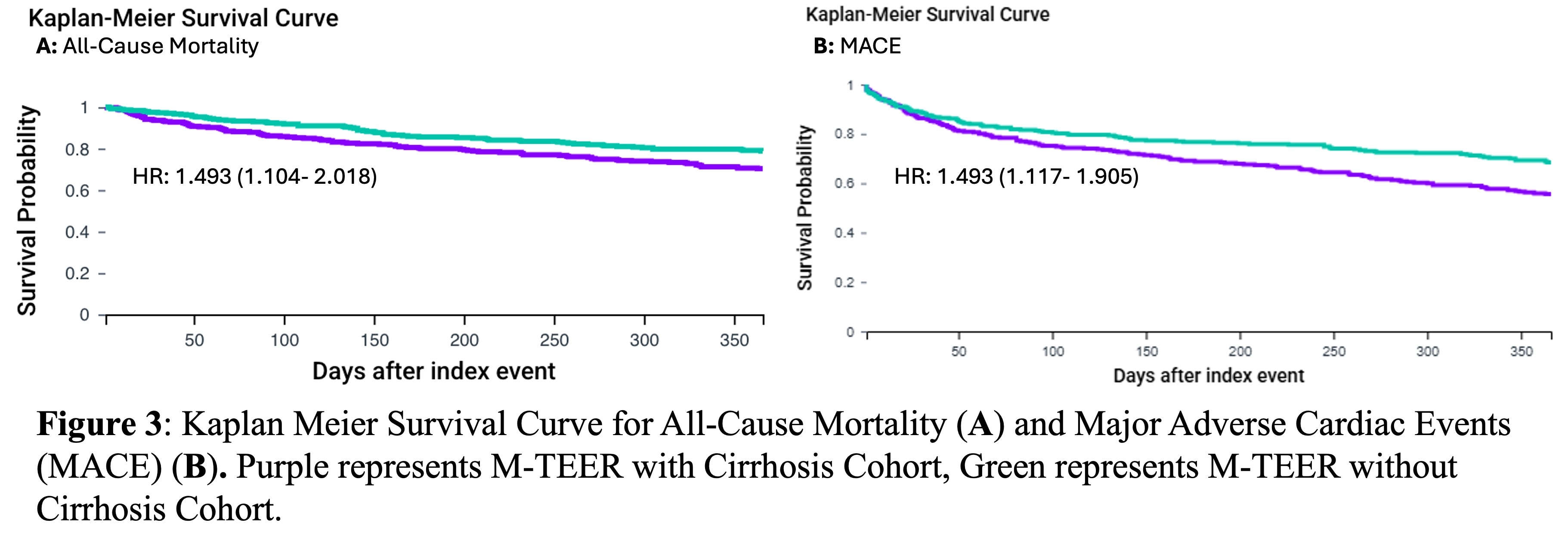
Abstract Body (Do not enter title and authors here): Introduction: Transcatheter Edge-to-Edge Repair (M-TEER) is a safe and effective intervention for both primary and secondary mitral regurgitation. Cirrhosis, a common and high-risk comorbidity, can significantly increase procedural risk. This study aims to evaluate the outcomes of M-TEER in patients with cirrhosis compared to those without cirrhosis. Methods: The TriNetX U.S. Collaborative Network was utilized to identify adult patients (age >18 years) who underwent M-TEER (n = 8,002), as depicted in Figure 1A. From this population, two cohorts were defined: patients with a prior diagnosis of cirrhosis (n = 373) and those without a history of cirrhosis (n = 7,629). The diagnostic codes used to define these groups are detailed in Figure 1B. Propensity score matching (PSM) was performed based on age, gender, race, comorbid diagnoses, and prior cardiac procedures. Clinical outcomes assessed at 30 and 365 days post-procedure included all-cause mortality, major adverse cardiac events (MACE), myocardial infarction (MI), stroke, cardiac tamponade, major bleeding, blood transfusion, hospitalization, and use of intravenous (IV) diuretics. Results: Following PSM analysis, 373 patients were present in each cohort ( Figure 2A). Within the M-TEER with cirrhosis group, there was a significantly increased odds of all-cause mortality, MACE, MI, and stroke at 30 days (Figure 2B) and significantly increased odds of all-cause mortality, MACE, MI, major bleeding, blood transfusion, and hospitalization at 365 days (Figure 2C). A Kaplan-Meier Analysis for all-cause mortality and MACE demonstrate a notable increased probability of event within the M-TEER with cirrhosis group (Figure 3A-B; purple line representing M-TEER with cirrhosis cohort and green line representing M-TEER without cirrhosis cohort). Conclusions: Patients with cirrhosis are at significantly elevated risk of death and adverse cardiac outcomes at 30 days. There was also a trend towards increased cardiac tamponade, bleeding, hospitalization, and IV diuresis at 30 days, both of which may suggest elevated procedural risk of M-TEER in patients with cirrhosis. The increased risk of adverse outcome at 365 days is likely a reflection of the severity of illness associated with cirrhosis, rather than procedural risk attributable to M-TEER. As a final point, this study is limited by its retrospective design and dependence on administrative coding.
Saeed, Yusef
(
University Hospitals CMC
, Cleveland , Ohio , United States )
Shahrori, Zaid
(
University Hospitals CMC
, Cleveland , Ohio , United States )
Dweekat, Abdallah
(
University Hospitals CMC
, Cleveland , Ohio , United States )
Ukaigwe, Anene
(
Harrington HVI, University Hospital
, Cleveland , Ohio , United States )
Tayal, Bhupendar
(
University of Arkansas for Medical Sciences
, Little Rock , Arkansas , United States )
Author Disclosures:
Yusef Saeed:DO NOT have relevant financial relationships
| Zaid Shahrori:DO NOT have relevant financial relationships
| Abdallah Dweekat:No Answer
| Anene Ukaigwe:DO have relevant financial relationships
;
Speaker:Boston Scientific:Active (exists now)
; Speaker:Edwards Lifesciences:Active (exists now)
; Consultant:Medtronic Inc:Active (exists now)
| Bhupendar Tayal:No Answer