Logo

American Heart Association

  12
  0


Final ID: MP791

Serum Transthyretin as a Screening Tool For Transthyretin Amyloid Cardiomyopathy

Abstract Body (Do not enter title and authors here): Abstract
Introduction
Diagnosing transthyretin amyloid cardiomyopathy (ATTR-CM) remains challenging due to overlapping clinical features with causes of heart failure. Current screening tools primarily detect advanced disease and often miss early or atypical presentations of ATTR-CM. Serum transthyretin (TTR) has emerged as a potential low-cost biomarker for broad ATTR-CM screening.
Aims
To evaluate whether serum TTR can facilitate screening for ATTR-CM in patients with suspected disease.
Methods
In this multicentre diagnostic study, serum TTR concentrations were compared between patients with ATTR-CM (n=96 in the development cohort; n=812 in the validation cohort) and non-amyloid controls (n=183 development cohort; n=215 validation cohort). The optimal cut-off value was determined using Youden’s index. Multivariable logistic regression was performed to assess the association between serum TTR and ATTR-CM, adjusted for clinical factors (e.g. Age, sex, NT-proBNP, hsTnT and echocardiographic parameters).
Results
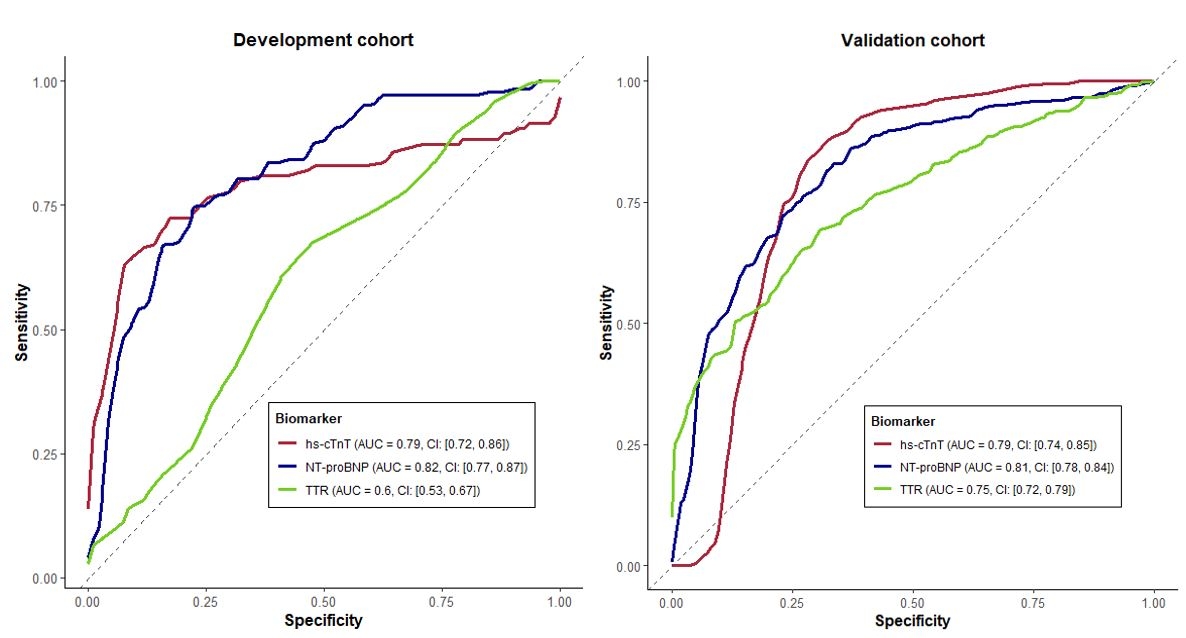
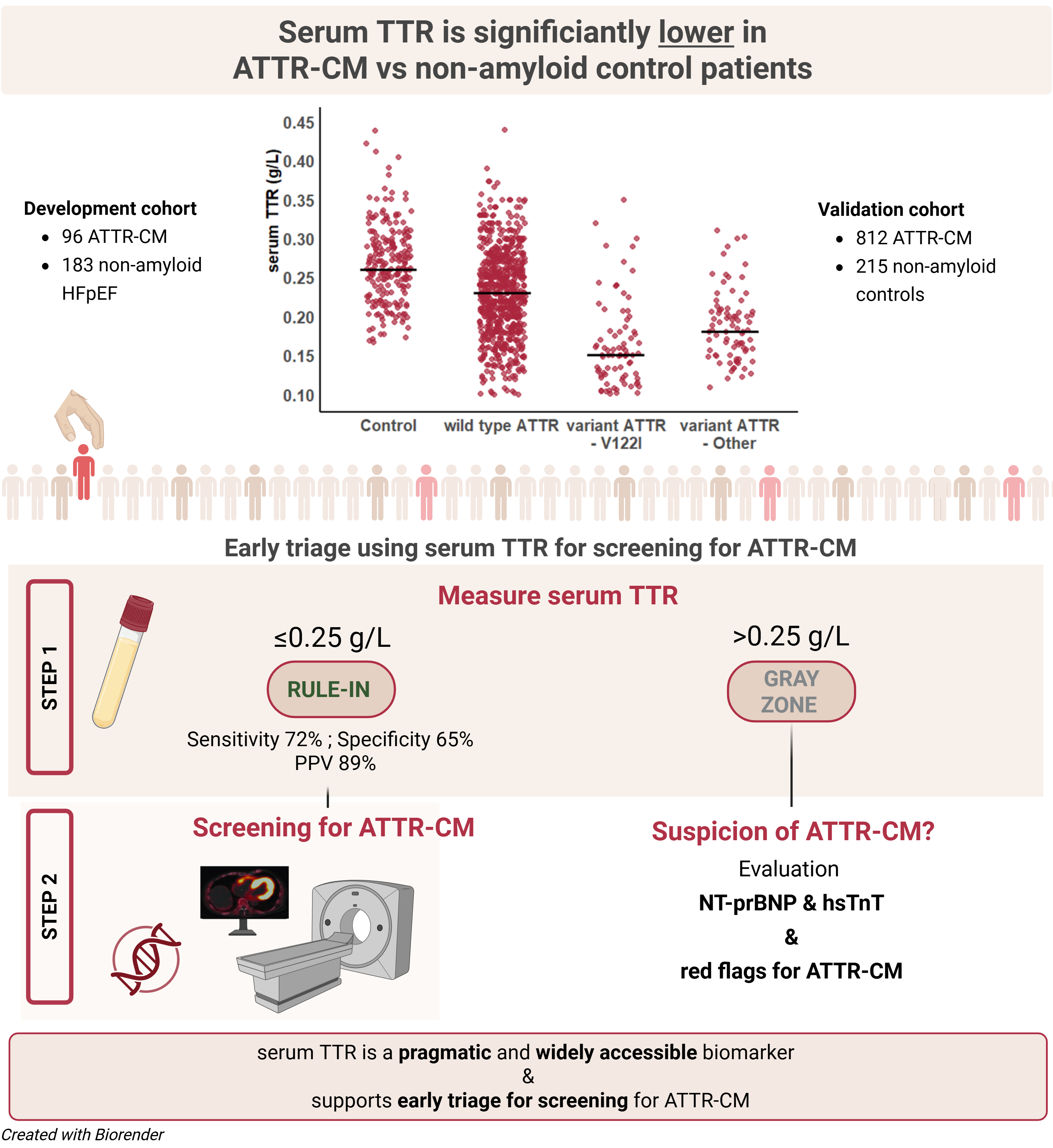
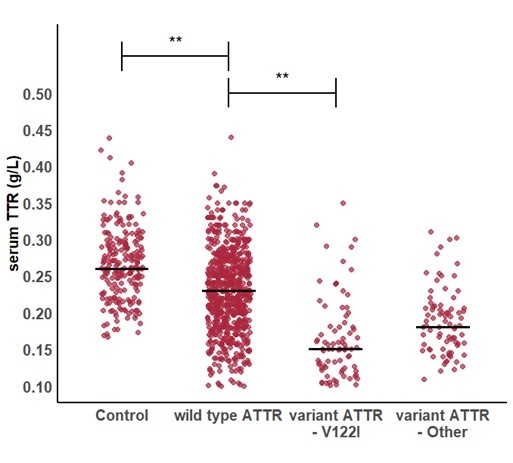
Serum TTR was significantly lower in ATTR-CM compared to controls (Figure 1; p<0.001), even after matching for age, sex and body mass index. Patients with variant ATTR-CM had significantly lower serum TTR concentration compared to those with wild-type ATTR-CM (0.16g/L – IQR [0.13, 0.20] vs 0.22g/L IQR [0.19, 0.26] respectively, p<0.001). Variant ATTR-CM patients with the p.(V142I) variant presented with the lowest serum TTR concentration (0.15g/L IQR [0.11, 0.18], Figure 1). The diagnostic performance of TTR alone was modest (AUC 0.60–0.75). A threshold of ≤0.25 g/L was identified as the optimal cut-off (Figure 2). In the validation cohort, a serum TTR level ≤0.25 g/L had 72% sensitivity and 65% specificity with a positive predictive value 89% for ATTR-CM. Multivariable regression confirmed serum TTR concentration as an independent predictor of ATTR-CM (adjusted OR 0.25 per 0.1 g/L increase, p<0.001).
Conclusion
A serum TTR concentration of ≤0.25 g/L is a strong indicator of underlying ATTR-CM in heart failure patients. Routine measurement of serum TTR could serve as a simple, accessible, and cost-effective initial screening tool to identify patients who should undergo diagnostic evaluation for ATTR-CM. Incorporating serum TTR into clinical pathways may facilitate earlier diagnosis and enable timely initiation of disease-modifying therapies.
  • Achten, Anouk  ( Maastricht University CARIM School , Maastricht , Netherlands )
  • Tingen, Hendrea Sa  ( University Medical Centre Groningen , Grongingen , Netherlands )
  • Sheikh, Awais  ( National Amyloid Centre , London , United Kingdom )
  • Nienhuis, Hans La  ( University Medical Centre Groningen , Grongingen , Netherlands )
  • Fontana, Marianna  ( National Amyloid Centre , London , United Kingdom )
  • Knackstedt, Christian  ( Maastricht University CARIM School , Maastricht , Netherlands )
  • Gillmore, Julian  ( National Amyloid Centre , London , United Kingdom )
  • Author Disclosures:
    Anouk Achten: DO NOT have relevant financial relationships | Hendrea SA Tingen: No Answer | Awais Sheikh: DO NOT have relevant financial relationships | Hans LA Nienhuis: No Answer | Marianna Fontana: DO have relevant financial relationships ; Consultant:Alnylam, Alexion/Caelum Biosciences, Astrazeneca, Bridgbio/Eidos, Prothena, Attralus, Intellia Therapeutics, Ionis Pharmaceuticals, Cardior, Lexeo Therapeutics, Janssen Pharmaceuticals, Prothena, Pfizer, Novonordisk, Bayer, Mycardium:Active (exists now) ; Individual Stocks/Stock Options:Mycardium (shares):Active (exists now) ; Individual Stocks/Stock Options:LexeoTherapeutics (share options):Active (exists now) ; Other (please indicate in the box next to the company name):Alnylam, Bridgbio, Astrazeneca, Pfizer.(research grants):Active (exists now) | Christian Knackstedt: DO have relevant financial relationships ; Advisor:Bayer:Active (exists now) ; Research Funding (PI or named investigator):Pfizer:Past (completed) ; Advisor:Alnylam:Active (exists now) ; Advisor:Philips:Active (exists now) ; Advisor:Cytokinetics:Active (exists now) ; Advisor:BMS:Active (exists now) ; Advisor:Pfizer:Active (exists now) | Julian Gillmore: No Answer
Meeting Info:

Scientific Sessions 2025

2025

New Orleans, Louisiana

Session Info:

Under the Sheets: Contemporary Cardiac Amyloidosis Research

Saturday, 11/08/2025 , 09:15AM - 10:25AM

Moderated Digital Poster Session

More abstracts on this topic:
More abstracts from these authors:
Refining Prediction of Cerebrovascular Events in ATTR-CM with Sinus Rhythm to Guide Preventive Anticoagulation

Porcari Aldostefano, Solomon Scott, Martinez-naharro Ana, Hawkins Philip, Gillmore Julian, Fontana Marianna, Dal Passo Beatrice, Venneri Lucia, Bandera Francesco, Razvi Yousuf, Sheikh Awais, Mansell Josephine, Zaro Elisa, Giampieri Gaia

Effects of Vutrisiran on Measures of Cardiac Structure, Function and Amyloid Burden by Cardiovascular Magnetic Resonance from the HELIOS-B Trial

Razvi Yousuf, Bansilal Sameer, Eraly Satish, Aldinc Emre, Solomon Scott, Gillmore Julian, Fontana Marianna, Sheikh Awais, Patel Rishi, Achten Anouk, Mansell Josephine, Martinez-naharro Ana, Venneri Lucia, Hawkins Philip, Vest John

You have to be authorized to contact abstract author. Please, Login
Not Available