The Associations of Energy Intake with All-cause Mortality among Adults with Cardiometabolic Diseases: A National Prospective Cohort Study
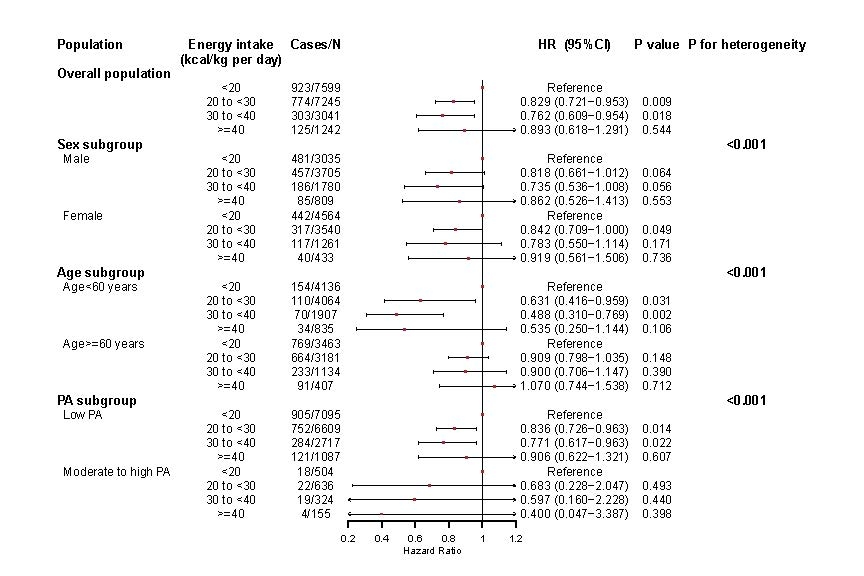
Abstract Body (Do not enter title and authors here): Background Dietary risks, including energy intake, contribute to disease burden. We examined associations of energy intake with all-cause mortality in American adults with cardiometabolic diseases. Methods This prospective cohort study used NHANES 1999-2018 data. Energy intake (kcal/kg/day) was calculated as daily calorie intake divided by ideal (IBW) or actual body weight. Cardiometabolic diseases included obesity, hypertension, diabetes, high cholesterol, heart failure, stroke, and coronary artery disease. Covariates included age, sex, race, education, smoking, drinking, body mass index (BMI), history of respiratory disease, and history of cancer. Cox models estimated adjusted hazard ratios (HRs) and 95% CIs across different age, sex, and physical activity (PA) level. Restricted cubic splines analyzed dose-response relationships. Results Among 19,127 adults (mean follow-up: 8.88±0.11 years), energy intake and mortality showed a nonlinear relationship. Adjusted for IBW, 30-<40 kcal/kg IBW/day had the lowest mortality risk (HR=0.792, 95% CI: 0.629–0.978, P=0.028). Subgroup analyses revealed heterogeneity: females had lower mortality at 20-<30 (HR=0.702, P=0.005) and 30-<40 kcal/kg IBW/day (HR=0.738, P=0.047), while males showed no association. Younger adults (<60 years) had maximal protection at ≥40 kcal/kg IBW/day (HR=0.553, P=0.021), whereas older adults (≥60 years) benefited at 20-<30 kcal/kg IBW/day (HR=0.781, P=0.030). Low-PA individuals mirrored overall trends (30-<40 kcal/kg IBW/day: HR=0.804, P=0.037), but moderate-to-high PA subgroups showed no association. Actual weight-adjusted intake yielded similar results (optimal: 30-<40 kcal/kg/day, HR=0.762, P=0.018). Younger adults required higher intake (≥40 kcal/kg/day: HR=0.488, P=0.002), while older adults benefited at 20-<30 kcal/kg/day (HR=0.702, P=0.005). Dose-response analyses confirmed nonlinearity (P<0.05) overall and in females, older adults, and low-PA subgroups. Conclusion Energy intake exhibited a nonlinear relationship with all-cause mortality in cardiometabolic disease patients. Lowest risk occurred at 30-<40 kcal/kg/day (ideal/actual weight). Subgroup heterogeneity underscores the need for personalized nutrition guidance over generalized recommendations.
Li, Qi
(
Fuwai Hospital
, Beijing , China )
Gao, Mingyou
(
Fuwai Hospital
, Beijing , China )
Li, Wei
(
Fuwai Hospital
, Beijing , China )
Author Disclosures:
Qi Li:DO NOT have relevant financial relationships
| Mingyou Gao:No Answer
| Wei Li:No Answer