
Logo

American Heart Association

  23
  0


Final ID: MP997

Fuzheng Kangfu Decoction Inhibits Neutrophil Extracellular Traps Formation and Excessive Inflammation, Alleviating Atrial Fibrillatio

Abstract Body (Do not enter title and authors here): Background: Atrial fibrillation (AF) significantly increases the risk of stroke and heart failure, with high disability and mortality rates. Recent studies have shown that neutrophil extracellular traps (NETs) contribute to AF pathogenesis by aggravating myocardial injury via cytotoxic effects on cardiomyocytes and activation of inflammatory cascades. Fuzheng Kangfu Decoction (FZKF), a traditional Chinese herbal formula comprising Codonopsis pilosula, Poria cocos, and other herbs, has shown clinical efficacy in treating AF and AF with heart failure, but its mechanisms remain unclear. This study aimed to explore FZKF’s regulatory effects on NETs in vitro and in vivo to better understand its anti-AF mechanism.
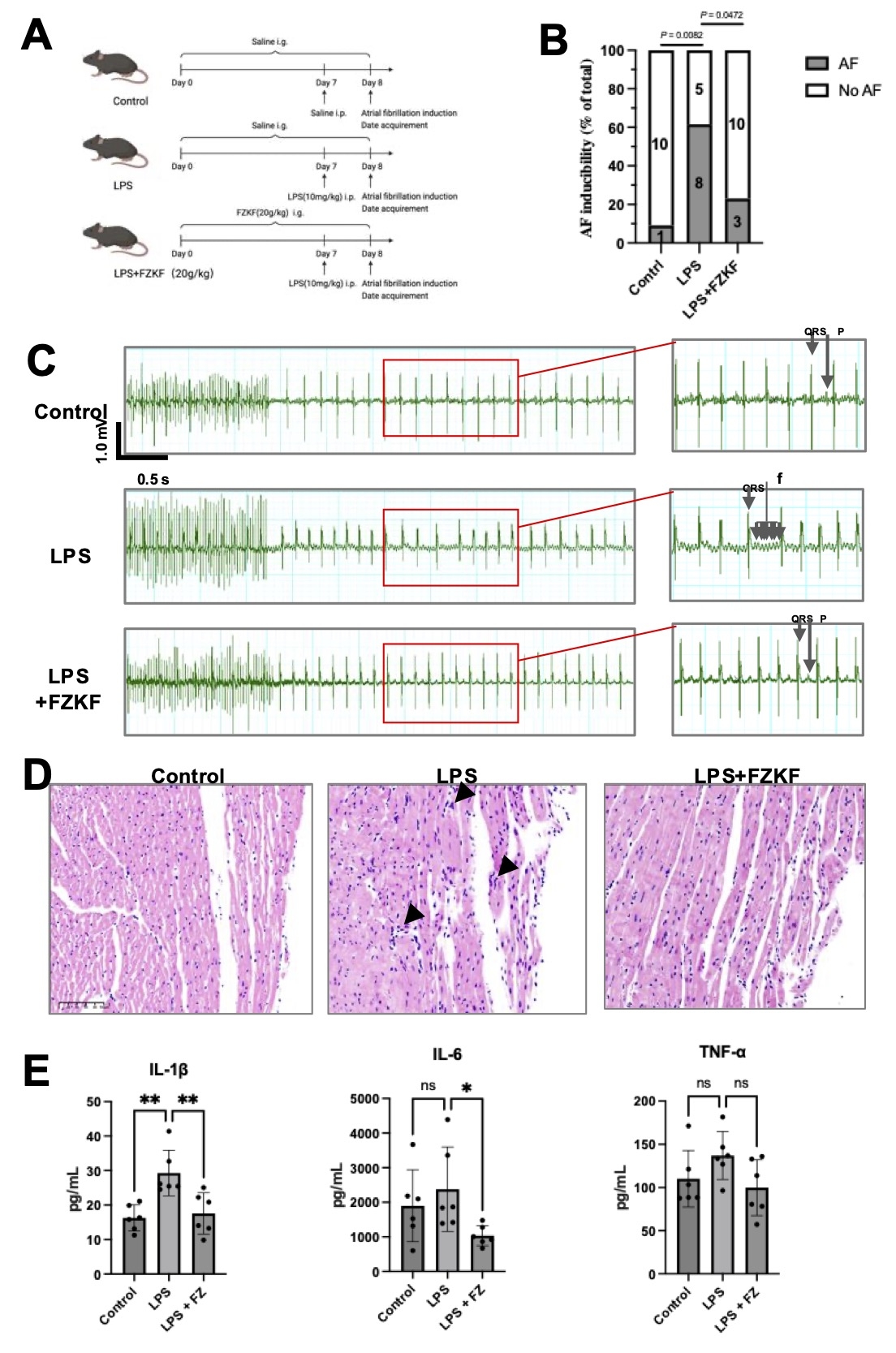
Methods and Results: An AF mouse model was induced by intraperitoneal lipopolysaccharide and high-frequency (35 Hz) electrical stimulation. FZKF treatment significantly reduced AF inducibility, as shown by more regular RR intervals and fewer fibrillatory waves on electrocardiogram. It also mitigated atrial tissue injury and reduced pro-inflammatory cytokines, as assessed by H&E staining and ELISA. Immunostaining showed that FZKF suppressed NETs formation, with decreased expression of neutrophil markers (Ly6G, CD11b) and NETs components (ELA2, MPO) in left atrial tissue. Western blot confirmed reduced expression of citrullinated histone H3 (Cit-H3), a NET-specific marker. Atrial RNA-seq data revealed neutrophil involvement and implicated damage-associated molecular patterns (DAMPs), such as HMGB1 and HMGB2, suggesting possible underlying mechanisms.
At the cellular level, primary neutrophils were stimulated with conditioned medium (CM) from rapid-paced murine atrial HL-1 cells. FZKF treatment reduced both HMGB1 and HMGB2 mRNA in HL-1 cells, while a significant reduction was observed in HMGB2 protein levels, both intracellularly and in the CM. Importantly, CM from FZKF-treated HL-1 cells exhibited a markedly reduced ability to promote neutrophil chemotaxis (Transwell assay) and NETs formation (MPO-positive reticular structures and Cit-H3 expression).
Conclusion: This study demonstrates that FZKF’s anti-AF effect may involve suppression of cardiomyocyte-derived DAMPs and neutrophil NETs formation, thereby alleviating inflammation-mediated atrial injury and reducing AF susceptibility.
  • Chen, Xuechun  ( Hangzhou first people's hospital , Hangzhou , China )
  • Xu, Linhao  ( Hangzhou first people's hospital , Hangzhou , China )
  • Xu, Yizhou  ( Hangzhou first people's hospital , Hangzhou , China )
  • Author Disclosures:
    Xuechun Chen: DO NOT have relevant financial relationships | Linhao Xu: DO NOT have relevant financial relationships | Yizhou Xu: No Answer
Meeting Info:

Scientific Sessions 2025

2025

New Orleans, Louisiana

Session Info:

Inflammation as a Driver of Arrhythmic Risk: Pathophysiology and Therapeutic Implications

Saturday, 11/08/2025 , 10:45AM - 12:00PM

Moderated Digital Poster Session

More abstracts on this topic:

A Large Animal Model of Persistent Atrial Fibrillation

Mostafizi Pouria, Goldman Steven, Moukabary Talal, Lefkowitz Eli, Ref Jacob, Daugherty Sherry, Grijalva Adrian, Cook Kyle Eric, Chinyere Ike, Lancaster Jordan, Koevary Jen

A mechanism whereby SGLT2 inhibitor dapagliflozin reverses cardiac diastolic dysfunction in a model of HFpEF

Liu Man, Liu Hong, Kang Gyeoung-jin, Kim Eunji, Neumann Mitchell, Johnson Madeline, Murikinati Ruthvika, Dudley Samuel

You have to be authorized to contact abstract author. Please, Login
Not Available