
Logo

American Heart Association

  15
  0


Final ID: MP2052

Temporary Atrial Pacing to Lower Left Ventricular Filling Pressures in Restrictive Cardiomyopathy: A Case Report

Abstract Body (Do not enter title and authors here): Introduction:
An 85-year-old man presented to the hospital with acute on chronic diastolic heart failure secondary to transthyretin cardiac amyloidosis. He has a known history of grade III diastolic dysfunction with NYHA Class IIIb symptoms.
His past medical history includes paroxysmal atrial fibrillation on Sotalol, hypertension, Type 2 diabetes mellitus, chronic kidney disease stage 3B, hypothyroidism, restrictive cardiomyopathy with heart failure with reduced ejection fraction, and prior triple vessel coronary artery bypass graft.
On presentation:
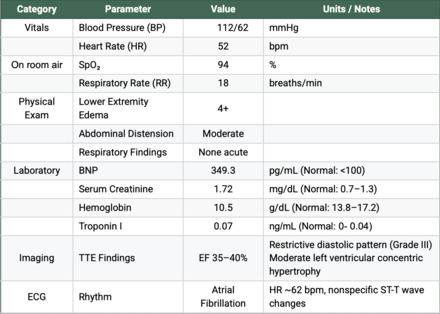
Initial clinical findings including vitals, labs, and imaging are summarized in Figure 1
He was initially treated with intravenous furosemide but had limited response. It was noted that during atrial fibrillation his symptoms worsened, likely due to loss of atrial kick. His home sotalol was changed to amiodarone to improve rhythm control, but this resulted in bradycardia, further contributing to symptoms.
Hypothesis:
Given his restrictive cardiomyopathy, we suspected a fixed stroke volume and heart rate dependency for cardiac output (CO). Thus, we proceeded with right heart catheterization to better assess his volume status and hemodynamics.
Methods:
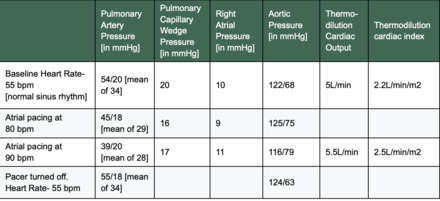
A pulmonary artery catheter was placed for pressure and CO measurements, along with a temporary right atrial pacemaker wire. Pulmonary artery and pulmonary capillary wedge pressures, along with thermodilution CO, were recorded at baseline and during atrial pacing at multiple rates to assess hemodynamic changes.
Results:
Hemodynamic parameters at baseline and during atrial pacing are shown in Figure 2.
Gradual increases in atrial pacing led to reductions in pulmonary artery and wedge pressures, while cardiac output remained stable. These findings suggest that in restrictive physiology with chronotropic incompetence, modest atrial pacing may lower filling pressures as a result of shortened diastolic filling time, without compromising cardiac output.
Conclusion:
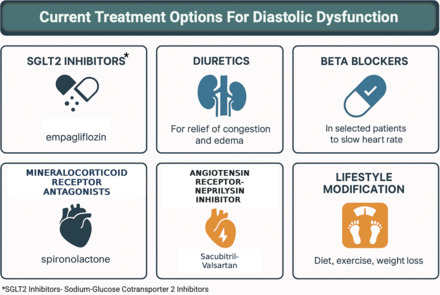
Current treatment of advanced diastolic heart failure (Figure 3) focuses primarily on preload reduction. We propose atrial pacing to shorten diastolic filling time as an alternate approach to lower left ventricular filling pressures. Further studies are warranted to explore device-based therapy for these patients.
  • Desai, Twaraa  ( Seth G.S. Medical College and KEMH , Mumbai , India )
  • Shukla, Pranav  ( Grant Medical College and JJ Hospital , Mumbai , India )
  • Purewal, Vikramjit  ( HonorHealth , Tempe , Arizona , United States )
  • Singh, Inderpal  ( St. Joseph's Hospital , Phoenix , Arizona , United States )
  • Bond, Rachel  ( Dignity Health Medical Group , Chandler , Arizona , United States )
  • Sraow, Dan Inder  ( Sun State Cardiology , Chandler , Arizona , United States )
  • Author Disclosures:
    Twaraa Desai: DO NOT have relevant financial relationships | Pranav Shukla: No Answer | Vikramjit Purewal: DO NOT have relevant financial relationships | Inderpal Singh: DO NOT have relevant financial relationships | Rachel Bond: DO NOT have relevant financial relationships | Dan Inder Sraow: DO NOT have relevant financial relationships
Meeting Info:

Scientific Sessions 2025

2025

New Orleans, Louisiana

Session Info:

Heart Failure and Cardiomyopathy: Disease Management and Outcomes

Monday, 11/10/2025 , 12:15PM - 01:10PM

Moderated Digital Poster Session

More abstracts on this topic:
More abstracts from these authors:
Pulsed-Field Ablation Achieves Superior 12-Month Arrhythmia-Free Survival, Comparable Safety, and Shorter Procedure Times Versus Thermal Ablation in Paroxysmal Atrial Fibrillation: An Updated Systematic Review and Meta-Analysis

Purewal Vikramjit, Verma Juhi, Bhatti Muqadas, Ahmed Alisha, Veldi Venkata Dileep Kumar, Das Ashesh, Sharma Bhavya, Arora Amrit, Sadana Atul, Keswani Krish, Vithalani Manal, . Anveshak

Pregnancy & Hypertension: Novel Assessment Tools and Therapeutic Thresholds

Njoroge Joyce, Bond Rachel

You have to be authorized to contact abstract author. Please, Login
Not Available