Conduction System Pacing: Short and Long-Term Clinical Outcomes in a Developing Country
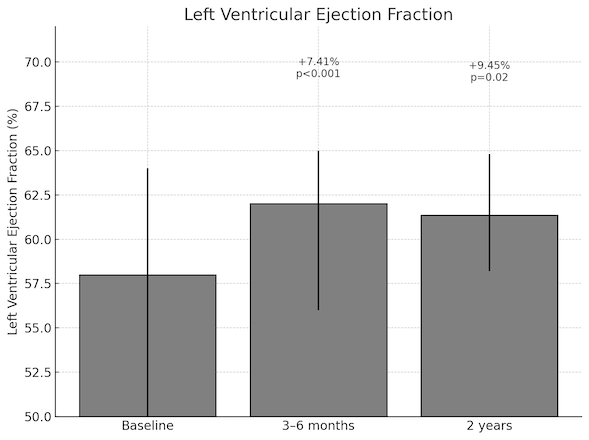
Abstract Body (Do not enter title and authors here): Introduction: Conduction system pacing (CSP) is a more physiological pacing strategy with fewer deleterious effects compared to conventional myocardial pacing. However, data on outcomes beyond 1 year remain scarce. We aimed to evaluate electrocardiographic (ECG), echocardiographic (echo), and New York Heart Association (NYHA) functional class (FC) outcomes over a 2-year follow-up. Methods: Consecutive patients undergoing CSP between January 2020 and April 2025 were prospectively enrolled at 3 Brazilian centers. Patients underwent clinical assessment, standardized transthoracic echo at baseline and follow-up (3–6 months, 2 years), and digital ECG pre- and post-procedure. Variables of interest included QRS duration (ms), NYHA FC, and left ventricular ejection fraction (LVEF). Pre/post comparisons were assessed using the Wilcoxon test, and temporal parameter variation was compared between patients with reduced (<50%) vs. preserved LVEF using the Mann-Whitney test. Results: A total of 205 patients (mean age 77±14 years, 62% male) were enrolled; 63% were in NYHA FC III or IV and 24 (12%) had Chagas chronic cardiomyopathy. Left bundle branch pacing was performed in 151 (74%), His bundle pacing in 46 (22%), and 8 (4%) underwent additional cardiac resynchronization therapy via the coronary sinus. CSP significantly narrowed QRS duration from 140 (IQR 100–160) to 110 (95–120) ms (p<0.001); 130 patients (63%) demonstrated numerical QRS narrowing. Clinical and echo early follow-up was available for 152 (74%) and 117 (57%) patients, respectively. LVEF increased from 58% (43–64) to 62% (56–65) (p<0.001), and NYHA FC improved from 2.9 (2.0–3.0) to 1.4 (1.0–2.0) (p<0.001); only 7 patients remained in FC III or IV. Patients with baseline LVEF <50% (N=55, 32%) had greater QRS narrowing (-40 vs. -19 ms, p<0.001) and greater LVEF improvement (+11.0% vs. +0.1%, p<0.001) than those with preserved LVEF, while NYHA FC improvement was similar between groups. Among 39 patients with complete 2-year follow-up, LVEF gains persisted (+9.45%, p=0.02) (Image 1), as did FC improvement (-51.2%, p<0.001). Conclusions: CSP resulted in significant QRS narrowing, LVEF improvement, and sustained NYHA FC improvement, with greater early benefits in patients with LV dysfunction. Improvements were maintained through 2 years of follow-up.
Soares Sousa, Daniel
(
Hospital Madre Teresa
, Belo Horizonte , Brazil )
Mesquita, Leonardo
(
Hospital Madre Teresa
, Belo Horizonte , Brazil )
Diniz, Thulio
(
Complexo de Saúde São João de Deus
, Divinópolis , Minas Gerais , Brazil )
Tostes, Paulo
(
Complexo de Saúde São João de Deus
, Divinópolis , Minas Gerais , Brazil )
Silva Barbosa, Rodrigo
(
Complexo de Saúde São João de Deus
, Divinópolis , Minas Gerais , Brazil )
Miranda, Carlos
(
Hospital Madre Teresa
, Belo Horizonte , Brazil )
Brito, Mitermayer
(
Hospital Madre Teresa
, Belo Horizonte , Brazil )
Andrade, Yane
(
Hospital Madre Teresa
, Belo Horizonte , Brazil )
Lelis, Sarah
(
Complexo de Saúde São João de Deus
, Divinópolis , Minas Gerais , Brazil )
Nascimento, Bruno
(
Universidade Federal de MG
, Belo Horizonte , Brazil )
Author Disclosures:
DANIEL SOARES SOUSA:No Answer
| Bruno Nascimento:DO NOT have relevant financial relationships
| Leonardo Mesquita:DO NOT have relevant financial relationships
| Thulio Diniz:No Answer
| Paulo Tostes:No Answer
| Rodrigo Silva Barbosa:No Answer
| CARLOS MIRANDA:No Answer
| Mitermayer Brito:No Answer
| Yane Andrade:No Answer
| Sarah Lelis:No Answer