Subclinical Inflammatory Biomarker Profiles and Associations with Future Chronic Inflammatory-Related Disease and Cardiovascular Disease in the Multi-Ethnic Study of Atherosclerosis
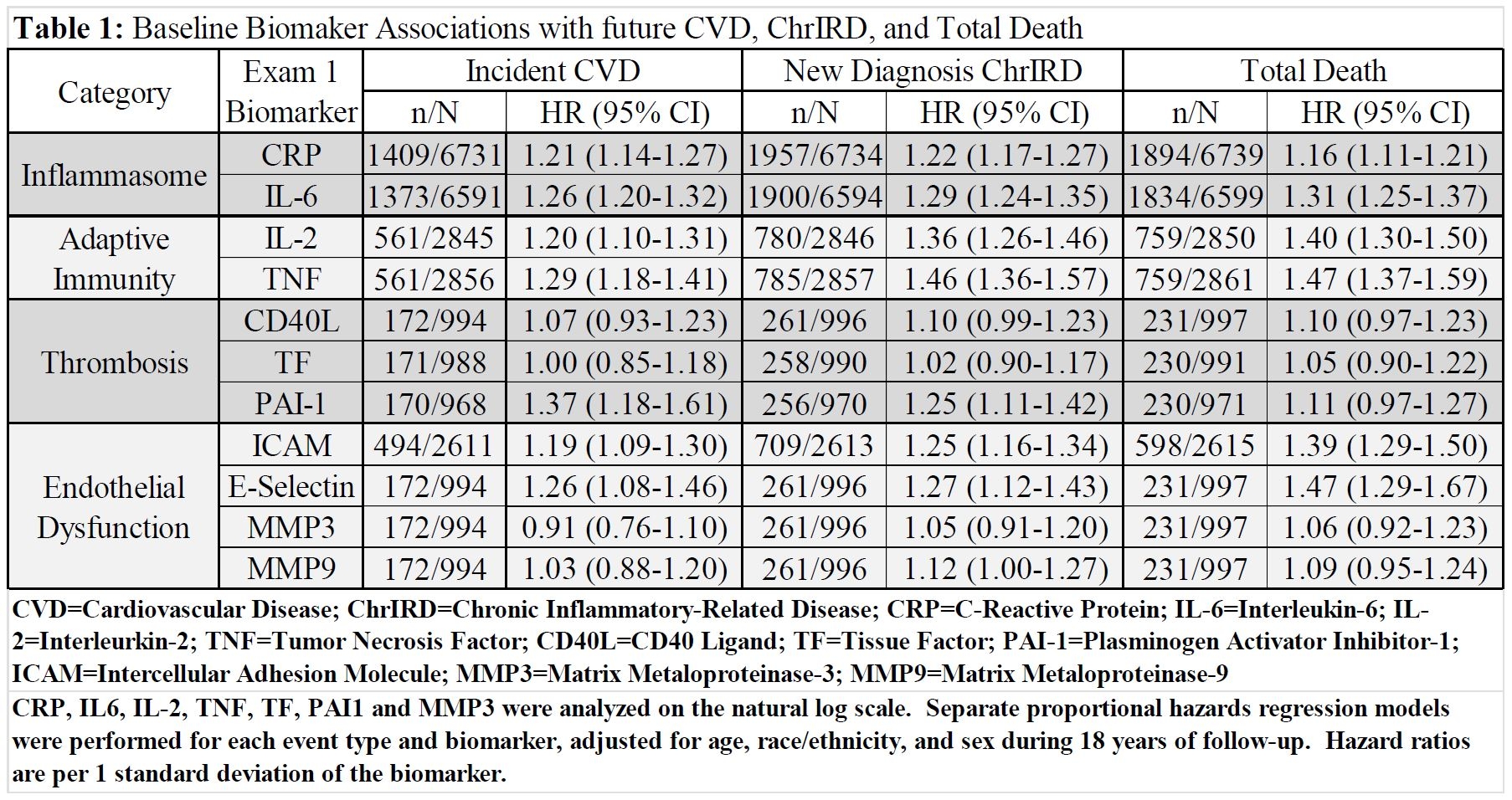
Abstract Body (Do not enter title and authors here): Background Inflammation is associated with cardiovascular diseases (CVD). We previously described Chronic Inflammatory-Related Disease (ChrIRD), a composite of non-cardiovascular, non-diabetes, and non-cancer pathologies, both infectious and non-infectious, with a common basis of inflammation. ChrIRD had a bidirectional association with CVD, was predated by elevated inflammatory biomarker levels, and portended high mortality. ChrIRD represents a unique opportunity to study underlying inflammatory processes that link clinical inflammatory disease and CVD. Hypothesis We hypothesize that a subclinical biochemical profile consistent with inflammasome activity is associated with future ChrIRD and CVD while profiles of other inflammatory pathways associated with atherogenesis may associate differentially. Methods In 2000-2002 the Multi-Ethnic Study of Atherosclerosis (MESA) enrolled 6,814 participants aged 45-84 and free of overt CVD. ChrIRD diagnosis was based on review of hospital and death ICD codes. Incident CVD was adjudicated by review of medical records. Inflammation biomarker levels were measured in baseline blood samples and categorized as associated primarily with inflammasome activity, adaptive immune system activation, thrombosis, or endothelial dysfunction. We performed separate age, race, sex adjusted proportional hazards regressions for these baseline biomarker groups and future ChrIRD, future CVD, and mortality. Results Participants had mean age 62±10 years and 47% were male. Baseline biomarker associations are summarized in Table 1. Each outcome occurred in about 20% of participants. Biomarkers associated with inflammasome activity and adaptive immune system activity were associated with future ChrIRD, CVD, and mortality. Among biomarkers associated with thrombosis, only PAI-1 was associated with future ChrIRD and CVD but not mortality. For endothelial dysfunction, matrix metalloproteinases were not associated whereas cellular adhesion markers ICAM and E-Selectin were associated with ChrIRD, CVD, and mortality. Conclusions Subclinical biochemical profiles consistent with increased inflammasome activity and various inflammatory mechanisms associated with atherogenesis predict both future ChrIRD and CVD.
Manning, Evan
(
University of Minnesota
, Saint Paul , Minnesota , United States )
Jacobs, David
(
University of Minnesota
, Minnetonka , Minnesota , United States )
Duprez, Daniel
(
University of Minnesota
, Minneapolis , Minnesota , United States )
Author Disclosures:
Evan Manning:DO NOT have relevant financial relationships
| David Jacobs:DO NOT have relevant financial relationships
| Daniel Duprez:DO have relevant financial relationships
;
Research Funding (PI or named investigator):Novartis:Active (exists now)
; Research Funding (PI or named investigator):Arrowhead Pharmaceuticals:Active (exists now)
; Research Funding (PI or named investigator):Merck:Active (exists now)
; Research Funding (PI or named investigator):Amgen:Active (exists now)