
Artificial Intelligence enabled Electrocardiograms (AI-ECG) and Pregnancy Related Cardiomyopathy: a Systematic Review and Diagnostic Meta-Analysis
Abstract Body (Do not enter title and authors here): Background
Cardiomyopathy occurring during pregnancy or in the postpartum period is a leading case of maternal death in the US. The most commonly described form of pregnancy related cardiomyopathy (PRCM) associated with left ventricular systolic dysfunction is peripartum cardiomyopathy, defined as left ventricular ejection fraction (LVEF) <45% on echocardiography. PRCM symptoms often overlap with those of normal pregnancy and the lack of validated screening tools limits effective recognition, contributing to diagnostic delays. Recently, several artificial intelligence enabled electrocardiogram (AI-ECG) models have been developed and evaluated for PRCM detection.
Aim & Hypothesis
We sought to investigate the pooled diagnostic performance of AI-ECG models for detecting PRCM. We hypothesized that AI-ECG models would be effective for detecting PRCM.
Methods
A systematic search of PubMed, Scopus, and Cochrane was performed by combining search terms “artificial intelligence”, “machine learning”, “deep learning”, “algorithm”, “ECG”, “EKG”, “electrocardiogram”, “peripartum cardiomyopathy”, “pregnancy”, “pregnancy related cardiomyopathy”, to identify studies investigating the use of AI-ECG models for PRCM detection. Studies included those utilizing standard 12-lead ECGs as well as single lead ECGs from various devices. For inclusion in the meta-analysis, studies had to provide complete confusion matrix data for the AI-ECG model. Inverse variance random effects model meta-analysis was performed. Pooled performance estimates with corresponding 95% CIs are presented in forest plots and a summary receiver operating characteristics (sROC) curve.
Results
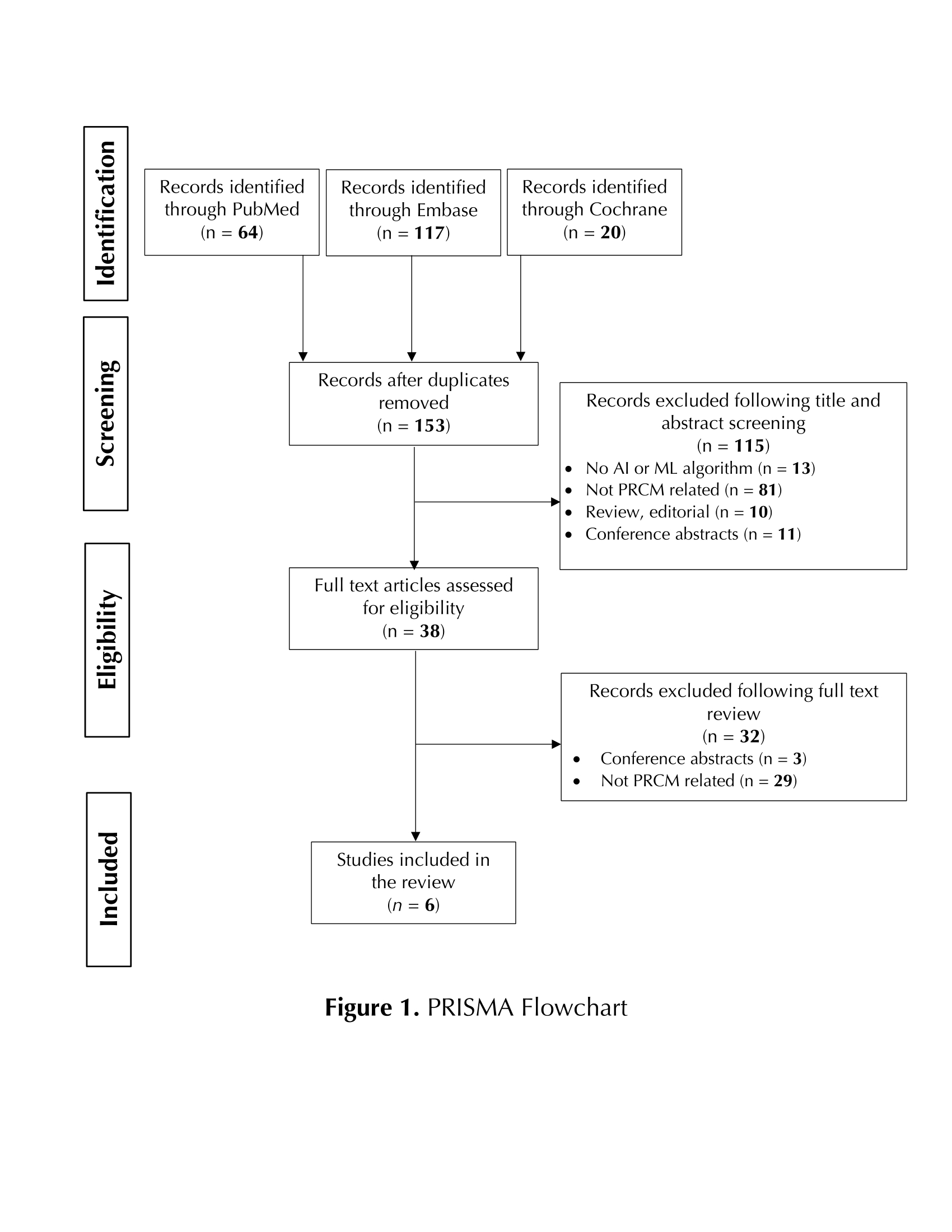
Our search identified a total of 201 studies (PubMed: 64, Embase: 117, Cochrane: 20) from which 6 studies involving 11 AI-ECG models and 3,006 patients were included in the meta-analysis (Fig. 1). Following random effect bivariate meta-analysis, the AI-ECG models yielded a pooled sensitivity of 0.721 (95% CI 0.676–0.762); specificity of 0.931 (95% CI 0.932–0.938); diagnostic odds ratio (DOR) of 44.658 (95% CI 23.843–83.644); and AUC of 0.896 (95% CI 0.87–0.91), for PRCM detection (Fig. 2A-C, 3).
Conclusion
AI-ECG models appear to be effective tools for detecting PRCM and may represent a viable solution to reduce diagnostic delays consequently improving maternal outcomes. Additional studies are needed to evaluate its impact on clinical outcomes in pragmatic settings.
Adesanya, Oluwafolajimi
( University of Illinois U-C
, Urbana
, Illinois
, United States
)
Irorere, Osaivbie
( University of the Visayas
, Cebu
, Philippines
)
Carter, Rickey
( Mayo Clinic
, Jacksonville
, Florida
, United States
)
Young, Katie
( Mayo Clinic
, Rochester
, Minnesota
, United States
)
Butler Tobah, Yvonne
( Mayo Clinic
, Jacksonville
, Florida
, United States
)
Adedinsewo, Demilade
( Mayo Clinic
, Jacksonville
, Florida
, United States
)
Author Disclosures:
Oluwafolajimi Adesanya:DO NOT have relevant financial relationships
| Osaivbie Irorere:DO NOT have relevant financial relationships
| Rickey Carter:DO have relevant financial relationships
;
Advisor:Anumana:Active (exists now)
; Advisor:Neetera:Active (exists now)
| Katie Young:DO NOT have relevant financial relationships
| Yvonne Butler Tobah:No Answer
| Demilade Adedinsewo:DO have relevant financial relationships
;
Research Funding (PI or named investigator):NIH:Past (completed)
; Research Funding (PI or named investigator):Miami Heart Research Institute:Active (exists now)