Logo

American Heart Association

  25
  0


Final ID: MP1165

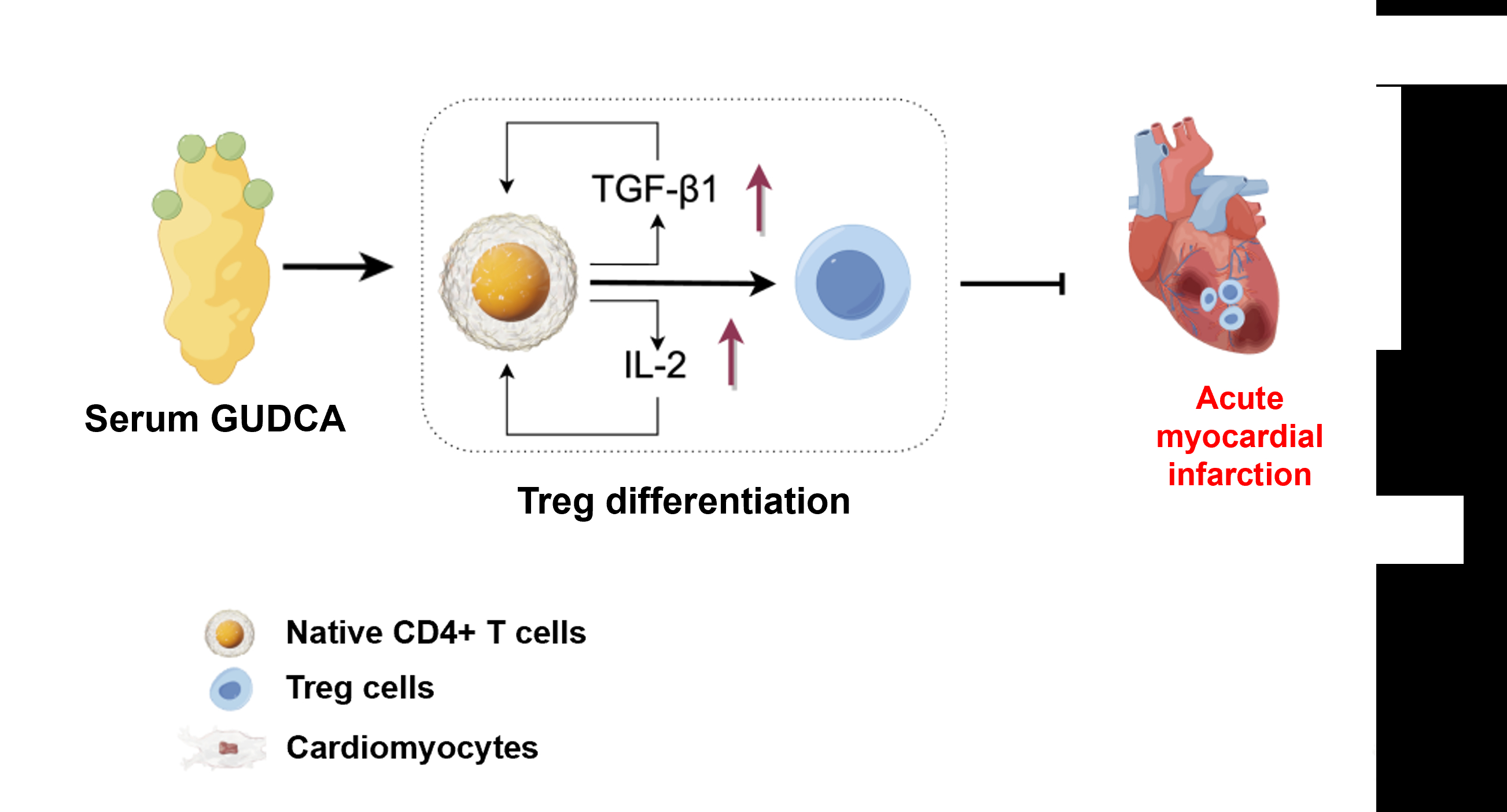
Serum GUDCA Alleviates Cardiac Injury in Acute Myocardial Infarction by Promoting Regulatory T Cell Differentiation

Abstract Body (Do not enter title and authors here): Background
Regulatory T cells (Tregs) exert protective effects following acute myocardial infarction (AMI), yet their levels decline rapidly after injury. Although serum metabolites regulate various immune processes, it remains unclear whether specific metabolites can promote Treg expansion and mitigate post-AMI cardiac damage.
Methods
Serum non-targeted metabolomics was performed in ST-elevation myocardial infarction (STEMI) patients stratified by Treg levels: high (Tregs/CD4 T cells > 1.5%; n = 30) vs. low (Tregs/CD4 T cells < 0.25%; n = 30) at admission. Glycoursodeoxycholic acid (GUDCA), identified as a candidate metabolite, was validated by LC-MS and ELISA. In a murine model of AMI, GUDCA (50 mg/kg/day, oral gavage) was administered post-infarction. Treg levels were analyzed by flow cytometry on Day 3. Cardiac fibrosis and function were evaluated by Sirius Red staining and echocardiography on Day 7. In vitro, naïve CD4 T cells were treated with GUDCA (100 nM) for three days to assess Treg differentiation. Cytokine profiling and ELISA were used to determine involvement of key immunoregulatory cytokines.
Results
STEMI patients with higher Treg frequencies exhibited significantly elevated serum GUDCA levels. In vivo, GUDCA treatment increased Treg abundance, reduced myocardial fibrosis, and improved cardiac function post-AMI. In vitro, GUDCA directly promoted Treg differentiation from naive CD4 T cells. Mechanistically, GUDCA enhanced autocrine production of TGF-β1 and IL-2, two essential cytokines for Treg induction. Pharmacologic blockade of these cytokines abrogated GUDCA-mediated Treg differentiation.
Conclusions
GUDCA, a serum metabolite elevated in STEMI patients with higher Treg levels, promotes Treg differentiation and protects against cardiac injury following AMI. These findings highlight GUDCA’s potential as a novel immunometabolic therapeutic strategy for post-infarction cardiac remodeling.
  • Li, Jiayu  ( Beijing Friendship Hospital , Beijing , China )
  • Chen, Hui  ( Beijing Friendship Hospital , Beijing , China )
  • Xiang, Yang  ( UNIVERSITY CALIFORNIA , Davis , California , United States )
  • Cao, Ning  ( Beijing Friendship Hospital , Beijing , China )
  • Author Disclosures:
    Jiayu Li: DO NOT have relevant financial relationships | Hui Chen: DO NOT have relevant financial relationships | Yang Xiang: DO NOT have relevant financial relationships | Ning Cao: DO NOT have relevant financial relationships
Meeting Info:

Scientific Sessions 2025

2025

New Orleans, Louisiana

Session Info:

Redefining Cardioprotection: Molecular and Cellular Insights into Ischemic Heart Injury

Saturday, 11/08/2025 , 10:45AM - 11:55AM

Moderated Digital Poster Session

More abstracts on this topic:
Accentuated Effect of Transportation Noise Exposure on Cardiovascular Risk in Individuals with Anxiety and Depression

Saeed Fatima, Khawand Annemarie, Seligowski Antonia, Banks Jamie, Muenzel Thomas, Tawakol Ahmed, Osborne Michael, Abohashem Shady, Abikaram Krystel, Assefa Alula, Ahmad Taha, Arora Gagan, Khalil Maria, Lau Hui Chong, Aldosoky Wesam

A Novel ECG Time-Frequency Eyeball Method for Robust Detection of Myocardial Infarction from Single-Channel ECG: A Preclinical Study

Alavi Rashid, Li Jiajun, Dai Wangde, Matthews Ray, Pahlevan Niema, Kloner Robert, Gharib Morteza

You have to be authorized to contact abstract author. Please, Login
Not Available