The Kaiser Permanente Cardiovascular Health Enhancement and Monitoring for Oncology (KP CHEMO) Study
Abstract Body (Do not enter title and authors here): Background: There are nearly 19 million cancer survivors in the U.S., projected to reach 22 million by 2030, many at increased risk for cardiovascular disease complications.
Research Question: To delineate the contemporary incidence of cancer therapy-related cardiac dysfunction (CTRCD) in a real-world, diverse population.
Methods: We identified adults diagnosed with liquid or solid malignancy (excluding non-melanoma skin cancer) who received cardiotoxic cancer therapies (i.e., anthracyclines, human epidermal growth factor receptor 2 [HER2] inhibitors, immune checkpoint inhibitors [ICIs], tyrosine kinase inhibitors [TKIs]) within a large, integrated healthcare delivery system in Northern California from 2012-2022. The primary outcome was CTRCD, defined as either new-onset asymptomatic left ventricular dysfunction (i.e., a >10% absolute decrease in LVEF from ≥53% to <53%) or new-onset symptomatic heart failure, identified using a validated natural language processing algorithm applied to electronic health record data.
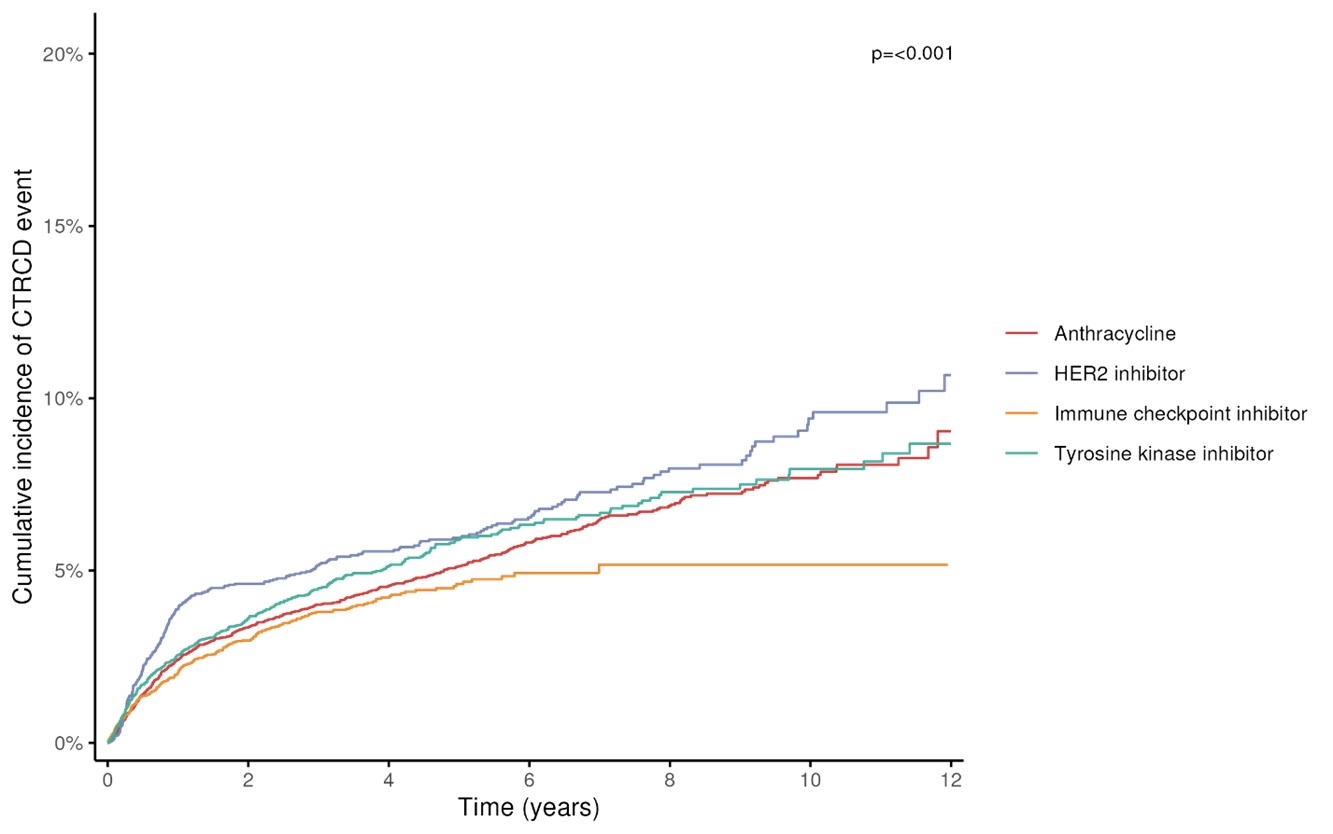
Results: Among 26,646 eligible patients, mean age was 62 ± 14 years, 64% were women, and 43% identified as a race/ethnicity other than non-Hispanic White. Breast (32%), lung (17%), and hematologic cancers (15%) were most common. Of the cohort, 38% received anthracyclines, 15% received HER2 inhibitors, 26% received ICIs, and 22% received TKIs. During a median of 2.0 [0.7-4.5] years of follow-up, the overall cumulative incidence of CTRCD was 8.4%, varying significantly by cancer therapy, with the highest for HER2 inhibitors (10.7%) and lowest for ICIs (5.2%) (P<0.001) (Figure). Early CTRCD (within 12 months) occurred at a higher rate (3.0 [2.8-3.3] per 100 person-years) than late CTRCD (1.1 [1.1-1.2] per 100 person-years), with nearly half of cases occurring in the first year of treatment.
Conclusions: In a large, contemporary cohort of cancer patients receiving cardiotoxic therapies, CTRCD affected nearly 1 in 10 patients, with many events occurring during the first year after treatment initiation. Validated prediction models are needed for short-term risk stratification, guiding targeted screening strategies, and earlier interventions to improve cardiovascular outcomes.
Thadani, Samir
(
Kaiser Permanente Northern California
, Oakland , California , United States )
Go, Alan
(
Kaiser Permanente Northern California
, Oakland , California , United States )
Liu, Jane
(
Kaiser Permanente Northern California
, Oakland , California , United States )
Garcia, Elisha
(
Kaiser Permanente Northern California
, Oakland , California , United States )
Adatya, Sirtaz
(
Kaiser Permanente Northern California
, Oakland , California , United States )
Bhatt, Ankeet
(
Kaiser Permanente Northern California
, Oakland , California , United States )
Kwan, Marilyn
(
Kaiser Permanente Northern California
, Oakland , California , United States )
Lin, Amy
(
Kaiser Permanente Northern California
, Oakland , California , United States )
Liu, Raymond
(
Kaiser Permanente Northern California
, Oakland , California , United States )
Lopez, Alfredo
(
Kaiser Permanente Northern California
, Oakland , California , United States )
Nugent, Joshua
(
Kaiser Permanente Northern California
, Oakland , California , United States )
Ouyang, David
(
Kaiser Permanente Northern California
, Oakland , California , United States )
Yen, Alberta
(
Kaiser Permanente Northern California
, Oakland , California , United States )
Zaroff, Jonathan
(
Kaiser Permanente Northern California
, Oakland , California , United States )
Ambrosy, Andrew
(
Kaiser Permanente Northern California
, Oakland , California , United States )
Author Disclosures:
Samir Thadani:DO NOT have relevant financial relationships
| Alfredo Lopez:No Answer
| Joshua Nugent:DO NOT have relevant financial relationships
| David Ouyang:DO have relevant financial relationships
;
Consultant:InVision:Active (exists now)
; Consultant:Pfizer:Past (completed)
; Consultant:Ultromics:Past (completed)
; Consultant:EchoIQ:Past (completed)
; Consultant:AstraZeneca:Active (exists now)
| Alberta Yen:No Answer
| Jonathan Zaroff:No Answer
| Andrew Ambrosy:DO have relevant financial relationships
;
Consultant:Bayer:Expected (by end of conference)
; Consultant:BMS:Expected (by end of conference)
; Consultant:Novo Nordisk:Past (completed)
; Consultant:Merck:Past (completed)
; Researcher:BI:Active (exists now)
; Researcher:Abiomed:Active (exists now)
; Researcher:Bayer:Active (exists now)
| Alan Go:DO have relevant financial relationships
;
Research Funding (PI or named investigator):Bristol Myers-Squibb:Active (exists now)
; Research Funding (PI or named investigator):Edwards Life Sciences:Active (exists now)
; Research Funding (PI or named investigator):Novartis:Past (completed)
| Jane Liu:DO NOT have relevant financial relationships
| Elisha Garcia:DO NOT have relevant financial relationships
| Sirtaz Adatya:No Answer
| Ankeet Bhatt:DO have relevant financial relationships
;
Consultant:AstraZeneca:Past (completed)
; Consultant:Merck:Active (exists now)
| Marilyn Kwan:DO NOT have relevant financial relationships
| Amy Lin:No Answer
| Raymond Liu:DO have relevant financial relationships
;
Researcher:BeOne:Active (exists now)
; Researcher:Biotheranostics:Active (exists now)
; Researcher:AZ:Active (exists now)
; Researcher:BMS:Active (exists now)