Trends and Stroke Outcomes in Left Atrial Appendage Clearance Using Cardiac CT Angiography Prior to Cardioversion
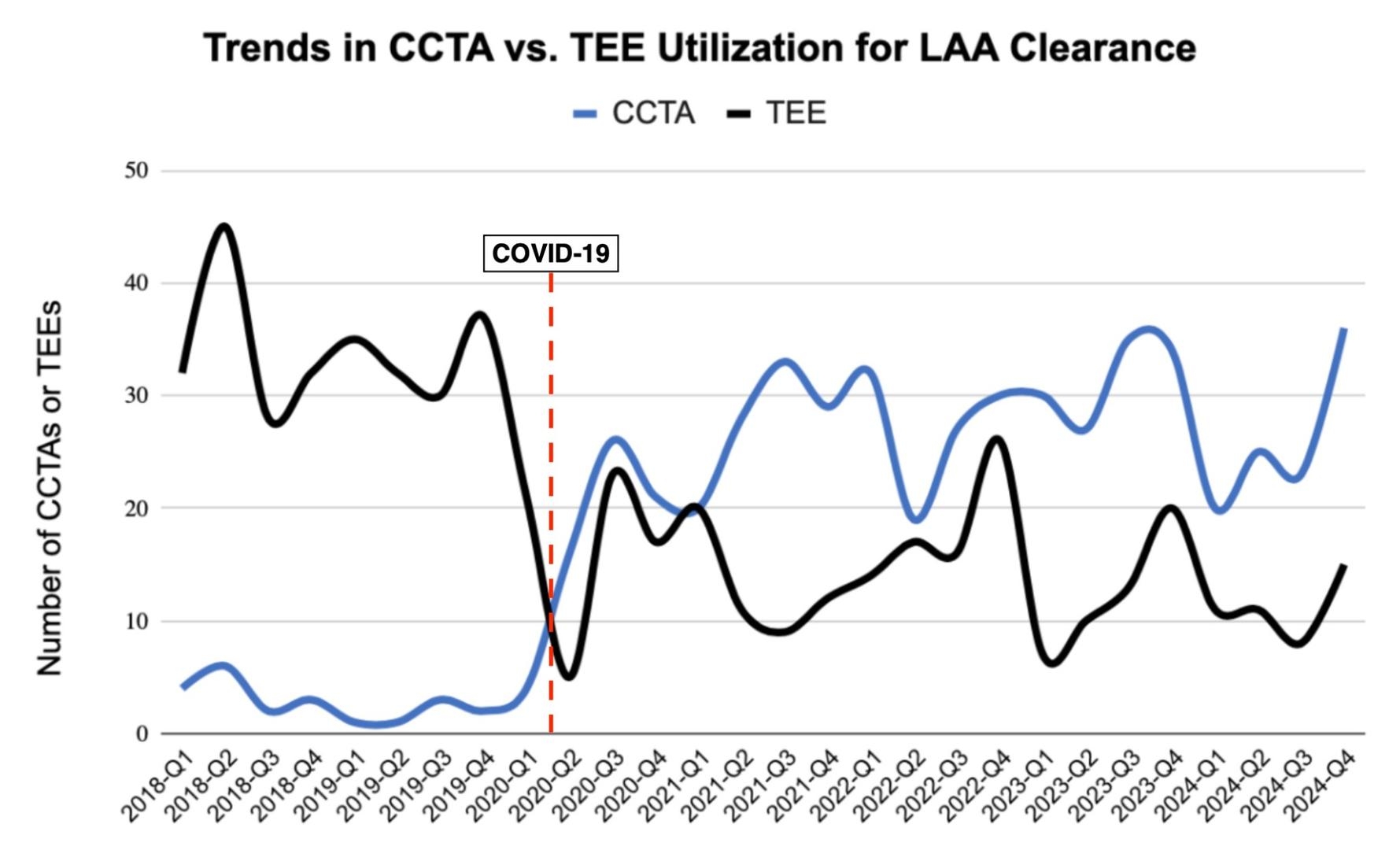
Abstract Body (Do not enter title and authors here): Introduction: Transesophageal echocardiography (TEE) has long been the standard imaging modality for left atrial appendage (LAA) thrombus exclusion before direct current cardioversion (DCCV) in patients with atrial fibrillation (AF) or atrial flutter (AFL). However, cardiac computed tomography angiography (CCTA) has emerged as a non-invasive, lower-risk alternative with high sensitivity and specificity for detecting LAA thrombi. This study evaluates institutional trends in CCTA versus TEE use for LAA clearance and compares post-imaging stroke outcomes between modalities. Research Question: How have institutional trends in imaging modality for LAA clearance prior to DCCV evolved over time, and do 90-day stroke rates differ between patients undergoing CCTA or TEE? Methods: A retrospective cohort study was conducted using institutional data from patients who underwent DCCV for AF or AFL at the University of Virginia Medical Center between 2018–2024. Patients were included if they had a TEE or CCTA within 21 days prior to DCCV. CCTA exams were performed on a third-generation, dual-source CT scanner (Siemens SOMATOM Force, Erlangen, DE) using low-radiation, high-pitch helical imaging with both first-pass and delayed acquisitions. Results: A total of 1,094 patients were included, of whom 37% were female. Over the study period, use of CCTA increased steadily, eventually surpassing TEE as the dominant modality. The COVID-19 pandemic marked a key inflection point, coinciding with rapid CCTA adoption. CCTA utilization rose from 26 cases (8.2%) pre-COVID (before Q2 2020) to 511 cases (66.3%) post-COVID, while TEE use declined from 292 cases (91.8%) to 265 cases (33.7%). A chi-square test confirmed a significant shift in imaging modality between the pre- and post-COVID periods (p < 0.0001). Among all patients, 90-day stroke rates were similarly low between groups (CCTA: 0.56%, TEE: 0.54%), with no statistically significant difference (p = 0.964). Conclusion: The increasing adoption of CCTA for LAA clearance reflects a significant shift in clinical practice, influenced by the COVID-19 pandemic and the demand for non-invasive imaging. In our cohort, 90-day stroke rates were equivalent between CCTA and TEE, supporting CCTA as a safe and effective alternative for appropriate patients. Further research is needed to evaluate long-term outcomes, cost-effectiveness, and patient/provider satisfaction.
Elkhechen, Justin
(
UVA Health
, Charlottesville , Virginia , United States )
Kirkpatrick, Summer
(
UVA Health
, Charlottesville , Virginia , United States )
Goldberg, Elliot
(
UVA Health
, Charlottesville , Virginia , United States )
Villines, Todd
(
University of Virginia
, Charlottesville , Virginia , United States )
Author Disclosures:
Justin Elkhechen:DO NOT have relevant financial relationships
| Summer Kirkpatrick:No Answer
| Elliot Goldberg:No Answer
| Todd Villines:DO NOT have relevant financial relationships