
Logo

American Heart Association

  24
  0


Final ID: MP295

Perceived Stress and Coronary Endothelial Dysfunction in Postpartum Women with a History of Preeclampsia

Abstract Body (Do not enter title and authors here): Introduction: Impaired nitric oxide-mediated coronary endothelial function (CEF) is a predictor of future cardiovascular (CV) events and may be impaired in women with preeclampsia (PEC). However, the contributing factors to impaired CEF—such as perceived stress, which is common in women with PEC—are not well understood. This study aimed to compare CEF in postpartum women with and without a history of PEC and to test the hypothesis that higher levels of perceived stress may associate with impaired CEF in women with a history of PEC.

Methods: Postpartum women with and without a history of PEC were prospectively enrolled. Cardiac MRI was used to measure nitric oxide-mediated CEF as the change in cross-sectional coronary area, coronary flow, and coronary velocity in response to isometric handgrip exercise using previously validated methods. Perceived external stress was assessed on the day of the imaging visit using the validated Perceived Stress Scale (PSS). Between-group comparisons were assessed using the Chi-Square test or Fisher’s exact test for categorical variables and the Mann-Whitney U test or t-test for continuous variables. The association of CEF and PSS in women with PEC was assessed using Spearman’s correlation coefficient and adjusted linear regression.

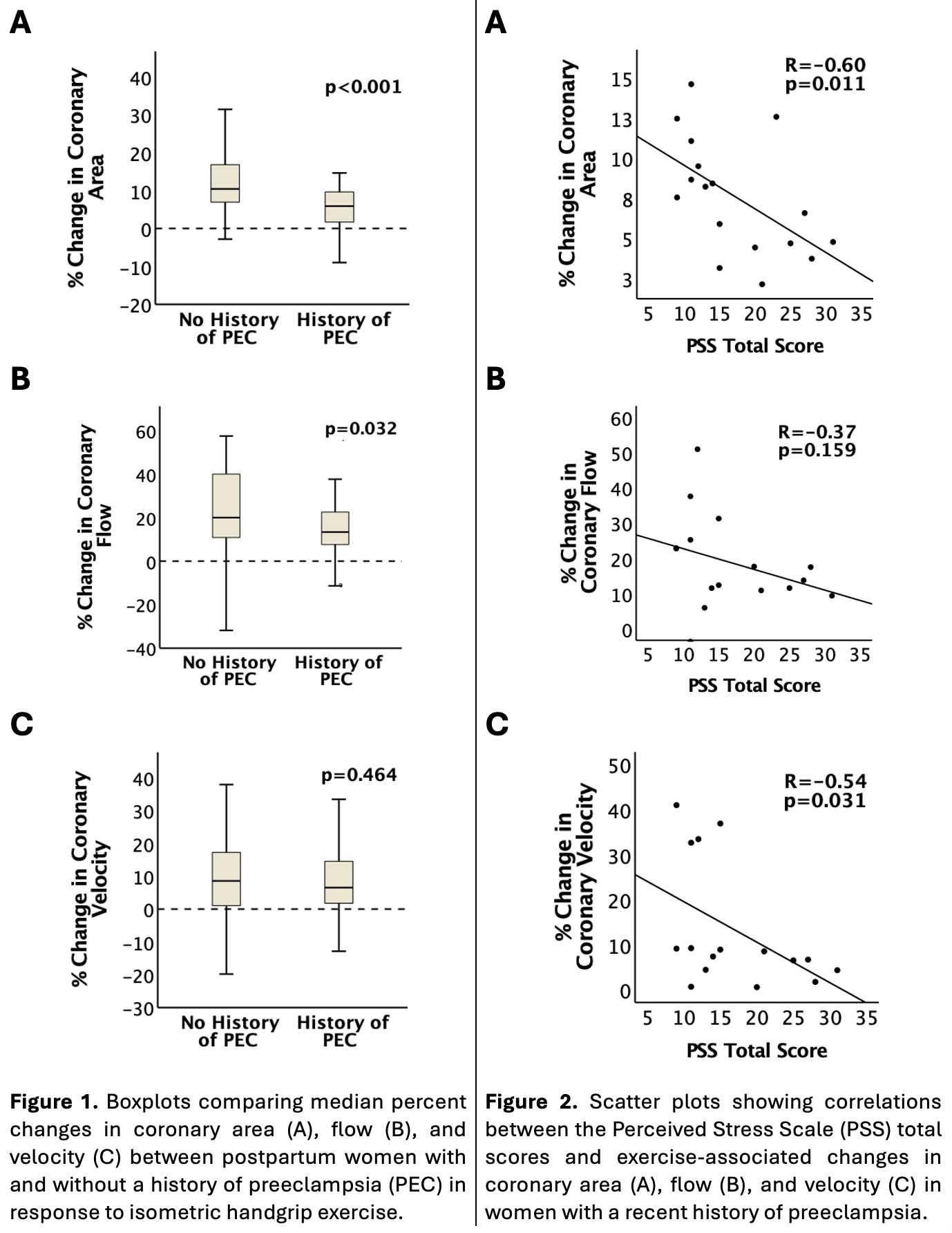
Results: Of 85 postpartum women, 42 had a recent history of PEC and 43 did not. Median age was 32 (IQR 30-36) and median time postpartum was 22 (IQR 16-29) weeks. In the PEC group, women had higher BMI but lower rates of type 2 diabetes, and were otherwise age and race matched with controls. Women with PEC had impaired CEF as reflected by lower exercise-induced changes in coronary area and coronary flow (Figures 1A and 1B). PEC remained a significant predictor of impaired CEF after adjusting for diabetes and BMI. In women with a history of PEC, higher PSS scores were associated with lower exercise-induced changes in coronary area (Fig 2A) and velocity (Fig 2C). Higher PSS remained a significant predictor of a lower change in coronary area (β=-0.53, p=0.045) but not coronary velocity after adjusting for age and race.

Conclusion: Women with PEC showed impaired nitric oxide-mediated CEF in the postpartum period, which is associated with increased CV risk. Higher perceived stress may associate with impaired CEF in women with PEC. These findings help understand the physiology behind increased CV risk in postpartum women with PEC and may suggest new risk stratification and reduction strategies.
  • Gharios, Charbel  ( The Johns Hopkins Hospital , Baltimore , Maryland , United States )
  • Minhas, Anum  ( Johns Hopkins University , Baltimore , Maryland , United States )
  • Bennett, Wendy  ( JOHNS HOPKINS UNIVERSITY , Baltimore , Maryland , United States )
  • Michos, Erin  ( Johns Hopkins Medicine , Clarksville , Maryland , United States )
  • Bukhari, Syed  ( Johns Hopkins University , Baltimore , Maryland , United States )
  • Yilma, Addis  ( Johns Hopkins University , Baltimore , Maryland , United States )
  • Vaught, Arthur  ( Johns Hopkins University , Baltimore , Maryland , United States )
  • Hays, Allison  ( Johns Hopkins , Clarksville , Maryland , United States )
  • Author Disclosures:
    Charbel Gharios: DO NOT have relevant financial relationships | Anum Minhas: DO NOT have relevant financial relationships | Wendy Bennett: DO NOT have relevant financial relationships | Erin Michos: DO have relevant financial relationships ; Consultant:Arrowhead:Active (exists now) ; Consultant:Zoll:Past (completed) ; Consultant:Pfizer:Past (completed) ; Consultant:Novartis:Past (completed) ; Consultant:Esperion:Past (completed) ; Consultant:Amgen:Past (completed) ; Consultant:Novartis:Past (completed) ; Consultant:Edwards Lifescience:Active (exists now) ; Consultant:Eli Lilly:Active (exists now) ; Consultant:Novo Nordisk:Active (exists now) ; Consultant:New Amsterdam:Active (exists now) ; Consultant:Merck:Active (exists now) ; Consultant:Boehringer Ingelheim:Active (exists now) ; Consultant:Bayer:Active (exists now) ; Consultant:Ionis:Active (exists now) | Syed Bukhari: No Answer | Addis Yilma: DO NOT have relevant financial relationships | Arthur Vaught: No Answer | Allison Hays: DO NOT have relevant financial relationships
Meeting Info:

Scientific Sessions 2025

2025

New Orleans, Louisiana

Session Info:

Hidden Risks, Emerging Tools: Imaging and Biomarkers in Personalized CV Health

Saturday, 11/08/2025 , 09:15AM - 10:15AM

Moderated Digital Poster Session

More abstracts on this topic:
A Novel Cardioprotective Mechanism in Myocardial Reperfusion Injury: Dual Neutrophil Modulation and ROS/HOCl Scavenging by an Atypical Chemokine

Zwissler Leon, Bernhagen Juergen, Cabrera-fuentes Hector Alejandro, Hernandez Resendiz Sauri, Yap En Ping, Schindler Lisa, Zhang Zhishen, Dickerhof Nina, Hampton Mark, Liehn Elisa, Hausenloy Derek

Acute and Chronic Phosphorylation of CaMKII on Coronary Microvascular/Endothelial Function

Iddrisu Hanisah, Xing Hang, Shi Guangbin, Liu Yuhong, Feng Jun

More abstracts from these authors:
A Heart-pounding Case of Cardiomyopathy in Pregnancy

Tran Linh, Everitt Ian, Vaught Arthur, Barth Andreas, Minhas Anum

Reproductive Risk Factors and Burden of Cardiovascular-Kidney-Metabolic Syndrome among Young Women

Boyer Theresa, Chow Timothy, Fang Michael, Selvin Elizabeth, Bennett Wendy, Michos Erin, Ndumele Chiadi, Minhas Anum

You have to be authorized to contact abstract author. Please, Login
Not Available