Logo

American Heart Association

  26
  0


Final ID: MP591

Retrospective Analysis of the Accuracy and Clinical Utility of Predictive Artificial Intelligence in Cardiovascular Event Risk Assessment : PACE Study

Abstract Body (Do not enter title and authors here): Introduction:
Predictive analytics powered by artificial intelligence (AI) and machine learning (ML) are revolutionizing cardiovascular risk assessment. Accurate prediction of low-density lipoprotein cholesterol (LDL-C) is critical for evaluating cardiovascular disease (CVD) risk and guiding therapeutic decisions. This study evaluates deep learning (DL) models for LDL-C prediction in patients with prior cardiovascular events, comparing their performance against traditional ML methods and established LDL-C estimation formulas.

Methods:
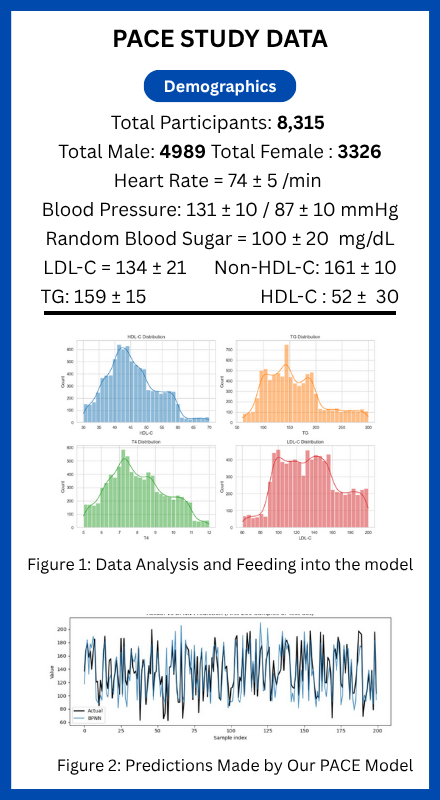
We retrospectively analyzed data from 8,315 patients with documented cardiovascular events from Rhythm Heart and Critical Care. Key lipid parameters included LDL-C, triglycerides (TG), total cholesterol (TC), and high-density lipoprotein cholesterol (HDL-C). Patient CVD history was blinded during model training to ensure unbiased prediction. DL models tested included Convolutional Neural Networks (CNN), Recurrent Neural Networks (RNN), Long Short-Term Memory (LSTM) networks, and a Transformer-based architecture. These were benchmarked against Back Propagation Neural Network (BPNN) models and LDL-C formulas by Sampson and Martin. Model performance was assessed using Root Mean Squared Error (RMSE) and Mean Absolute Percentage Error (MAPE).

Results:
The models generated LDL-C predictions for 5,132 patients (61% of the cohort). The Transformer-based model achieved the highest accuracy with an RMSE of 10.58 mg/dL and MAPE of 7.35%, significantly outperforming BPNN (RMSE 17.16 mg/dL; MAPE 11.01%), RNN (RMSE 32.47 mg/dL), and LSTM (RMSE 32.51 mg/dL). Deep learning models also surpassed traditional LDL-C formulas in accuracy. Partial Dependence Plots (PDP) of the Transformer model revealed clinically meaningful relationships between LDL-C and predictors such as HDL-C, BMI, and thyroid hormones, supporting physiological validity and interpretability.

Conclusion:
This study demonstrates that DL models, particularly the Transformer-based approach, significantly outperform conventional methods in predicting LDL-C levels among patients with cardiovascular events. The model’s superior accuracy and interpretability offer a promising clinical tool for personalized risk assessment, early detection, and optimized management of CVD. Incorporation of such AI-driven models into clinical workflows could improve patient outcomes and resource allocation in cardiovascular care.
  • Ma, Hongwei  ( The University of Sydney , Sydney , New South Wales , Australia )
  • Ch, Rahul  ( Sri Ramachandra Medical College and Research Institute , Chennai , India )
  • Biswas, Shankar  ( Ivano-Frankivsk National Medical Un , Meerut , India )
  • Kaste, Ritik  ( government medical college & hospital , Jammu , India )
  • Nandakishor, Nanditha  ( JJM medical college , Davanagere , India )
  • Karnasula, Varuni  ( Rohan hospital , Hyderabad , Telangana , India )
  • Narula, Aman  ( GMERS Medical college and hospital , Gandhinagar , India )
  • Tahir, Okasha  ( khyber medical university , Peshawar , Pakistan )
  • Reddy A, Likhitha  ( madras medical college , Chennai , India )
  • Sesham, John  ( alluri sitarama raju academy of medical sciences , Vishakapatnam , India )
  • Juneja, Manish  ( Rhythm Heart and Critical Care , Nagpur , India )
  • Gao, Junbin  ( The University of Sydney , Sydney , New South Wales , Australia )
  • Karande, Harsh  ( Rhythm Heart and Critical Care , Nagpur , India )
  • Jolly, Ivin  ( Anhui Medical University , Hefei , Anhui , China )
  • Ramteke, Harshawardhan Dhanraj  ( Rhythm Heart and Critical Care , Nagpur , India )
  • Khan, Rakhshanda  ( Ayaan institute of medical sciences , Moinabad , India )
  • Qianyi, Yang  ( Anhui University , Hefei , Anhui , China )
  • Farooqi, Sumayya  ( Dr vrk womens medical college , Hyderabad , India )
  • Banda, Susmitha  ( government medical college nizamabad , Nizamabad , India )
  • Rawat, Akash  ( himalayan institute of medical sciences , Dehradun , India )
  • Chilakala, Teja Vardhan  ( Narayana medical college , Nellore , India )
  • Author Disclosures:
    Hongwei Ma: DO NOT have relevant financial relationships | Rahul Ch: No Answer | Shankar Biswas: DO NOT have relevant financial relationships | Ritik Kaste: DO NOT have relevant financial relationships | Nanditha Nandakishor: DO NOT have relevant financial relationships | Varuni Karnasula: DO NOT have relevant financial relationships | Aman Narula: DO NOT have relevant financial relationships | Okasha Tahir: DO NOT have relevant financial relationships | Likhitha Reddy A: No Answer | John Sesham: DO NOT have relevant financial relationships | Manish Juneja: No Answer | Junbin Gao: DO NOT have relevant financial relationships | Harsh Karande: DO NOT have relevant financial relationships | Ivin Jolly: DO NOT have relevant financial relationships | Harshawardhan Dhanraj Ramteke: DO NOT have relevant financial relationships | Rakhshanda khan: DO NOT have relevant financial relationships | Yang Qianyi: DO NOT have relevant financial relationships | sumayya farooqi: DO NOT have relevant financial relationships | G N S Susmitha Banda: DO NOT have relevant financial relationships | Akash Rawat: DO NOT have relevant financial relationships | TEJA VARDHAN CHILAKALA: DO NOT have relevant financial relationships
Meeting Info:

Scientific Sessions 2025

2025

New Orleans, Louisiana

Session Info:

From Development to Deployment: Best Practices for Validating AI/ML Models in Healthcare

Saturday, 11/08/2025 , 01:45PM - 02:55PM

Moderated Digital Poster Session

More abstracts on this topic:
A Machine Learning-Derived Socio-Environmental Risk Score More Accurately Predicts Cardiovascular Events and Better Addresses Health Inequities than Social Deprivation Index

Chen Zhuo, Nasir Khurram, Al-kindi Sadeer, Rajagopalan Sanjay, Ponnana Sai Rahul, Dazard Jean-eudes, Zhang Tong, Dong Weichuan, Okyere Robert, Sirasapalli Santosh, Deo Salil, Khraishah Haitham

3D Aortic Geometry is Informative for Risk of Adverse Aortic Events

Pirruccello James

More abstracts from these authors:
Impact of Artificial Intelligence on Cardiovascular Disease Diagnosis, Risk Assessment, and Treatment: A Meta-Analysis of 45 Studies

Qianyi Yang, Ramteke Harshawardhan Dhanraj, Khan Rakhshanda, Jolly Ivin, Juneja Manish

Comparative Efficacy and Safety of Vutrisiran, Acoramidis, Tafamidis in Transthyretin Amyloid Cardiomyopathy: A Network Meta-Analysis

Ramteke Harshawardhan Dhanraj, Chaudhari Rucha, Malaiyappan Surya, Verma Pranav, Karnasula Varuni, Banda Susmitha, Juneja Manish, Jolly Ivin, Khan Rakhshanda, Gulzar Junaid, Makineni Karthik Sai, Bellam Manognya, Gill Jonty, Narula Aman, Bhattacharjee Mridula, Verma Bhanu

You have to be authorized to contact abstract author. Please, Login
Not Available