
Logo

American Heart Association

  5
  0


Final ID: HCM4

Machine Learning–Based Risk Stratification in Hypertrophic Cardiomyopathy: The Added Prognostic Value of Combined Cardiopulmonary Exercise Testing and Stress Echocardiography

Abstract Body (Do not enter title and authors here): INTRODUCTION
Hypertrophic cardiomyopathy (HCM) is a genetically mediated myocardial disorder with variable clinical expression and reduced functional capacity.
Cardiopulmonary exercise testing when integrated with stress echocardiography (CPET-TTE), offers a comprehensive evaluation of cardiovascular performance. In this study, we aimed to assess the added value of CPET-TTE for risk stratification in HCM using a machine learning–based approach to identify individuals at higher risk for major adverse events

METHODS
We retrospectively analyzed 413 HCM patients (46% obstructive; 63.1% male; mean age 48.3 years) who underwent CPET with rest and stress echocardiography, 24-hour ECG Holter, cardiac MRI, and genetic testing. Several machine learning models were developed to predict a composite outcome (SCD, aborted SCD, heart transplantation, stroke, myocardial infarction), with Gradient Boosting using Cox proportional hazards loss achieving the best performance. A semi-supervised clustering approach applying k-means to out-of-fold risk scores was used to stratify patients into high- and low-risk groups. Feature importance was assessed using the Kruskal-Wallis test and ranked by -log10(p-value); effect sizes were quantified using eta-squared.

RESULTS
Gradient Boosting achieved the best predictive performance (C-index: 0.722). Survival analysis showed a clear separation between high-risk (n = 56, 30.4% events) and low-risk (n = 357, 10.1% events) groups (p < 0.000001).
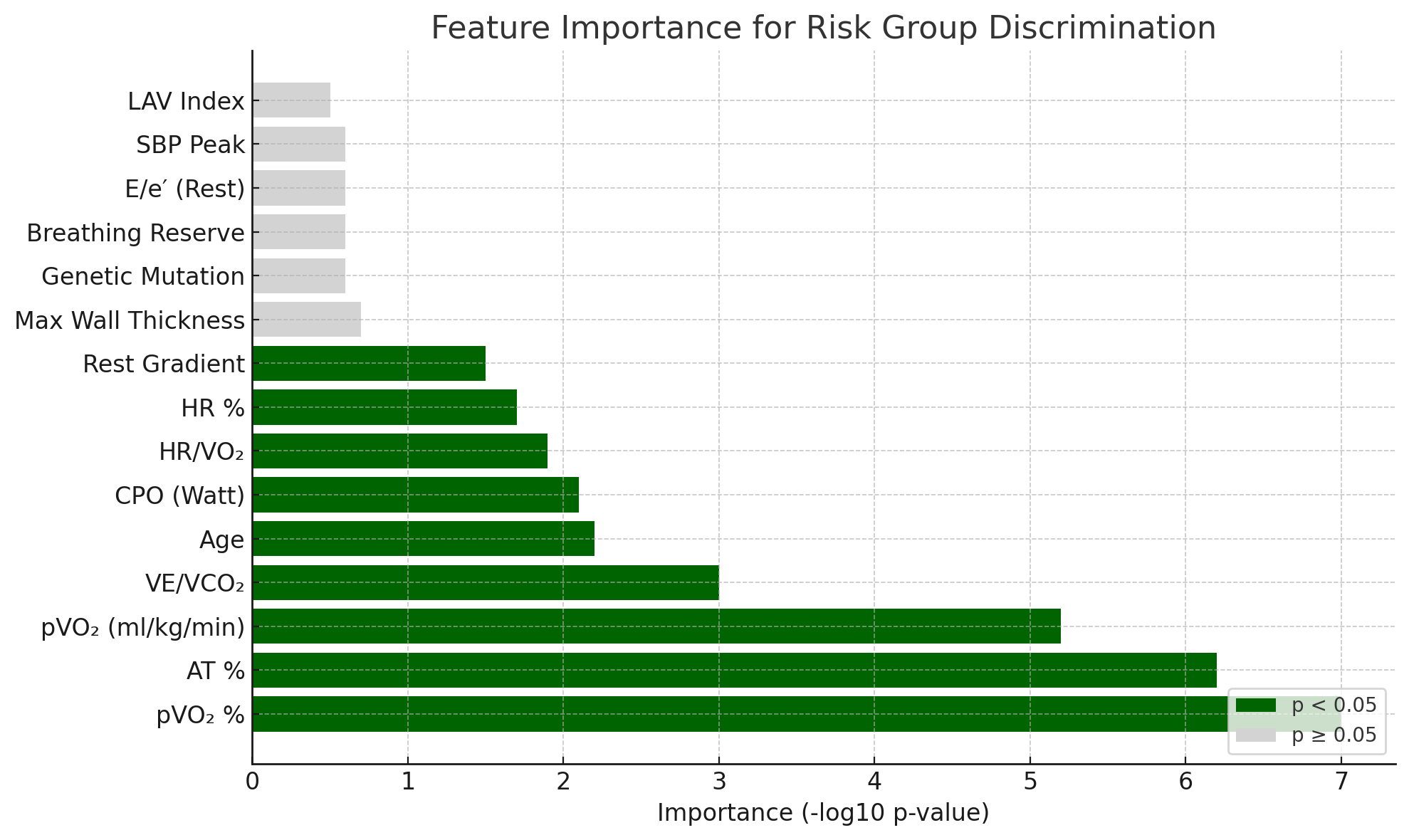
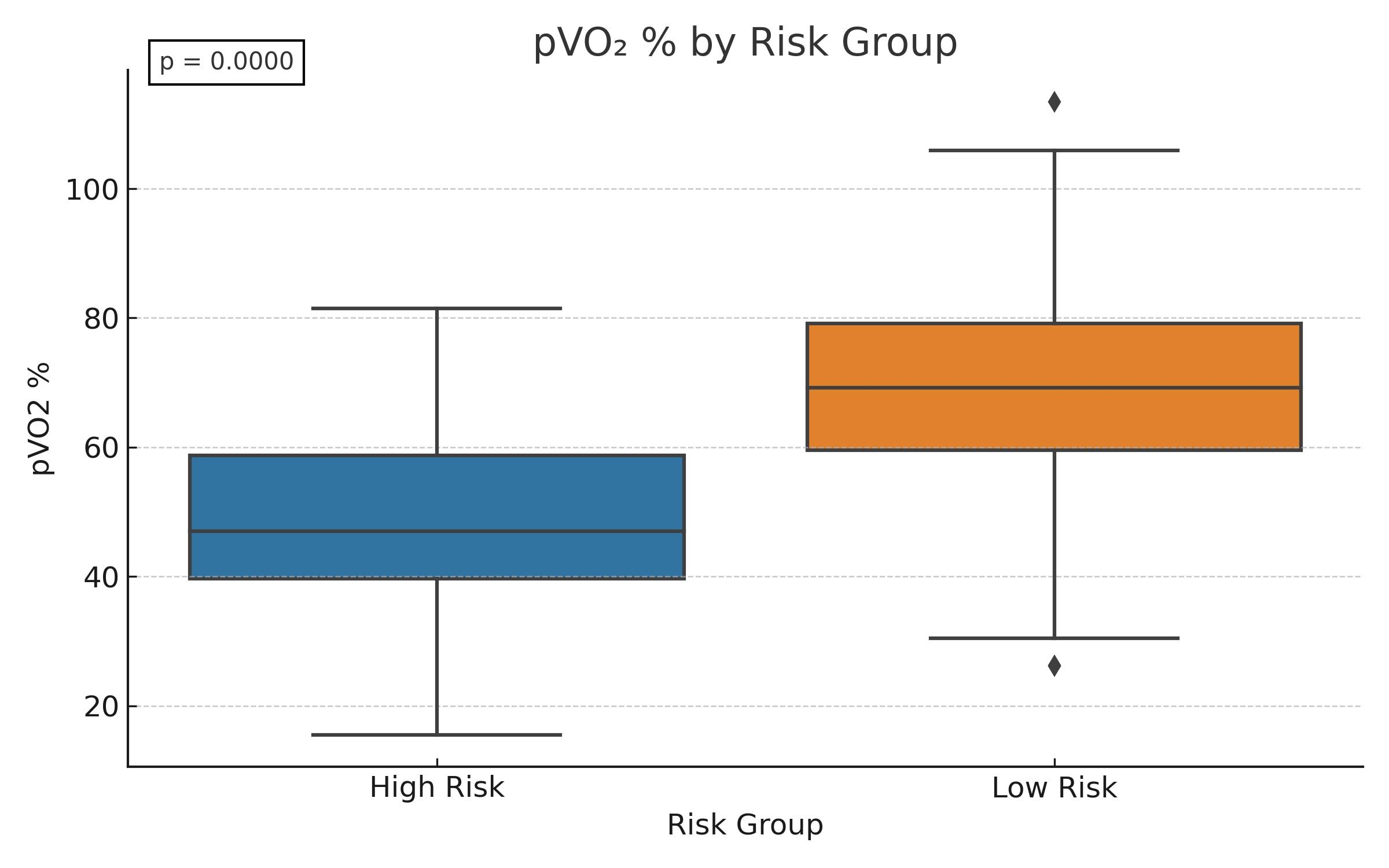
High-risk patients were older (56.0 vs 49.0 years) and had significantly reduced exercise capacity (VO2max%: 49.8% vs 68.0%; AT%: 41.3% vs 55.5%; pVO2: 15.1 vs 19.7 ml/kg/min), greater ventilatory inefficiency (VE/VCO2: 29.0 vs 26.5), lower watt ( 80.0 vs 100.0 W), and oxygen pulse (HR/VO2: 9.7 vs 11.4).No significant differences were observed in rest or peak LVOT gradient (14.5 vs 11.0 mmHg; 31.0 vs 30.0 mmHg) or E/e′ ratio at rest (11.7 vs 11.2) and stress (11.4 vs 10.3).
Key features contributing to risk prediction included VO2max%, AT%, pVO2 and VE/VCO2 slope (all p < 0.001).
CONCLUSION
The integration of CPET-TTE parameters with advanced machine learning techniques allowed for effective and clinically relevant risk stratification in patients with hypertrophic cardiomyopathy.. These findings highlight the central prognostic value of exercise capacity and ventilatory efficiency in HCM, supporting the routine use of CPET-TTE as a non-invasive, functional tool for personalized risk assessment.
  • Halasz, Geza  ( San Camillo Forlanini Hospital , Roma , Italy )
  • Re, Federica  ( San Camillo Forlanini Hospital , Roma , Italy )
  • Giacalone, Guido  ( Santa Andrea Hospital , Rome , Italy )
  • Mistrulli, Raffaella  ( Sapienza University , Rome , Italy )
  • Maroni, Gabriele  ( IDSIA, SUPSI Dalle Molle institute for artificial intelligence research , Lugano , Switzerland )
  • Piga, Dario  ( IDSIA, SUPSI Dalle Molle institute for artificial intelligence research , Lugano , Switzerland )
  • Moroni, Francesco  ( University of Virginia , Charlottesville , Virginia , United States )
  • Ayers, Michael  ( University of Virginia , Charlottesville , Virginia , United States )
  • Grigioni, Francesco  ( Policlinico Campus Biomedico , Rome , Italy )
  • Gabrielli, Domenico  ( San Camillo Forlanini Hospital , Roma , Italy )
  • Author Disclosures:
    Geza Halasz: DO NOT have relevant financial relationships | Federica Re: No Answer | Guido Giacalone: No Answer | Raffaella Mistrulli: DO NOT have relevant financial relationships | Gabriele Maroni: DO NOT have relevant financial relationships | Dario Piga: No Answer | Francesco Moroni: No Answer | Michael Ayers: No Answer | Francesco Grigioni: No Answer | Domenico Gabrielli: No Answer
Meeting Info:

Scientific Sessions 2025

2025

New Orleans, Louisiana

Session Info:

Hypertrophic Cardiomyopathy Medical Society Posters

Friday, 11/07/2025 , 06:30PM - 07:30PM

Abstract Poster Board Session

More abstracts on this topic:
A Hypertrophic Cardiomyopathy Polygenic Score Modifies Penetrance of Pathogenic Hypertrophic and Dilated Cardiomyopathy Variants in Opposite Directions

Abramowitz Sarah, Hoffman-andrews Lily, Depaolo John, Judy Renae, Owens Anjali, Damrauer Scott, Levin Michael

Can Stress Echocardiography during Cardiopulmonary Exercise Testing Help Predict Clinical Outcomes in Right-Sided Congenital Heart Disease?

Dizon Samantha, Krishnamurthy Yamini, Kochav Jonathan, Lewis Matthew, Rosenbaum Marlon, Zemer Wassercug Noa

More abstracts from these authors:
Artificial Intelligence-Enhanced Electrocardiography Detects Hypertrophic Cardiomyopathy in Patients at High Risk of Sudden Cardiac Death

Sharma Avneesh, Pagadala Trishya, Lewontin Myra, Bilchick Kenneth, Ayers Michael

ST-Elevation Myocardial Infarction as a Complication of Granulomatosis with Polyangiitis

Goodrich Robyn, Moroni Francesco, Ravindra Krishna, Abbate Antonio

You have to be authorized to contact abstract author. Please, Login
Not Available