Refining Atherosclerotic Risk Prediction in Patients with Systemic Sclerosis: Association with Uric Acid and the Creation of a Novel Scleroderma-Atherosclerotic Cardiovascular Disease Risk (ScleroRisk) Assessment Model
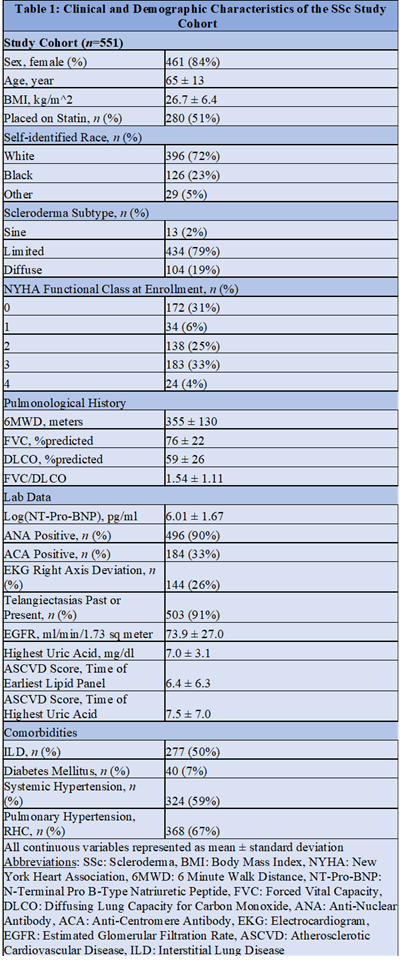
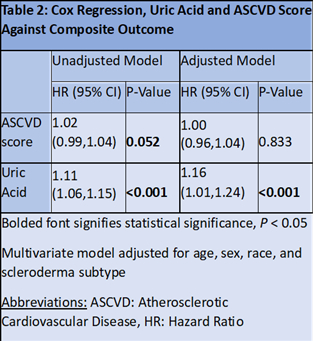
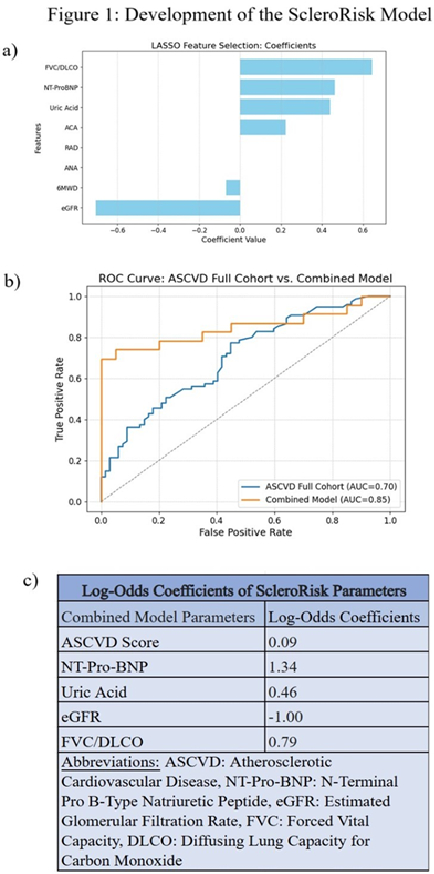
Abstract Body (Do not enter title and authors here): Introduction: Patients with systemic sclerosis (SSc) are known to have higher rates of atherosclerotic cardiovascular disease (ASCVD) compared to the general population. Without the inclusion of disease-specific factors, traditional models underestimate ASCVD risk in SSc populations. Further, higher uric acid levels are thought to be associated with higher mortality risk in patients with connective tissue diseases. This study aimed to clarify the prognostic significance of uric acid in SSc, and innovate models of ASCVD risk to better address high-risk patients. Methods: We analyzed a well-characterized cohort of SSc patients from the Johns Hopkins Scleroderma Center Research Registry. ASCVD score was assessed using the 2013 American Heart Association/American College of Cardiology Risk Calculator. Univariate and multivariate Cox regression models, adjusted for age, sex, race, and SSc subtype were utilized to classify hazard for a composite clinical endpoint of all-cause mortality, stroke, and myocardial infarction. Least absolute shrinkage and selection operator (LASSO) regression was utilized to identify top non-ASCVD predictors of adverse outcome risk. Top predictors were combined with ASCVD score in a logistic regression model, which was compared to ASCVD score alone using receiver operator curve analysis and a DeLong test. Results: Our cohort consisted of 551 SSc patients with a mean age of 65 years, 84% female, 72% white, and 79% with limited SSc subtype, Table 1. After adjustment, uric acid level displayed significant hazard (HR = 1.16, p <0.001) for the composite endpoint over traditional ASCVD score (HR = 1.00, p = 0.833), Table 2. LASSO revealed four top non-ASCVD predictors of the composite outcome: estimated glomerular filtration rate, forced vital capacity/diffusion capacity of carbon monoxide, brain natriuretic peptide, and uric acid. ScleroRisk, a logistic regression model developed from these four variables and ASCVD score, performed with a mean Area Under the Curve of 0.85 for the composite endpoint, compared to ASCVD score alone 0.70 (p <0.001), Figure 1. Conclusion: Uric acid and other disease-specific factors provide additive prognostic value above traditional ASCVD score alone in SSc. These findings highlight the critical need to further investigate uric acid as a biomarker of microvascular damage and chronic inflammation in systemic sclerosis and offer future direction for refining risk stratification within this high-risk population.
Kankaria, Rohan
(
Johns Hopkins School of Medicine
, Baltimore , Maryland , United States )
Osgueritchian, Ryan
(
Johns Hopkins University
, Baltimore , Maryland , United States )
Goldin, Garrett
(
Johns Hopkins University
, Baltimore , Maryland , United States )
Hsu, Steven
(
Johns Hopkins University
, Baltimore , Maryland , United States )
Hassoun, Paul
(
Johns Hopkins University
, Baltimore , Maryland , United States )
Mathai, Stephen
(
Johns Hopkins University
, Baltimore , Maryland , United States )
Wigley, Fredrick
(
Johns Hopkins University
, Baltimore , Maryland , United States )
Shah, Ami
(
Johns Hopkins University
, Baltimore , Maryland , United States )
Mukherjee, Monica
(
JOHNS HOPKINS UNIVERSITY
, Baltimore , Maryland , United States )
Author Disclosures:
Rohan Kankaria:DO NOT have relevant financial relationships
| Ryan Osgueritchian:No Answer
| Garrett Goldin:DO NOT have relevant financial relationships
| Steven Hsu:DO NOT have relevant financial relationships
| Paul Hassoun:No Answer
| Stephen Mathai:DO have relevant financial relationships
;
Advisor:Merck:Past (completed)
; Advisor:Gossamer:Past (completed)
; Advisor:United Therapeutics:Past (completed)
| Fredrick Wigley:No Answer
| Ami Shah:DO have relevant financial relationships
;
Research Funding (PI or named investigator):PPD:Active (exists now)
| Monica Mukherjee:DO NOT have relevant financial relationships