Prevalence and Clinical Correlates of Valvular Abnormalities in Systemic Sclerosis: Associations with Pulmonary Vascular and Disease Severity
Abstract Body (Do not enter title and authors here): Background: Cardiac involvement is a major contributor to morbidity and mortality in systemic sclerosis (SSc), yet valvular heart disease remains underrecognized. Fibrotic and vascular remodeling in SSc may predispose to valve lesions, which can exacerbate right or left heart failure, particularly in the presence of pulmonary hypertension (PH). Emerging data suggest that valvular dysfunction, especially regurgitant lesions, is associated with more advanced cardiopulmonary disease and may serve as a marker of increased mortality risk. We aimed to characterize the burden and distribution of valvular disease across SSc subtypes and PH phenotypes.
Methods: We analyzed a cohort of SSc patients from Johns Hopkins Medicine who were referred for transthoracic echocardiogram for evaluation of pulmonary vascular disease between September 2003 and April 2025. Demographic and clinical metrics, invasive hemodynamics, and echocardiographic parameters were analyzed. Patients were classified into limited cutaneous SSc, diffuse cutaneous SSc, or SSc with overlap of another mixed connective tissue disease (MCTD). PH subtype was determined based on invasive hemodynamics and World Health Organization classification. Disease duration was calculated from date of Raynaud’s onset. Comparative analyses were conducted using ANOVA, Chi-Squared tests, and ordered logistic regression.
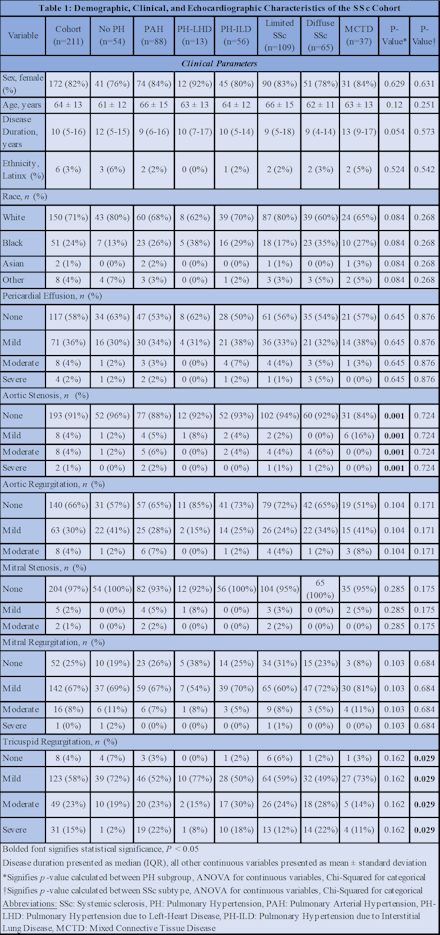
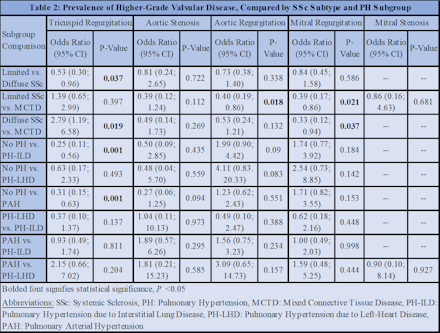
Results: Our cohort consisted of 211 SSc patients, mean age 64 ± 13 years, 82% female, 71% white, 52% limited SSc subtype, 74% with PH, Table 1. Patients with interstitial lung disease associated PH or pulmonary arterial hypertension displayed significantly higher odds for more severe tricuspid regurgitation (TR) compared to those without PH (p = 0.001), Table 2. Additionally, individuals with diffuse SSc showed a higher prevalence of advanced TR compared to those with limited SSc (p = 0.037) and MCTD (p = 0.019). Among patients with MCTD, extensive aortic regurgitation was more prevalent than in limited SSc (p = 0.018), and the occurrence of higher-grade mitral regurgitation was significantly greater compared to both limited (p = 0.021) and diffuse SSc (p = 0.037).
Conclusion: Valvular regurgitation is a prevalent and clinically relevant manifestation in SSc, particularly among patients with PH and diffuse SSc or MCTD. These findings underscore the importance of routine echocardiographic surveillance to detect and manage valvular disease early in the course of SSc-related cardiopulmonary involvement.
Goren, Lea
(
Johns Hopkins University School of Medicine
, Baltimore , Maryland , United States )
Goldin, Garrett
(
Johns Hopkins University
, Baltimore , Maryland , United States )
Osgueritchian, Ryan
(
Johns Hopkins University
, Baltimore , Maryland , United States )
Morcos, George
(
Johns Hopkins University School of Medicine
, Baltimore , Maryland , United States )
Mombeini, Hoda
(
Johns Hopkins University
, Baltimore , Maryland , United States )
Woods, Adrianne
(
Johns Hopkins University
, Baltimore , Maryland , United States )
Hummers, Laura
(
Johns Hopkins University
, Baltimore , Maryland , United States )
Mathai, Stephen
(
Johns Hopkins University
, Baltimore , Maryland , United States )
Wigley, Fredrick
(
Johns Hopkins University
, Baltimore , Maryland , United States )
Shah, Ami
(
Johns Hopkins University
, Baltimore , Maryland , United States )
Mukherjee, Monica
(
Johns Hopkins University
, Baltimore , Maryland , United States )
Author Disclosures:
Lea Goren:DO NOT have relevant financial relationships
| Ami Shah:DO have relevant financial relationships
;
Research Funding (PI or named investigator):PPD:Active (exists now)
| Monica Mukherjee:DO NOT have relevant financial relationships
| Garrett Goldin:DO NOT have relevant financial relationships
| Ryan Osgueritchian:No Answer
| George Morcos:DO NOT have relevant financial relationships
| Hoda Mombeini:No Answer
| Adrianne Woods:DO NOT have relevant financial relationships
| Laura Hummers:No Answer
| Stephen Mathai:DO have relevant financial relationships
;
Advisor:Merck:Past (completed)
; Advisor:Gossamer:Past (completed)
; Advisor:United Therapeutics:Past (completed)
| Fredrick Wigley:No Answer