Logo

American Heart Association

  23
  0


Final ID: Sa2080

GLP-1 Receptor Agonist in Patients Undergoing Percutaneous Left Atrial Appendage Occlusion: Impact on Outcomes

Abstract Body (Do not enter title and authors here):
Background
Patients undergoing percutaneous left atrial appendage occlusion (LAAO) for atrial fibrillation often have comorbid diabetes and obesity. GLP-1 receptor agonists provide benefit in patients with these comorbid conditions. The impact of GLP-1 receptor agonists on outcomes in patients undergoing LAAO occlusion has not been previously assessed.

Hypothesis
GLP-1 receptor agonists may contribute to improved outcomes in patients undergoing percutaneous LAAO compared to those not receiving GLP-1 therapy.

Methods
A retrospective analysis using the TriNetX network identified adults who underwent LAAO over the past 20 years. Patients were grouped as GLP-1 receptor agonist users or non-users within three months before or any time after the procedure. The primary outcome was a three-component MACE, comprising all-cause mortality, stroke, and major bleeding. Secondary outcomes included myocardial infarction and heart failure exacerbation. These were assessed using odds ratios (ORs), with statistical significance at p < 0.05. Kaplan–Meier curves and log-rank tests were used for time-to-event survival analysis.

Results
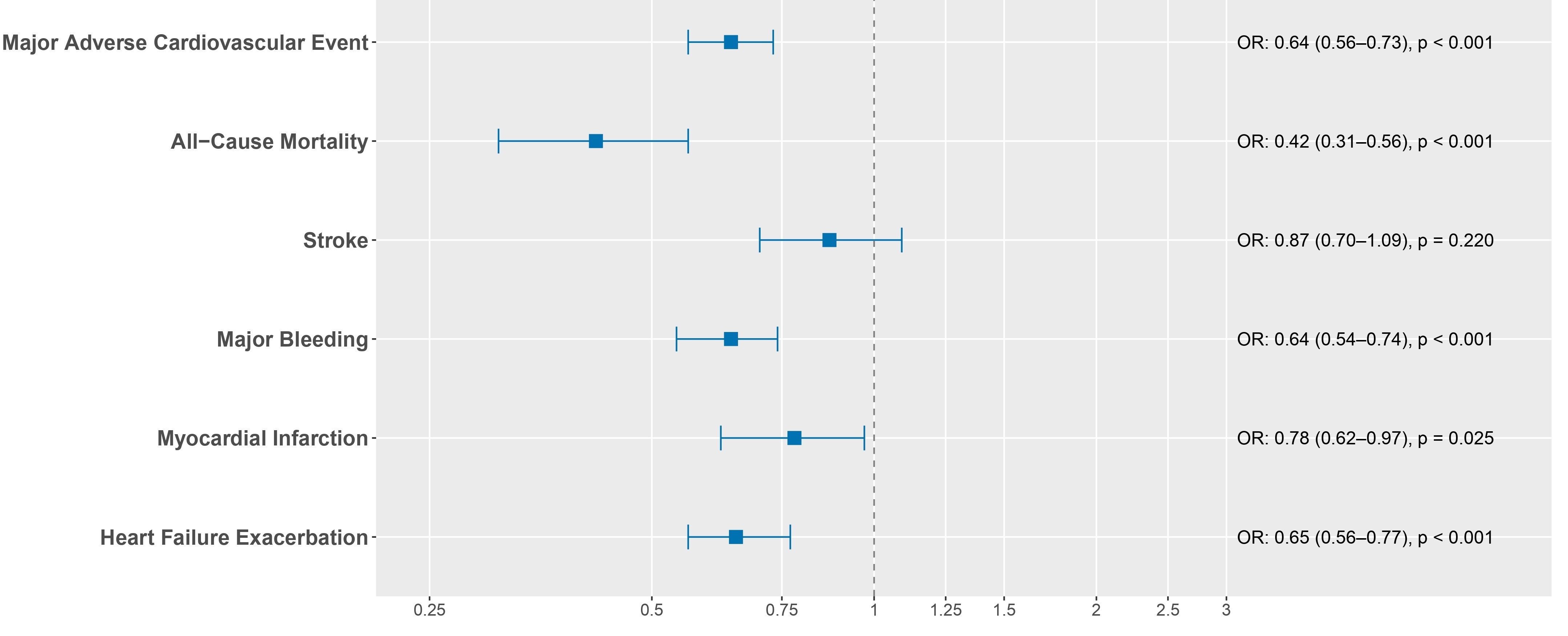
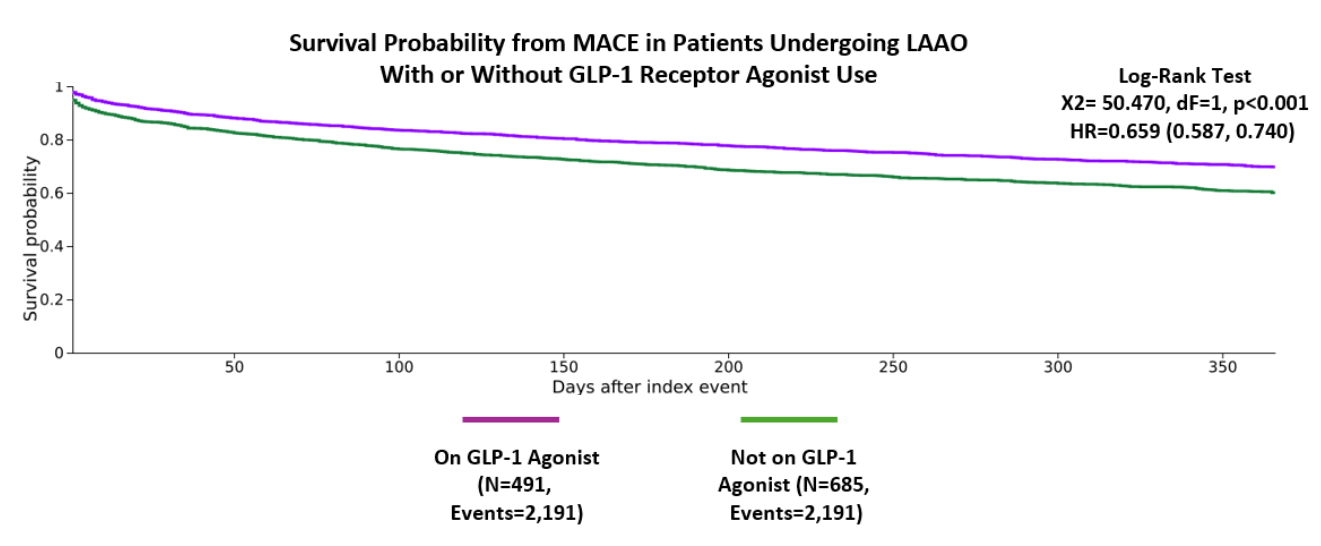
A total of 4,382 patients (2,191 in each group) were included after propensity score matching. The mean age was 71.6 years, with 57% identified as male. At one-year follow-up, patients in the GLP-1 group exhibited significantly lower odds of MACE (OR: 0.64; 95% CI: 0.56–0.73; p < 0.001). Kaplan–Meier analysis for MACE supported these findings, showing a hazard ratio of 0.66 (95% CI: 0.59–0.74) with a log-rank p-value of <0.001 (Figure 1). GLP-1 users also had significantly reduced odds of all-cause mortality (OR: 0.42; 95% CI: 0.31–0.56; p < 0.001), major bleeding (OR: 0.64; 95% CI: 0.54–0.74; p < 0.001), myocardial infarction (OR: 0.78; 95% CI: 0.62-0.97; p=0.025), and heart failure exacerbation (OR: 0.65; 95% CI: 0.56–0.77; p < 0.001). However, no significant differences were observed in the odds of stroke (OR: 0.87; 95% CI: 0.70–1.09; p=0.220) between the two groups (Figure 2).

Conclusions
GLP-1 receptor agonist therapy was associated with a significantly lower risk of MACE, primarily driven by reductions in mortality and bleeding. These findings suggest a beneficial role for GLP-1 receptor agonists in patients undergoing percutaneous LAAO.
  • Goyal, Aman  ( Cleveland Clinic Foundation , Cleveland , Ohio , United States )
  • Saeed, Humza  ( Rawalpindi Medical University , Rawalpindi , Pakistan )
  • Kanj, Mohamed  ( Cleveland Clinic Foundation , Cleveland , Ohio , United States )
  • Wazni, Oussama  ( Cleveland Clinic Foundation , Cleveland , Ohio , United States )
  • Hussein, Ayman  ( Cleveland Clinic Foundation , Cleveland , Ohio , United States )
  • Saliba, Walid  ( Cleveland Clinic Foundation , Cleveland , Ohio , United States )
  • Taigen, Tyler  ( Cleveland Clinic Foundation , Cleveland , Ohio , United States )
  • Santangeli, Pasquale  ( Cleveland Clinic Foundation , Cleveland , Ohio , United States )
  • Author Disclosures:
    Aman Goyal: DO NOT have relevant financial relationships | Humza Saeed: DO NOT have relevant financial relationships | Mohamed Kanj: DO have relevant financial relationships ; Speaker: boston scientific:Active (exists now) | Oussama Wazni: DO NOT have relevant financial relationships | Ayman Hussein: No Answer | Walid Saliba: DO have relevant financial relationships ; Advisor:Boston Scientific:Active (exists now) | Tyler Taigen: DO have relevant financial relationships ; Consultant:Boston Scientific:Active (exists now) ; Consultant:Medtronic:Active (exists now) | Pasquale Santangeli: No Answer
Meeting Info:

Scientific Sessions 2025

2025

New Orleans, Louisiana

Session Info:
More abstracts on this topic:
AI-Assisted Transseptal Puncture: Visual-Prompt Fine-Tuning of Foundation Models on Low-Dose X-RAY Images

Qi Xiuyu, Wang Xingyao, Cui Chang, Ju Weizhu, Chen Minglong

10-Year Trends in Last Known Well to Arrival Time in Acute Ischemic Stroke Patients: 2014-2023

Ferrone Nicholas, Sanmartin Maria, O'hara Joseph, Jimenez Jean, Ferrone Sophia, Wang Jason, Katz Jeffrey, Sanelli Pina

More abstracts from these authors:
Characterization of the Near-Field Bipolar Voltage Substrate Using a Novel Automated Peak Frequency Algorithm in Patients Undergoing Catheter Ablation of Postinfarction Ventricular Tachycardia

Nimmagadda Manojna, Saliba Walid, Bhargava Mandeep, Wazni Oussama, Nakagawa Hiroshi, Hussein Ayman, Santangeli Pasquale, Korzon Monica, Younis Arwa, Lee Justin, Higuchi Koji, Sroubek Jakub, Chung Roy, Kanj Mohamed, Nakhla Shady

Procedural Outcomes of Transvenous Lead Extraction in Patients with Prior Sternotomy: Insights from a Large Volume US Center

Mdaihly Mohamad, Taigen Tyler, Martin David, Kanj Mohamed, Bhargava Mandeep, Saliba Walid, Wazni Oussama, Hussein Ayman, Callahan Thomas, Hajj Joseph, Younis Arwa, Demian Joe, Watfa Adele, Motairek Issam, Tabaja Chadi, Santangeli Pasquale, Baranowski Bryan

You have to be authorized to contact abstract author. Please, Login
Not Available