Outcomes of Non-Cardiac Surgery Following Transcatheter Mitral Valve Replacement: A US Collaborative Network Cohort Study
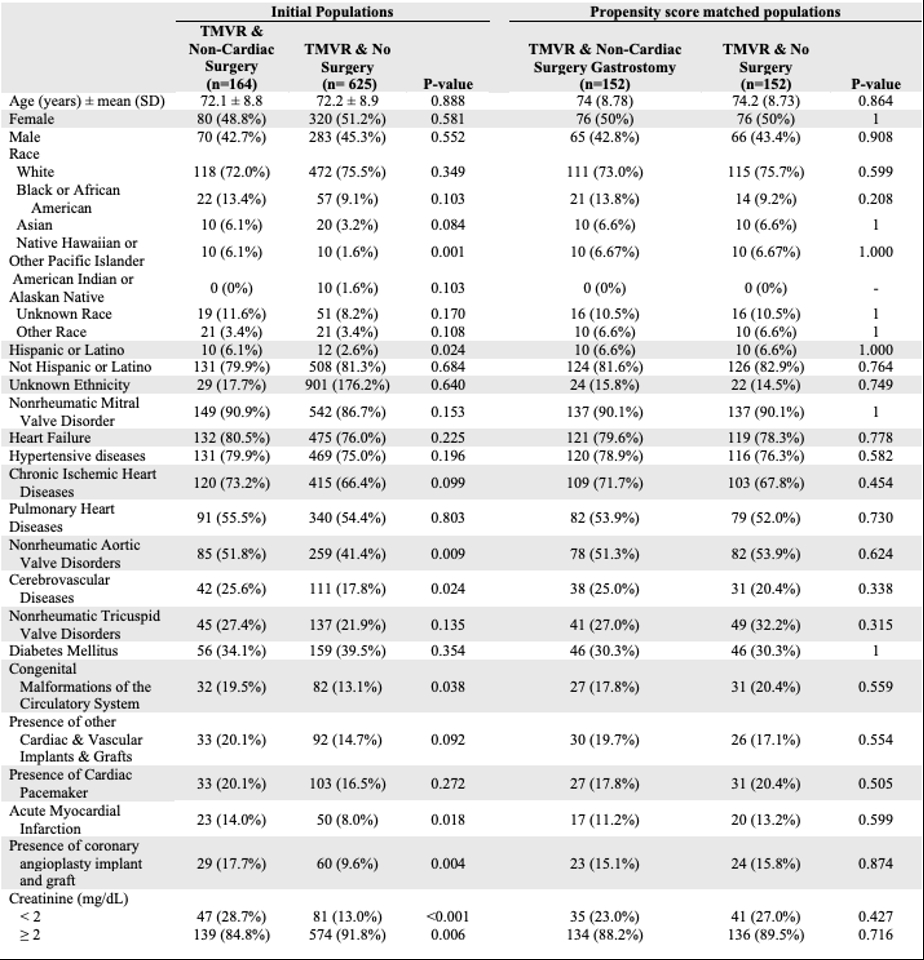
Abstract Body (Do not enter title and authors here): Introduction Transcatheter mitral valve replacement (TMVR) offers a less invasive alternative to traditional open-heart surgery for patients with mitral valve disease. Despite its growing use, there has been limited research on the post-procedural stratification of patients undergoing TMVR, particularly in relation to non-cardiac surgery (NCS). Methods Data was retrospectively collected from the US-based TriNetX network, which includes 120 million patients across 70+ healthcare organizations. We identified patients aged ≥50 who underwent TMVR between 2014 and 2025, excluding those with concomitant aortic replacements. Patients were divided into two cohorts: those who underwent NCS and those who did not. A 1:1 propensity score matching (PSM) was performed based on demographics and comorbidities. Hazard ratios were used to assess overall survival (OS) and outcomes at 1 and 3 years. Results We identified 789 patients aged 50 and above who underwent TMVR exclusively. After matching, each cohort included 152 patients. Cohort characteristics before and after matching are presented in Table 1. The group that underwent NCS exhibited significantly worse OS at both 1 year (hazard ratio [HR], 2.40 [95% CI, 1.30-4.42]) and 3 years (HR, 2.21 [95% CI, 1.37-3.57]). Additionally, readmission rates were notably higher in the NCS at 1 year (HR, 2.96 [95% CI, 1.89-4.66]) and 3 years (HR, 2.71 [95% CI, 1.79-4.12]). Gastrointestinal bleeding was also significantly more frequent in the NCS cohort at both 1 year (HR, 7.74 [95% CI, 3.28-18.28]) and 3 years (HR, 4.98 [95% CI, 2.57- 9.64]). The risk of acute kidney injury (AKI) was elevated in the NCS group at 1 year (HR, 4.69 [95% CI, 2.61-8.46]) and 3 years (HR, 4.28 [95% CI, 2.56-7.15]). However, there were no significant differences between groups regarding stroke or new-onset atrial fibrillation. Conclusion Patients who underwent NCS following TMVR experienced significantly worse outcomes compared to those who did not. These patients had higher risks of mortality, readmission, gastrointestinal bleeding, and AKI at both 1- and 3-year post-procedure. Patients undergoing TMVR who undergo NCS appear to be a particularly high-risk group and may benefit from targeted therapies and meticulous postoperative care.
Elchouemi, Mohanad
(
Paul L. Foster School of Medicine, Texas Tech University Health Science Center El Paso
, El Paso , Texas , United States )
Fadah, Kahtan
(
Texas Tech Health Science Center
, El Paso , Texas , United States )
Hussain, Usman
(
Paul L. Foster School of Medicine, Texas Tech University Health Science Center El Paso
, El Paso , Texas , United States )
Asad, Arsalaan
(
UTMB John Sealy School of Medicine
, Galveston , Texas , United States )
Mukherjee, Debabrata
(
TEXAS TECH UNIVERSITY HSC EL PASO
, El Paso , Texas , United States )
Author Disclosures:
Mohanad Elchouemi:DO NOT have relevant financial relationships
| Kahtan Fadah:No Answer
| Usman Hussain:No Answer
| Arsalaan Asad:DO NOT have relevant financial relationships
| Debabrata Mukherjee:DO NOT have relevant financial relationships