The Predictive Capabilities of Exhaled Volatile Organic Compounds on Heart Failure Status: A Pilot Study
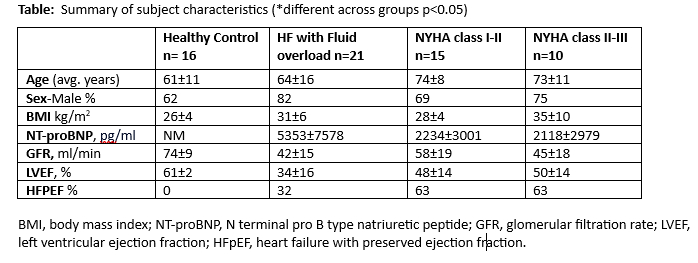
Abstract Body (Do not enter title and authors here): Background: Exhaled volatile organic compounds (VOCs) can provide insight into various physiological and metabolic processes. Aim: The purpose of this study was to determine if exhaled VOCs would differ across disease severity in heart failure (HF) patients. Methods: We recruited 62 individuals who were classified as healthy control (CTL), admissions with fluid overload (DHF), NYHA class I-II or NYHA class II-III. Breath samples were collected using the ReCIVA Breath Sampler (Owlstone Medical Ltd) and analyzed using mass spectrometry and gas chromatography. Typical clinical characteristics were documented at the time of exhaled breath collection. Results: Data were obtained on 16 CTL, 21 DHF, 15 NYHA I-II and 10 NYHA II-III (characteristics shown in Table). For the HF groups, DHF, NYHA I-II and NYHA II-III, the %HPEFF were 32, 63 and 63% respectively. Regarding exhaled VOCs, we observed a stepwise increase in VOCs potentially linked to lipid peroxidation or fatty acid metabolism, such as pent-3-en-2-one, 2-pentanone, and 4-heptanone, as disease severity worsened. A similar trend was seen for sulphur containing compounds (methyl propyl sulfide, allyl methyl sulfide and 1(methyl thiol)-1 propene)), potentially providing insight into impaired hepatic or renal clearance in more advanced HF. The level of methyl pyruvate on breath also rose with increasing disease severity, which may reflect altered energy metabolism. Finally, gut microbiome-related VOCs (acetoin, 2,3-butanediol, and butyric anhydride) increased across severity groups, potentially reflecting dysbiosis in advanced disease. Conclusions: In a small pilot study aiming to identify potential exhaled breath biomarkers in HF, we observed significant differences in VOCs across disease severity. These compounds have been linked to lipid peroxidation, energy metabolism, liver and kidney function as well as microbial fermentation and short-chain fatty acid metabolism. Collectively, these data demonstrate the ability of breath omics to potentially stratify disease severity and provide additional biological insights into HF pathophysiology. Larger studies are needed to determine whether a breath biomarker panel could be established to quantify disease severity and predict decompensation risk in HF.
Vungarala, Soumya
(
Mayo Clinic
, Rochester , Minnesota , United States )
Kerr, Matt
(
Owlstone Medical
, Cambridge , United Kingdom )
Wentz, Robert
(
Mayo Clinic
, Rochester , Minnesota , United States )
Ziegler, Briana
(
Mayo Clinic
, Rochester , Minnesota , United States )
Kim, Chul-ho
(
Mayo Clinic
, Rochester , Minnesota , United States )
Birch, Owen
(
Owlstone Medical
, Cambridge , United Kingdom )
Davies, Huw
(
Owlstone Medical
, Cambridge , United Kingdom )
Chou, Hsuan
(
Owlstone Medical
, Cambridge , United Kingdom )
Johnson, Bruce
(
Mayo Clinic
, Rochester , Minnesota , United States )
Author Disclosures:
Soumya Vungarala:DO NOT have relevant financial relationships
| Matt Kerr:No Answer
| Robert Wentz:No Answer
| Briana Ziegler:DO NOT have relevant financial relationships
| Chul-ho Kim:No Answer
| Owen Birch:No Answer
| Huw Davies:DO have relevant financial relationships
;
Employee:Owlstone Medical:Active (exists now)
| Hsuan Chou:No Answer
| Bruce Johnson:DO NOT have relevant financial relationships