An Integrative Strategy Combining Genetic, Proteomic, and Clinical Data Identifies Circulating WARS as a Candidate Target for Hypertension.
Abstract Body (Do not enter title and authors here): Background: Hypertension (HTN) is a major cardiovascular risk factor and a leading cause of premature death, affecting ~30% of the global population. Despite available treatments, ~20% of individuals live with drug-resistant HTN. Blood pressure (BP) regulation involves the endothelium in contact with circulating plasma proteins, which are easily pharmacologically accessible. Notably, drug targets with genetic support are 2.6 times more likely to succeed clinically.
Hypothesis:We hypothesized that a multi-omic strategy would identify genetically supported circulating proteins as promising therapeutic targets for HTN.
Methods: We combined two-sample Mendelian randomization (MR) with Bayesian genome-wide association studies (GWAS) in an analysis integrating BP GWAS data from ~1 million individuals and plasma protein quantitative trait loci data for 4,717 proteins from 35,559 individuals. This approach identified a causal plasma proteome (CPP) influencing BP through specific loci. Using the tag variants from these loci, we calculated a polygenic score (PS) to perform a PS-based phenome-wide association study (PS-PheWAS) to assess the association of the CPP with HTN and its pleiotropy across 795 phenotypes measured in ~500,000 participants from the UK Biobank (UKBB). We used MR to distinguish causal from pleiotropic associations. Finally, we used clinical features and plasma protein expression data from ~50,000 UKBB participants to prioritize causal proteins significantly associated with incident HTN and related diseases using Cox models adjusted for age, sex, and body mass index (BMI).
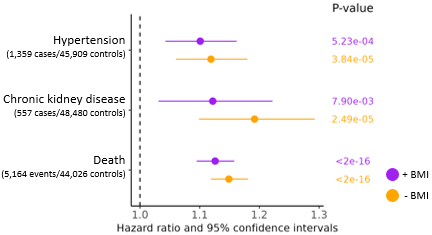
Results: From the 4,717 plasma proteins tested, we identified a CPP of 7 proteins associated with BP through 12 variants. The PS-PheWAS showed that the two strongest associations were for essential HTN (p = 3.78×10-36) and chronic kidney disease (CKD; p = 6.23×10⁻⁹). MR supported causal effects of the expression of 5 of the 7 proteins for CKD and lifespan (CLMP, NCAN, PLXNB2, TCEA2, and WARS). Prospective analyses showed that plasma levels of one of them, WARS, were significantly and positively associated with the incidence of HTN, CKD, and mortality, independently of BMI (Figure 1).
Conclusion: Our strategy prioritized WARS as a genetically supported causal plasma protein positively associated with HTN, CKD, and mortality, highlighting its potential as a new therapeutic target for HTN.
Chignon, Arnaud
(
Montreal Heart Institute
, Montreal , Quebec , Canada )
Lettre, Guillaume
(
Montreal Heart Institute
, Montreal , Quebec , Canada )
Author Disclosures:
Arnaud Chignon:DO NOT have relevant financial relationships
| Guillaume Lettre:DO NOT have relevant financial relationships