
Logo

American Heart Association

  18
  0


Final ID: Sa3002

Proteomics Signatures of Systemic Sirolimus Therapy in Pediatric Pulmonary Vein Stenosis

Abstract Body (Do not enter title and authors here): Introduction. Pulmonary vein stenosis (PVS) is a rare disease associated with significant morbidity and mortality, and its underlying pathophysiology remains poorly understood. PVS is characterized histologically by intimal hyperplasia and exuberant proliferation of myofibroblasts. Sirolimus, a mammalian target of rapamycin (mTOR) inhibitor, is increasingly employed in PVS patients to decrease myofibroblast proliferation and sirolimus has been associated with improved survival in PVS. Nevertheless, it is unclear how sirolimus alters the pathophysiology of PVS and whether biomarkers of response can be identified.

Hypothesis. Systemic sirolimus treatment alters the circulating proteomic profile in pediatric PVS, which may provide insight into the mechanisms of its therapeutic effect.

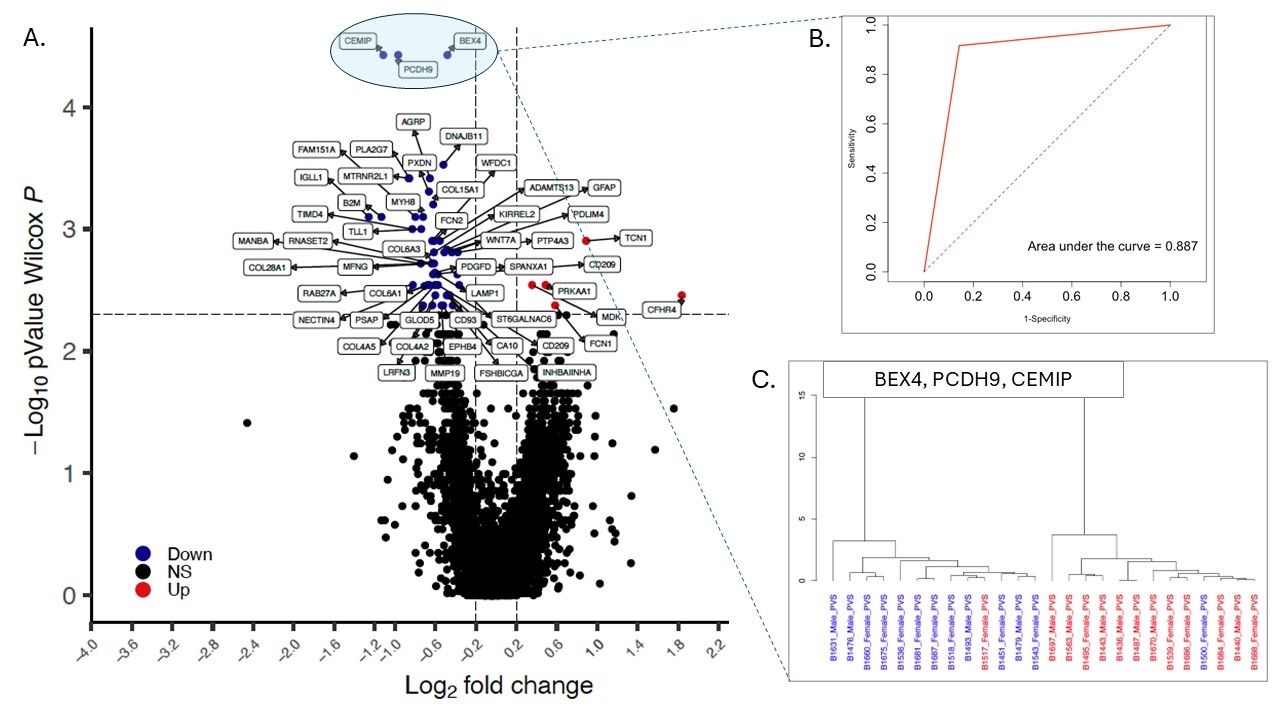
Methods. Pediatric PVS patients were prospectively identified and consented for a blood draw at the time of a clinically indicated cardiac catheterization. Clinical data were abstracted from the medical record. Serum was isolated and global, aptamer-based proteomics was performed (SomaScan 11K platform). Samples were grouped by sirolimus treatment and normalized data were analyzed by t-test with adjusted p-value (Wilcoxon) for multiple comparisons. The top 3 differentially regulated proteins were identified, and receiver operating characteristic (ROC) curve and random forest analysis were performed.

Results. Twenty-six samples were collected from 22 pediatric PVS patients (45% male) with a median age of 4.0 years (IQR 2.0 – 6.3). Half of the samples (n=13) were obtained from PVS patients on sirolimus at the time of blood collection with a median trough level of 7.5 ng/ml. BEX4 (log2fold change -0.48, adjusted p-value 0.047), PCDH9 (log2fold change -0.97, adjusted p-value 0.047), and CEMIP (log2fold change -1.12, adjusted p-value 0.047) were significantly downregulated in PVS patients on sirolimus (Figure 1A). In combination, BEX4, PCDH9 and CEMIP result in a ROC curve with an area under the curve of 0.887 (Figure 1B) and strong separation by random forest (Figure 1C).

Conclusions. Serum proteomic analysis in pediatric PVS patients reveals distinct protein expressions between those treated with systemic sirolimus and untreated individuals. Further investigation is warranted to evaluate the translational potential for utilizing circulating protein expression for risk stratification or as a biomarker of therapeutic response to sirolimus in pediatric PVS.
  • Zablah, Jenny  ( University of Colorado , Aurora , Colorado , United States )
  • Kegode, Imali  ( University of Colorado , Aurora , Colorado , United States )
  • Karimpour-fard, Anis  ( University of Colorado , Aurora , Colorado , United States )
  • Lin, Daniel  ( University of Colorado , Aurora , Colorado , United States )
  • Nakano, Stephanie  ( University of Colorado , Aurora , Colorado , United States )
  • Author Disclosures:
    Jenny Zablah: No Answer | Imali Kegode: DO NOT have relevant financial relationships | Anis Karimpour-Fard: DO NOT have relevant financial relationships | Daniel Lin: DO NOT have relevant financial relationships | Stephanie Nakano: No Answer
Meeting Info:

Scientific Sessions 2025

2025

New Orleans, Louisiana

Session Info:

Basic Science Advances in Pediatric Cardiology

Saturday, 11/08/2025 , 10:30AM - 11:30AM

Abstract Poster Board Session

More abstracts on this topic:
Angiotensin Converting Enzyme Gene Polymorphisms (ACE-I/D) Do Not Predict Exercise-Induced Cardiac Remodeling or Performance in Adolescent Male Athletes

Becker Kristian, Hardie William, Gubanich Paul, Hill Garick, Logan Kelsey, Martin Lisa, Powell Adam

A Multicenter Friedreich Ataxia Registry Identifies Posterior Wall Thickness as a Predictor of Major Adverse Cardiac Events

Lin Kimberly, Johnson Jonathan, Mccormack Shana, Lynch David, Tate Barbara, Feng Yixuan, Huang Jing, Mercer-rosa Laura, Dedio Anna, Mcsweeney Kara, Fournier Anne, Yoon Grace, Payne Ronald, Cripe Linda, Patel Aarti, Niaz Talha

More abstracts from these authors:
Lactosylceramide Drives Pathological Cardiac Remodeling and Mitochondrial Dysfunction in a Novel in vivo Model of HLHS Heart Failure

Pietra Ashley, Turner Mary, Sparagna Genevieve, Karimpour-fard Anis, Garcia Anastacia

Immune and Proteomic Dysregulation in Single Ventricle Congenital Heart Disease

Kumah Yvonne, Karimpour-fard Anis, Abbott Jordan, Lin Daniel, Nakano Stephanie

You have to be authorized to contact abstract author. Please, Login
Not Available