Lactosylceramide Drives Pathological Cardiac Remodeling and Mitochondrial Dysfunction in a Novel in vivo Model of HLHS Heart Failure
Abstract Body (Do not enter title and authors here): Introduction: While heart failure (HF) remains the leading cause of death and indication for transplant in patients with Hypoplastic Left Heart Syndrome (HLHS), the molecular mechanisms associated with HF progression remain poorly understood. Increasing evidence suggests that both inflammation and mitochondrial dysfunction have pathogenic relevance in promoting or potentiating cardiac remodeling in HLHS. Our prior data identified significantly increased levels of lactosylceramide (LacCer) in HLHS patient cardiac tissue and peripheral immune cells. While there are currently no HLHS animal models, this study aimed to assess whether exogenous LacCer can recapitulate in vivo, some of the cardio-metabolic derangements seen in HLHS and identify potential novel mechanisms of HLHS HF pathogenesis.
Hypothesis: Aberrant LacCer-mediated signaling drives maladaptive cardiac, lung, and immune cell responses that predispose HLHS patients to progressive cardiac dysfunction and ultimately HF.
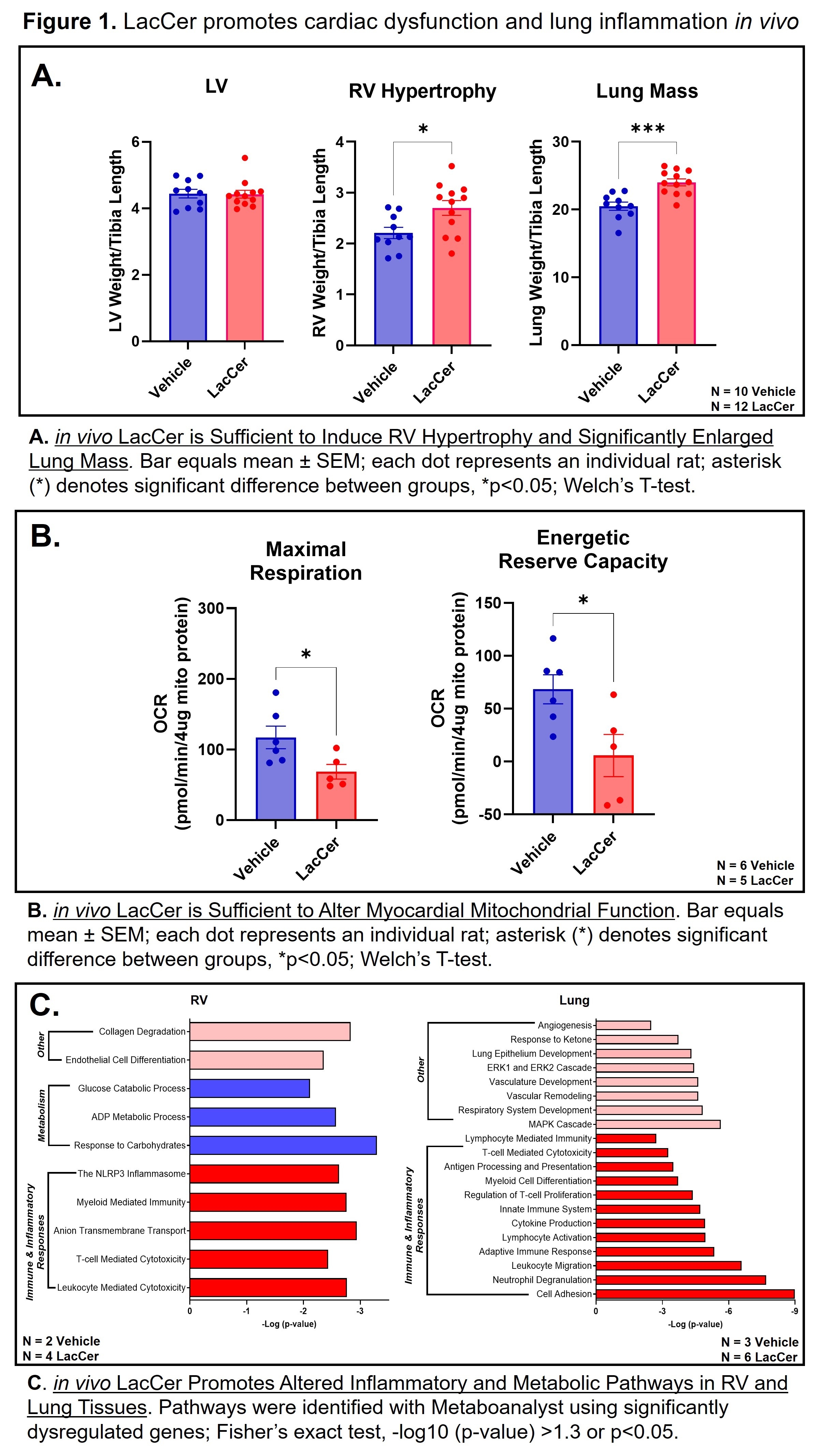
Methods: To assess whether exogenous LacCer promotes pathological myocardial remodeling in vivo, a daily dose of 10mg/kg LacCer was delivered to P2 neonatal Sprague Dawley rats by IP injection for 1 week (n= 10 vehicle control, n=12 LacCer). Morphometric data was collected and normalized to tibia length. Cardiac mitochondria were isolated from right ventricular (RV) myocardium, and mitochondrial bioenergetics were assessed using the Seahorse Bioanalyzer (Agilent). Normal phase high pressure LC/MS was used to quantify ceramide and mitochondrial cardiolipin levels, while gene expression changes in RV and lung tissues were assessed using bulk RNA-sequencing.
Results: Our data suggests exogenous LacCer in vivo: (A) is sufficient to induce RV hypertrophy and increase lung mass, with no significant changes in the left ventricle (LV), (B) impair cardiac mitochondrial maximal respiration and energetic reserve capacity, and (C) significantly alter expression of genes associated with immune and inflammatory responses in the heart and lung, and metabolic remodeling specifically in the heart (Figure 1).
Conclusions: Together, these data suggest that even in the absence of hemodynamic stress, LacCer plays a role in modulating cardiac dysfunction and lung inflammation in vivo. These data therefore highlight a novel rodent model that recapitulates unique aspects of HLHS which can provide a useful mechanistic platform to investigate signaling pathways altered by HLHS pathophysiology.
Pietra, Ashley
(
University of Colorado - Anschutz
, Arvada , Colorado , United States )
Turner, Mary
(
University of Colorado - Anschutz
, Arvada , Colorado , United States )
Sparagna, Genevieve
(
University of Colorado - Anschutz
, Arvada , Colorado , United States )
Karimpour-fard, Anis
(
University of Colorado - Anschutz
, Arvada , Colorado , United States )
Garcia, Anastacia
(
University of Colorado - Anschutz
, Arvada , Colorado , United States )
Author Disclosures:
Ashley Pietra:DO NOT have relevant financial relationships
| Mary Turner:DO NOT have relevant financial relationships
| Genevieve Sparagna:No Answer
| Anis Karimpour-Fard:DO NOT have relevant financial relationships
| Anastacia Garcia:DO NOT have relevant financial relationships